Yelets: Russian lace that turns wildflowers into thread
Yelets: Russian lace that turns wildflowers into thread
In the Russian city of Yelets, wildflowers aren't preserved in a herbarium: they're woven into bobbin lace. Multi-petaled rosettes, curved stems, clovers, stars, and tiny spiders fill a lacework that has been transforming nature into design for over two centuries. Its appearance may seem light and spontaneous, but behind each motif lies a precise construction and a vocabulary passed down through generations.
The Yelets Museum of Folk Arts and Crafts traces the roots of this tradition to the late 18th and early 19th centuries. One possible clue lies in the woolen cords used to adorn military uniforms. Over time, the skill of braiding and arranging threads found new forms in the homes of wealthy merchant families and on the estates of rural landowners.
Among the women of the city, the nuns of the Znamenski Monastery were considered especially skilled. The monastery served as a school for lacemakers and helped to transmit knowledge that later spread to workshops and homes. The craft grew to become one of Yelets's defining artisanal traditions, comparable in importance to other major Russian centers.
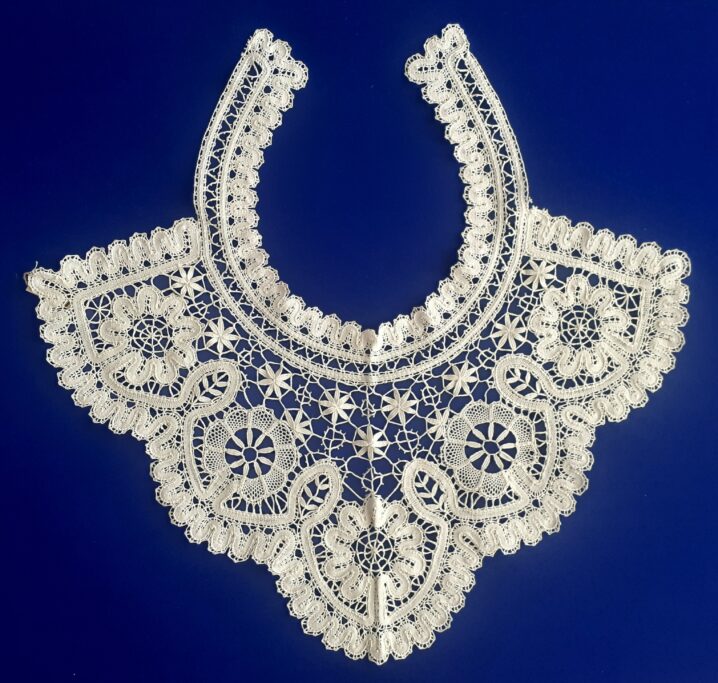
The main motif of Yelets lace is floral and vegetal. The lacemakers construct the design with a strip of knitted fabric whose width and density vary depending on the section. This strip can be made more compact to define a petal or open up to become a mesh area, while complex backgrounds appear around it to support the composition.
The large, multi-petaled rosettes are one of its most recognizable features. Some have elongated leaves, others round; some are dense, while others allow light to pass through. Alongside them emerge shapes reminiscent of clover, rose, carnation, or dandelion. The so-called "Yelets flower" combines rounded petals worked in a mesh pattern with a center formed by small, oval leaves.
The local language is as expressive as the pieces themselves. Traditional patterns are given names that evoke stars, spiders, peacocks, buckwheat, pearls, or rivers. These aren't just labels: they help recognize structures and remember how the yarn is arranged. Each word transforms a technical solution into an image easily shared within the workshop.
This combination of ribbon, backgrounds, and small elements allows for the creation of both lace by the meter and complete works. The museum's collection includes borders, inserts, tablecloths, bedspreads, skirts, collars, capes, scarves, napkins, and decorative panels. The scale changes, but the same balance between dense areas and open spaces remains.
To interpret one of these works, one can begin with a rosette and follow the ribbon that emerges from its petals. This path leads to a leaf, changes width, and then opens again against the background. Then the small, repeated motifs appear, ordering the empty space and preventing the composition from losing its unity. In this way, one discovers that the floral abundance is the result of a carefully considered architecture.
The lacemakers of Yelets took their work far beyond the town. Among the awards preserved by the museum is the diploma for the gold medal received at the 1937 Paris Exposition. During the 20th century, vocational schools, cooperatives, and artisan businesses continued to train workers and adapt the designs to new pieces.
A cotton neck brace made by MF Tselykh in the 1970s demonstrates this continuity. Its rosettes and curved lines maintain the botanical motif, but the piece is designed to be integrated into a modern garment. It is a good example of how a tradition can preserve its characteristics without becoming stagnant.
The white cotton against a dark background beautifully showcases this interplay. The compact areas create floral patterns and borders; the grids allow the piece to breathe; and the small oval leaves highlight points of light. The beauty doesn't depend on a single spectacular motif, but on the constant dialogue between them all.
In 2022, the Yelets lace-making technique was added to the register of intangible cultural heritage of the peoples of Russia. This recognition protects more than just a collection of objects: it encompasses the movements, the names of the motifs, the interpretation of the lace patterns, and the expertise required to regulate each pair of bobbins.
The museum keeps that history visible with antique and contemporary pieces, tools, and demonstrations. Viewing them against the distinctive blue background allows you to calmly follow every curve. There, the flowers don't exactly imitate nature; they maintain its rhythm. And in that white garden, arranged with pins, Yelets preserves his own way of narrating the landscape.
© El Mundillo de Eva 2026