Yak lace: Victorian lace that didn't always use yak hair
Yak lace: Victorian lace that didn't always use yak hair
Its name seems to take us to the mountains of Asia, but the so-called yak lace It holds a little secret. This black lace, popular in Victorian England, wasn't always made with yak hair. A piece held by the Pitt Rivers Museum in Oxford is crafted from combed sheep's wool. Its history intertwines fashion, mourning, domestic economy, and the lacemakers' ability to adapt bobbins to unusual materials.
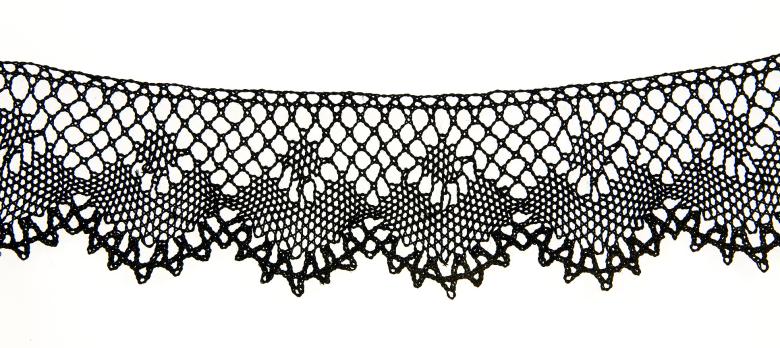
A dictionary from 1913 defined the yak lace like a thick cushion lace made from the silky hair of the yak. However, the specimen studied by the Pitt Rivers Museum It tells a different story. It was made by a Mrs. Campbell of Bicester, Oxfordshire, using combed sheep's wool, and the museum considers it to be a good representation of the current production of this type of work.
The word “yak” could have served as an attractive marketing label for various dark, woolly trimmings. More than guaranteeing a specific fiber, it evoked a warm texture and a distant origin. Bicester’s piece thus invites us to look at the material before the name: beneath that quaint designation lies a practical, inexpensive solution perfectly suited to the clothing of its time.
Technically, it's a very simple Torchon bobbin lace. Its geometric design rests on a wide mesh, easy to read and relatively quick to work. At the border, or head, fans appear with an almost heart-shaped block made in half-stitch. It doesn't aim for the lightness of a very fine tulle nor the meticulous modeling of a floral lace. Its beauty comes from rhythm, contrast, and a straightforward structure.
Wool changes the lacemaker's experience. Compared to linen, it has elasticity, volume, and a smoother surface. When the pins are removed, the fabric can contract significantly; the museum study indicates that the sample shrinks to approximately two-thirds of its size when stretched over the cushion. The stitching and tension, therefore, must anticipate this movement. What appears ample under the pins ends up more compact when released.
Wool lace was known from the 17th century, although it reached its greatest popularity in the mid-to-late 19th century. yak lace It served as an inexpensive embellishment for underwear, christening gowns, children's winter clothing, and outerwear. The coarser variations could be used to finish curtains. It was a useful, visible, and affordable lace, designed to adorn everyday objects rather than be relegated to a display case.
Its black version found a particular place in Victorian society. Mourning regulations could require men, women, and children to wear black or dark colors for extended periods, sometimes up to two years after a family member's death. This custom fueled a steady demand for understated embellishments made from modest materials. A black wool border allowed a garment to be decorated without breaking the language of mourning.
The fashion for wearing wool for health reasons also played a role. In the 1880s, the German zoologist Gustav Jaeger promoted his wool garments as hygienic and healthy. His ideas circulated through shops and catalogs in London, and the brand name eventually came into the hands of Lewis Tomalin, later associated with the well-known Jaeger fashion house. Humble lace thus shared shop window space with a new way of presenting wool to the urban public.
Bicester was one of Oxfordshire's lace-making centers. During the 19th century, many Midlands women worked long hours at home for merchants who supplied thread and patterns and set the price of the finished piece. Competition from machine-made lace reduced wages and markets. In that context, a simple and quick task like lacemaking yak lace It was not a minor curiosity: it was a response to produce an ornament that could still be sold.
Mrs. Campbell's collection was purchased in 1900 and donated to the museum in 1917 by Henry Balfour. It has survived as a small fragment, but it allows us to follow many threads at once: women's work, the fashion of mourning, the trade in exotic names, and the search for alternatives to machines.
Today it can also inspire a technical perspective. Working with a Torchon design in wool requires accepting that the fiber has a will of its own: it stretches, curls, and softens the pattern. Therein lies its charm. yak lace It demonstrates that bobbin lace is not limited to fine, white threads. It can also be dark, warm, and domestic, transforming a humble strand of wool into a collective memory.
© El Mundillo de Eva 2026