Valenciennes: the diamond lace where flowers and background are born together
Valenciennes: the diamond lace where flowers and background are born together
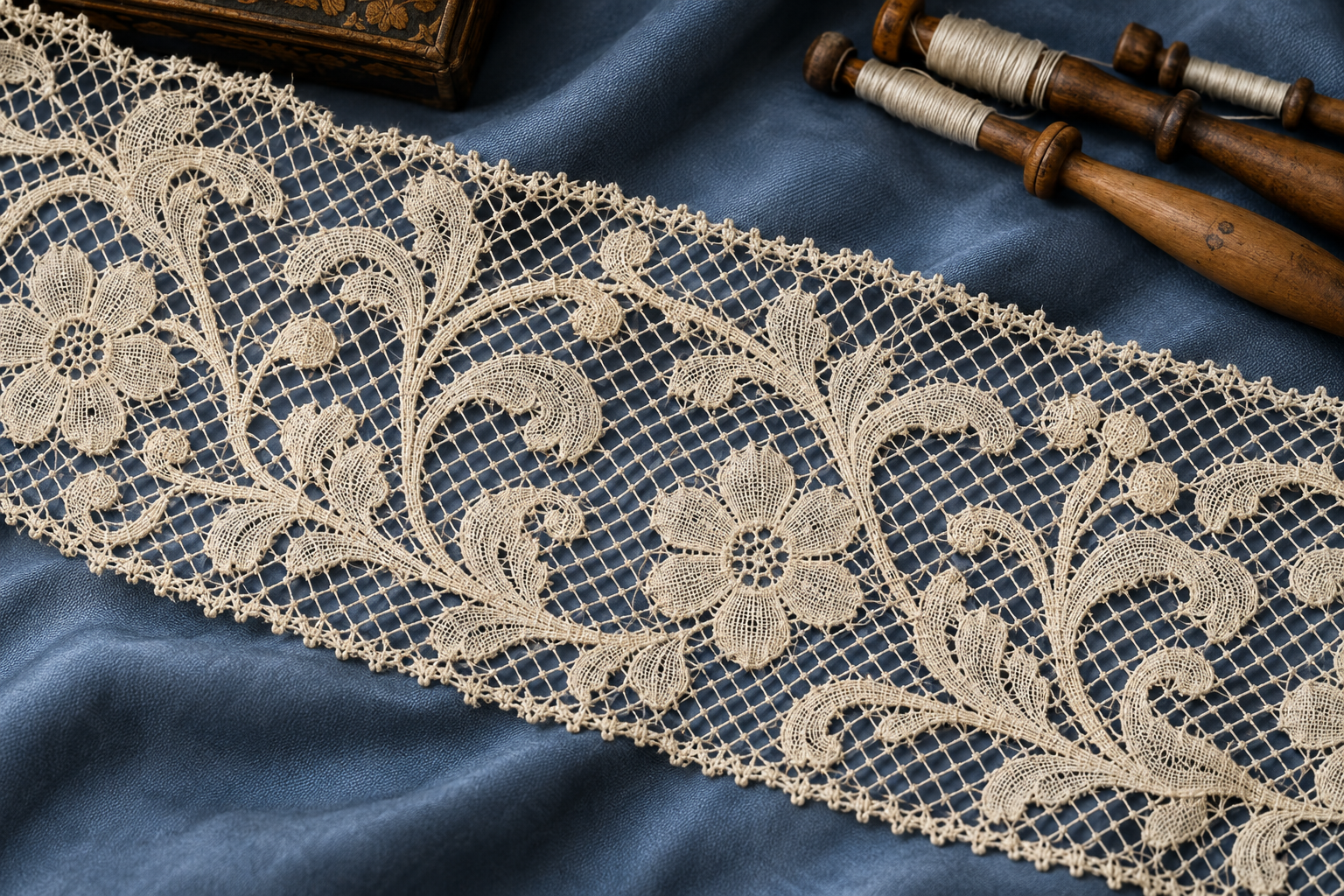
Valenciennes lace seems to hold its flowers within a grid of light. At first glance, it is delicate and serene; upon closer inspection, a demanding construction emerges, made with very fine threads and a mesh of tiny diamonds. It doesn't need a thick cord to separate the design from the background. Motif and mesh are born together, like inseparable parts of the same fabric woven with bobbins.
Valenciennes is located in northern France, near the Belgian border. Textile Research Center Leiden It places the origin of this bobbin lace there and notes that it achieved enormous popularity during the 18th century. Over time, production spread to Belgium and reached centers such as Ypres.
The name eventually came to describe a method of lace construction, as well as its origin. This happened with many European styles: patterns traveled, lacemakers moved around, and merchants adapted production to new fashions. Therefore, a piece called Valenciennes can belong to different places and times, even though it retains recognizable technical characteristics.
Valenciennes lace is a continuous lace technique. The same threads are used in both the dense areas and the network, and the work progresses as a single unit. Pairs that form a leaf can then emerge into the background, meet other threads, and return to a new motif. Individual flowers are not made to be joined later.
This continuity requires careful planning of the thread paths. When the pattern widens, it needs to receive pairs of threads; when it narrows, it must return them in an orderly fashion to the mesh. The lacemaker not only follows the visible outline but also manages a small circulation of threads so that no area is overloaded or too weak.
The most distinctive background is formed by a rhomboidal mesh. It emerged at the beginning of the 18th century and distinguished the so-called true Valenciennes, the true Valenciennes, of earlier forms known as fausse ValenciennesRepetition requires great regularity, because any change in tension immediately alters the size of the gaps.
On dark fabric, these diamonds are easily visible. However, when the lace is placed on white linen or skin, the netting almost disappears and the motifs seem to float. This characteristic explains its use in lightweight garments and pieces that require a fine border without too much texture.
A key difference from Mechelen lace is the absence of an added thread outlining the flowers. In Valenciennes lace, the separation is achieved through the contrast between the dense stitch of the motif and the transparency of the background. The edge of a leaf may be sharp, but it does not stand out as a thick line against the surface.
The result is serene and uniform. The eye moves seamlessly from the mesh to the flower. To achieve this, the fabric stitch must maintain a consistent density, and changes in direction must be executed with utmost precision. The visual simplicity belies a highly controlled execution.
This lace was used in bed linens, underwear, figurines, and accessories. Metropolitan Museum of Art She owns a 19th-century French handkerchief surrounded by a Valenciennes lace band about six centimeters wide. Another example from her collection combines lace with drawn thread embroidery on a collar from the first half of the same century.
These pieces display a practical quality: the lace complements the fabric without overpowering it. It can follow a corner, form a continuous edge, and withstand wear better than other, extremely fragile varieties. Its delicacy transformed an everyday object into something special, without completely sacrificing lightness.
During the 19th century, mechanical manufacturing began to imitate Valenciennes lace patterns and designs. Production became faster, and the appearance of lace reached a wider audience. Textile Research Centre It uses precisely a mechanical imitation to teach how to observe differences in the movement of the threads, the fillings, and the right and wrong sides of a piece.
Examining a handmade Valenciennes lace piece with a magnifying glass draws attention back to the original gesture. Each rhombus relies on repeated crosses, each flower redistributes pairs, and the entire surface shares a common tension. Its beauty doesn't require grand reliefs: it resides in continuity, in the minute mesh, and in that silent way of transforming many threads into a single fabric of air.
© El Mundillo de Eva 2026