Three lace brands from Croatia: Pag, Lepoglava and Hvar
Three lace brands from Croatia: Pag, Lepoglava and Hvar
There are countries where lace seems to change its landscape without ceasing to be lace. In Croatia, a single word encompasses three very different traditions: the needlework of the island of Pag, the bobbin lace of Lepoglava, and the striking floral lace of Hvar. All three were inscribed by UNESCO in 2009 as intangible cultural heritage, and all three tell a story about the community that keeps them alive.
La UNESCO fact sheet He explains that this inscription doesn't refer to a single technique. Pag, on the Adriatic coast, preserves needle lace. Lepoglava, in the north of the country, works with bobbin lace. Hvar, on a Dalmatian island, preserves a craft made with fibers extracted from the aloe plant. The map helps to understand this: it's not a recipe that travels the same way everywhere, but a family of crafts that adopts the materials and techniques of each place.
They also share something essential. For generations, it was primarily women from rural areas who did this work and turned it into a supplementary income. The finished piece could be used for clothing, decorating a house, or accompanying a ceremony, but the knowledge needed to create it also had a social dimension. It was learned by watching, repeating, and talking.
Pag lace is based on a pattern reminiscent of a spiderweb. Geometric motifs are then embroidered onto this base with a needle. UNESCO notes that it was first used for ecclesiastical vestments, tablecloths, and clothing embellishments. There is something special about this technique: the design is not created by crossing bobbins, but rather by small stitches that gradually build a network.
Traditional transmission also deserves attention. Older women organize year-long courses to teach the craft. This fact is much more than a date: it shows that continuity requires time, companionship, and someone willing to explain why a thread passes through a particular place. For the bobbin lace maker, it's an invitation to recognize the same patient touch in another tool.
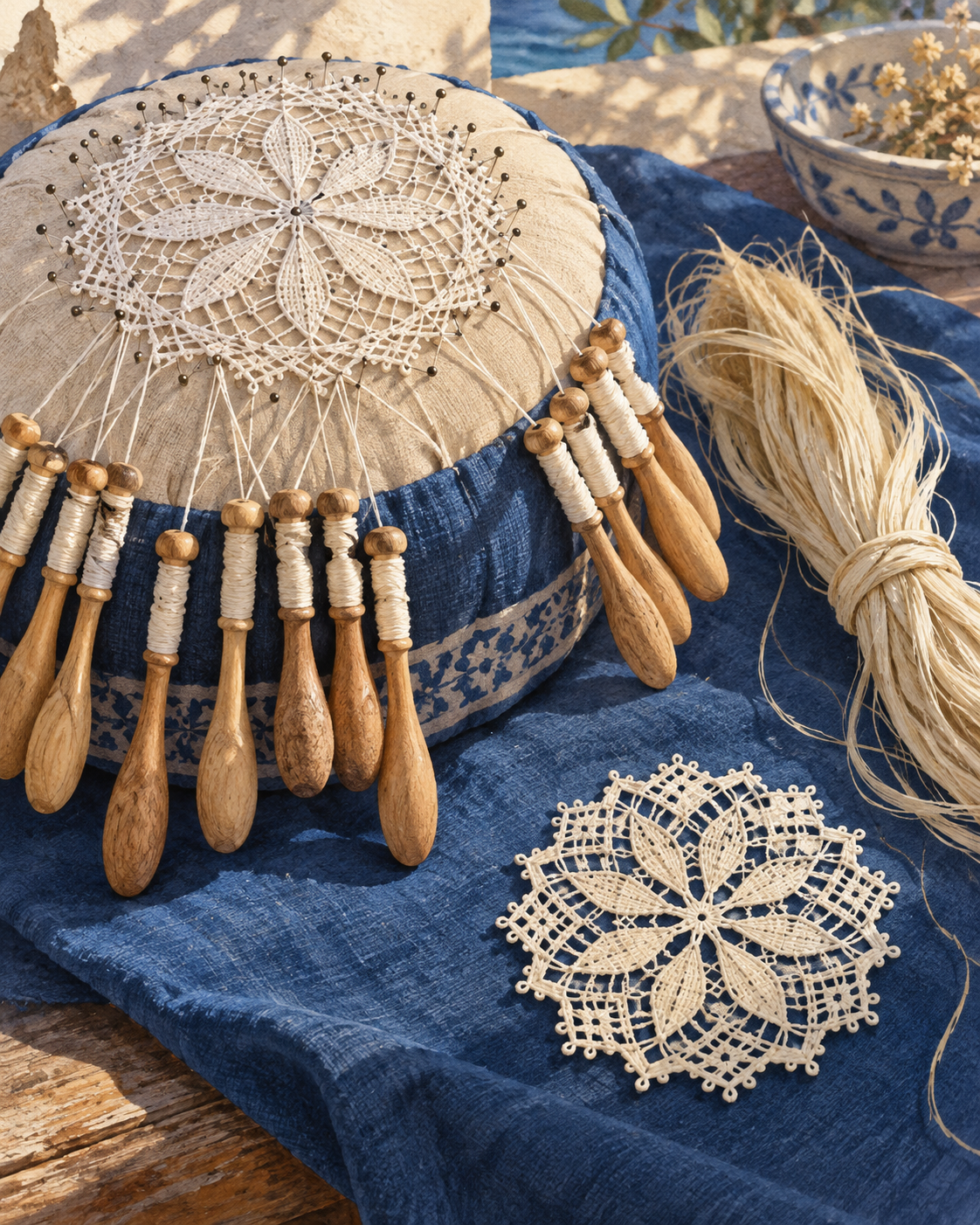
In Lepoglava we do find the familiar gesture: threads wound on bobbins that are braided and crossed over a pattern. city tourist office It describes a white and beige cotton lace, worked on a round cushion and adorned with geometric motifs, flowers, and animals. The designs can be dense or very open, so that relief and airiness become part of the final result.
The tradition became firmly established between the late 19th and the first half of the 20th century. Local accounts highlight the role of Zlata Šufflay and Danica Brössler, who were involved in organizing the teaching and the evolution of the designs. It's important to consider these names carefully: they don't replace the many artisans who made the pieces possible, but they do help trace how a domestic skill also became a recognizable identity.
Every September, Lepoglava hosts an international lace festival. The exact date varies each year, so it's best to check the official schedule before planning a visit. The festival's appeal lies in its combination of exhibitions, workshops, and gatherings: lacemaking is observed, explained, and practiced.
The third tradition seems straight out of a botanical tale. In Hvar, Benedictine nuns make lace from fine threads extracted from the inner parts of aloe leaves. These threads are arranged on a net or over a cardboard pattern. The raw material completely changes the conversation: here, the lace doesn't begin with cotton or linen, but with a plant that grows in the island's environment.
UNESCO presents it as a symbol of Hvar. Its fragility is easily understood. One need only imagine the preparation of the fiber, the care given to each strand, and the knowledge of when it is ready to be worked. Such labor unites landscape, craft, and memory in a single piece.
The fact that these three techniques are on an international list doesn't mean they've been frozen in time. UNESCO itself speaks of living traditions. Their uses, teaching methods, and the people who take up the craft continue to evolve. Some pieces retain their traditional functions; others become small paintings, ornaments, or gifts.
For us, the lesson is relatable. Lace doesn't just live in a display case or a pretty photograph. It comes alive when someone prepares the yarn, asks about a stitch, adjusts the tension, and tries again. Pag, Lepoglava, and Hvar remind us that diversity can also find a place on a sewing table.
If we ever travel to Croatia, we can leisurely seek out these places and explore their museums, associations, and tourist offices. And if a trip is far off, we can always connect with them from our own world: examine a piece, consider its materials, and let the bobbins tell us that heritage, like thread, is best preserved when it continues to be passed down from hand to hand.
© El Mundillo de Eva 2026