Torchon: the geometry that teaches you to read bobbin lace
Torchon: the geometry that teaches you to read bobbin lace
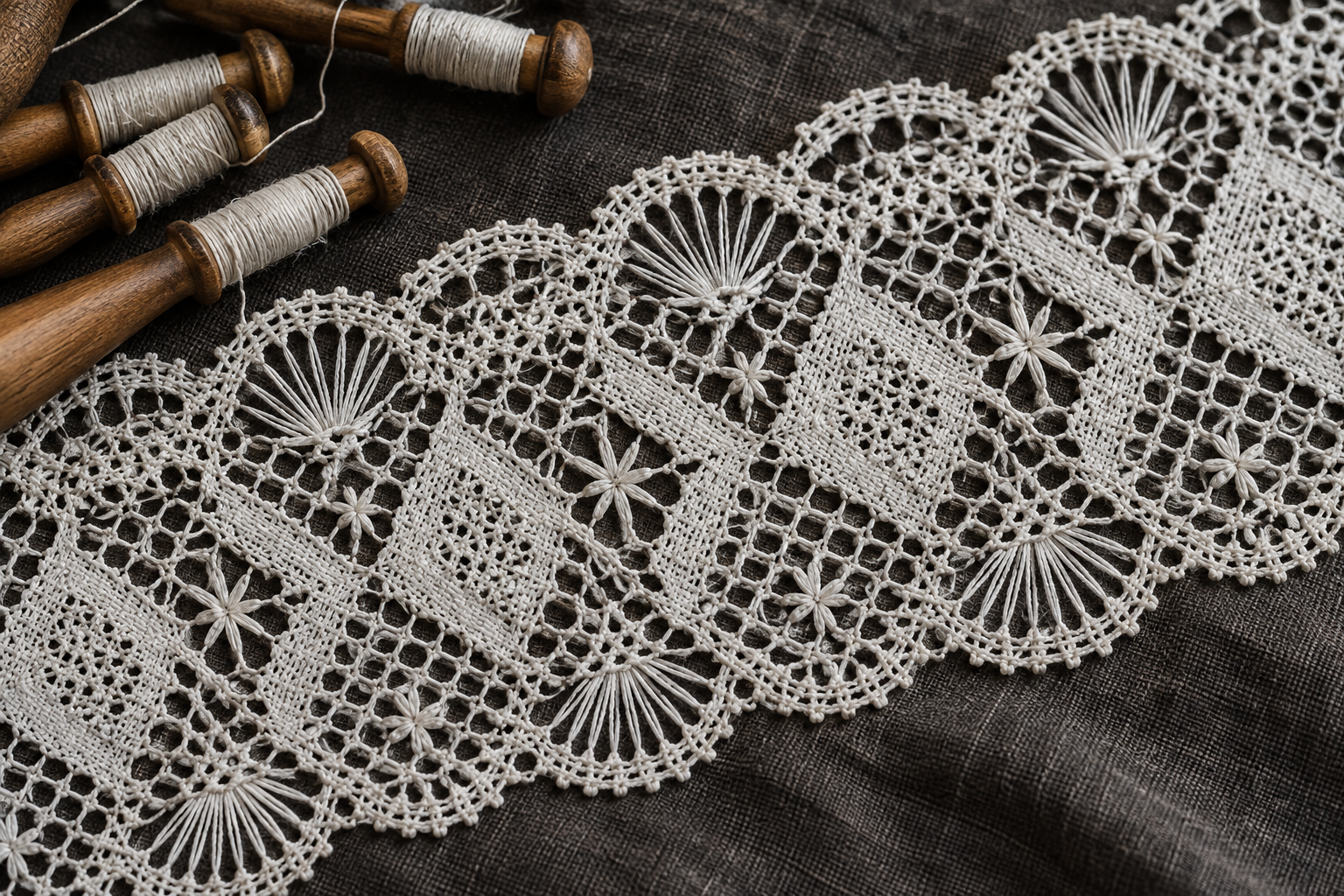
Some lace patterns resemble gardens, while others read almost like a chessboard. The Torchon pattern belongs to this second category: diamonds, fans, triangles, and small figures are arranged on a regular grid. Its simplicity has made it a common entry point to bobbin lace, but calling it simple doesn't mean it lacks beauty. Its repetitions reveal rhythm, balance, and many hidden design choices.
El Textile Research Center Leiden Torchon is described as one of the most common forms of bobbin lace. Traditionally, it was worked with relatively thick linen, although cotton is also used. The background and motifs are constructed simultaneously, usually on narrow, sturdy strips.
Its French name refers to a cloth used for everyday purposes, and for years it was also given less flattering names such as "beggar's lace." Those words spoke more of social hierarchies than of the technique itself. In contrast to the exquisite silks and naturalistic designs of laces intended for the court, Torchon lace offered a practical, visible, and durable craft, capable of adorning linens, shelves, tablecloths, and handkerchiefs.
The key lies in the stitch pattern. The stitches are usually arranged on a diagonal grid, with lines intersecting at regular angles. This grid guides the pairs of threads and makes it easy to repeat a motif without losing its proportions. When looking at a Torchon pattern, the stitches seem to advance along oblique paths: some lead to the background, others widen to form a dense area, and still others turn towards the edge.
Geometry makes the process easy to follow visually. It also allows you to detect errors. If a pin breaks the alignment or a pair takes the wrong path, the rhombus stops closing or the net changes size. That's why this technique teaches something fundamental: reading the lace before moving the bobbins.
With just a few movements, a vast vocabulary can be built. The whole stitch creates compact areas resembling a tiny fabric. The half stitch leaves a more open and lighter texture. Twists separate the threads, provide firmness, and control the shape of the stitch. A thicker strand, called contour thread or cord, can encircle certain motifs to highlight them.
The combination matters as much as each isolated movement. Two rhombuses with the same silhouette change completely if one is filled with a whole stitch and the other with a half stitch. An additional twist makes the background more open; one less can make it heavy. Thus, a seemingly rigid structure allows for numerous nuances.
Among the most beloved motifs are spiders. Several pairs arrive from different directions, converge at a compact center, and then spread out again toward the grid. The name aptly describes the image: a small body from which thread legs extend. Fans frequently appear at the edges, where pairs unfurl around successive pins to create curves and waves.
The backing holds these elements together. It can be transparent or slightly denser, but it requires constant tension to ensure the openings maintain their size. The foot forms the straight edge used to sew the lace to fabric; the outer edge allows for points, waves, and decorative teeth. Each area serves a purpose, and together they create a stable pattern.
The Lace Guild Use the Torchon to introduce equipment, basic points, and a gradual progression of patterns. This makes sense: the grid allows you to practice familiar moves while gradually increasing the number of pairs and the variety of routes.
A first sampler can begin with a straight band and a few bobbins. Then come the diamonds, the crossroads, the spiders, and the corners. Repeating isn't a waste of time; it's the way to get both hands working at a similar rhythm and for tension to no longer depend on force.
The Torchon pattern was not confined to old samplers. Today's lacemakers change scales, mix colors, and transform the grid units into contemporary compositions. In the gallery of The Lace Guild You can even see a circular piece based on this technique, proof that a regular structure does not require you to always work in a straight line.
Its charm emerges when you look closer. What seemed like a simple succession of rhombuses reveals dense stitches, open crossings, and centers where many pairs converge. This careful observation explains why the Torchon continues to accompany the first steps of so many lacemakers and, at the same time, continues to offer ample room for experimentation throughout a lifetime.
© El Mundillo de Eva 2026