Tønder: the Danish lace that survived between borders and machines
Tønder: the Danish lace that survived between borders and machines
In the far south of Denmark, near a border that has shifted more than once, the town of Tønder holds a history written in the finest thread. Its bobbin lace once employed thousands of hands, adorned elegant garments, and had to adapt to wars, political changes, and machines capable of producing lace at high speed. Even so, it did not disappear. Today, it remains one of the country's most delicate textile expressions and a wonderful reason to look beyond the usual centers of lacemaking.
The Museum Sønderjylland places the beginnings of lace production in the Tønder region in the early 17th century. Its golden age arrived during the 18th century, when thousands of lacemakers worked in the city and surrounding rural villages. With cushions, pins, and bobbins, they transformed an extraordinarily fine linen thread into lightweight pieces that traveled far beyond their own reach.
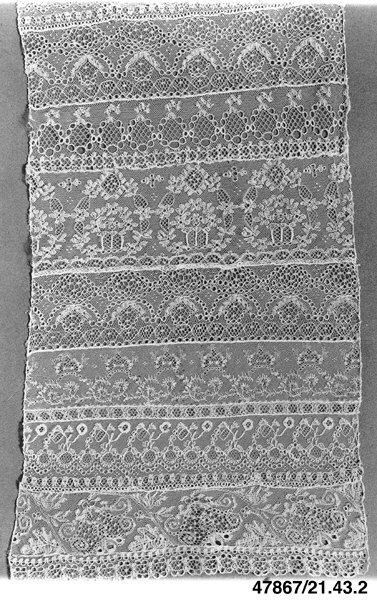
Delicacy was part of its prestige. Tønder lace belongs to the family of background laces: the floral motifs appear to rest on a clear, regular grid, with contours that help to decipher each leaf and each curve. Seen up close, the negative space is as important as the thread. The work does not fill the entire surface, but rather organizes small spaces of air so that the design retains its luminosity.
For a long time, these laces were associated with the dresses and accessories of the upper classes. But the 19th century shifted the balance. Mechanical production offered faster and cheaper lace, and competing with it using the finest linen became increasingly difficult. The lacemakers of Tønder responded with a practical adaptation: they began using thicker cotton thread, which allowed them to work quickly and reduce the cost of the piece.
The result was less ethereal, but it opened lacemaking up to farmers and middle-class families. This transformation tells a story that is repeated in many crafts: tradition does not remain static, but rather changes materials and rhythms to find a place in a different society. Even when a piece loses some of its extreme delicacy, it can gain new uses and reach homes that previously could not afford it.
The war of 1864 left Tønder under Prussian and then German administration. According to the museum, from then on the tradition nearly disappeared. Domestic production was already weakened by industry, and the changing borders added further difficulties. After the reunification of the area with Denmark in 1920, a revival movement began, bringing the patterns, tools, and the history of the lacemakers back into the spotlight.
This recovery allows us to admire pieces with a complete history today. The Metropolitan Museum of Art in New York, for example, houses an 18th-century Danish bridal veil from Tønder. Made of bobbin lace, it measures just over a meter and a half in length. Its size and transparency help us imagine how many hours of concentration could have gone into a garment destined to accompany such a solemn moment.
Those who travel to Tønder can experience this tradition at Drøhses HusA historic house in the city center, it is part of the Museum Sønderjylland. Its rooms showcase lace from the region, tools, and stories about its production. The building itself retains the atmosphere of an old home, so the pieces don't appear isolated from the everyday life in which they were created and used.
The visit continues even after you leave: the house's garden is inspired by a lace pattern some two hundred years old. It's a charming way of translating the logic of the craft into the landscape, as if the paths and plants were threads drawing flowers on a different scale. The museum also advertises free admission, a detail that makes it easy to incorporate the visit into a stroll through the city.
Tønder lace reminds us that visual fragility does not signify weakness. Its netting appears almost weightless, yet the tradition has withstood economic, border, and cultural shifts. It has done so thanks to the skill of its workers in adapting materials and thanks to those who, in the 20th century, understood that preserving a pattern was also preserving a part of local history.
When we look at that bridal veil today, or at a sample displayed at Drøhses Hus, we see much more than white flowers. We see a domestic economy, a shared skill, and a city that still recognizes bobbin lace as one of its voices. Tønder demonstrates that lace can be as delicate as air and, at the same time, have roots capable of reaching across centuries.
© El Mundillo de Eva 2026