Roseground: the rose background that opens windows in the lace
Roseground: the rose background that opens windows in the lace
There are lace backgrounds that almost disappear to let the flowers, ribbons, or fans speak for themselves. roseground It does something different: it makes the mesh itself the protagonist. Its small shapes, resembling geometric roses, open windows of light between the motifs and give Torchon lace a rhythm that is easy to recognize once we learn to look.
The English name literally means "rose background." It doesn't describe an embroidered flower or a naturalistic motif, but rather the effect produced by several pairs of stitches crossing, twisting, and converging around the points of the embroidery. From a distance, a succession of rosettes is perceived; up close, an ordered structure of diagonals, small open spaces, and thread intersections appears.
Like other Torchon lace patterns, the rose ground adapts well to a regular grid. This geometry is one of its strengths: it allows the module to be repeated, widened, or combined with denser areas. The rose is not added later, but rather emerges simultaneously with the ground, row after row.
A simple mesh primarily serves to unify motifs without overshadowing them. The rose background, on the other hand, introduces an intermediate ornament. It remains light, yet has enough presence to fill a large space without making it feel heavy. By alternating with linen stitch, half stitch, spider stitch, or fan stitch, it creates a dialogue between compact and transparent surfaces.
Light is crucial. The open spaces illuminate the work, while the diagonals that form each rosette cast small shadows. In white thread, the result is delicate and architectural; with colors, each pair can help follow the path and clearly reveal how the module is constructed.
To work on this, it's not enough to simply recognize crosses and turns separately. You have to keep the pairs well-ordered and know which ones are in each zone. If a pair changes position, the repetition loses symmetry; if the tension varies too much, one rose becomes round while the next stretches out.
That's why it's usually learned after mastering the basic movements. It's helpful to work slowly, separating the bobbins after each sequence and observing the center before moving on to the next group of pins. The cushion must hold the pricking firmly, and the pins must be inserted straight, as even a small deviation will be magnified when repeating the background.
It's also important to apply gentle tension. Pulling too tightly can close the gaps that give character to the rose ground; leaving the threads loose blurs its outline. The goal isn't to immobilize the work, but to distribute the tension so that all the roses breathe in a similar way.
The Smithsonian's National Museum of American History holds a pictorial titled Lace Pattern; named Rose GroundIt was registered in 1904 by the Torchon Lace Company of St. Louis. The cartoon shows rows of dots numbered from 1 to 30 and was related to a lesson in The American Lace MakerIt is a modest object, but it tells an important story: at the beginning of the 20th century, this craft was taught through patterns and publications that brought lacemaking to new students.
The pattern doesn't contain the finished piece. It holds its potential. The perforations mark where the pins will be placed, but it's the hands that must interpret the path, choose the thread, and regulate the tension. This distance between the pattern and the lace explains why two pieces made with the same design are never completely identical.
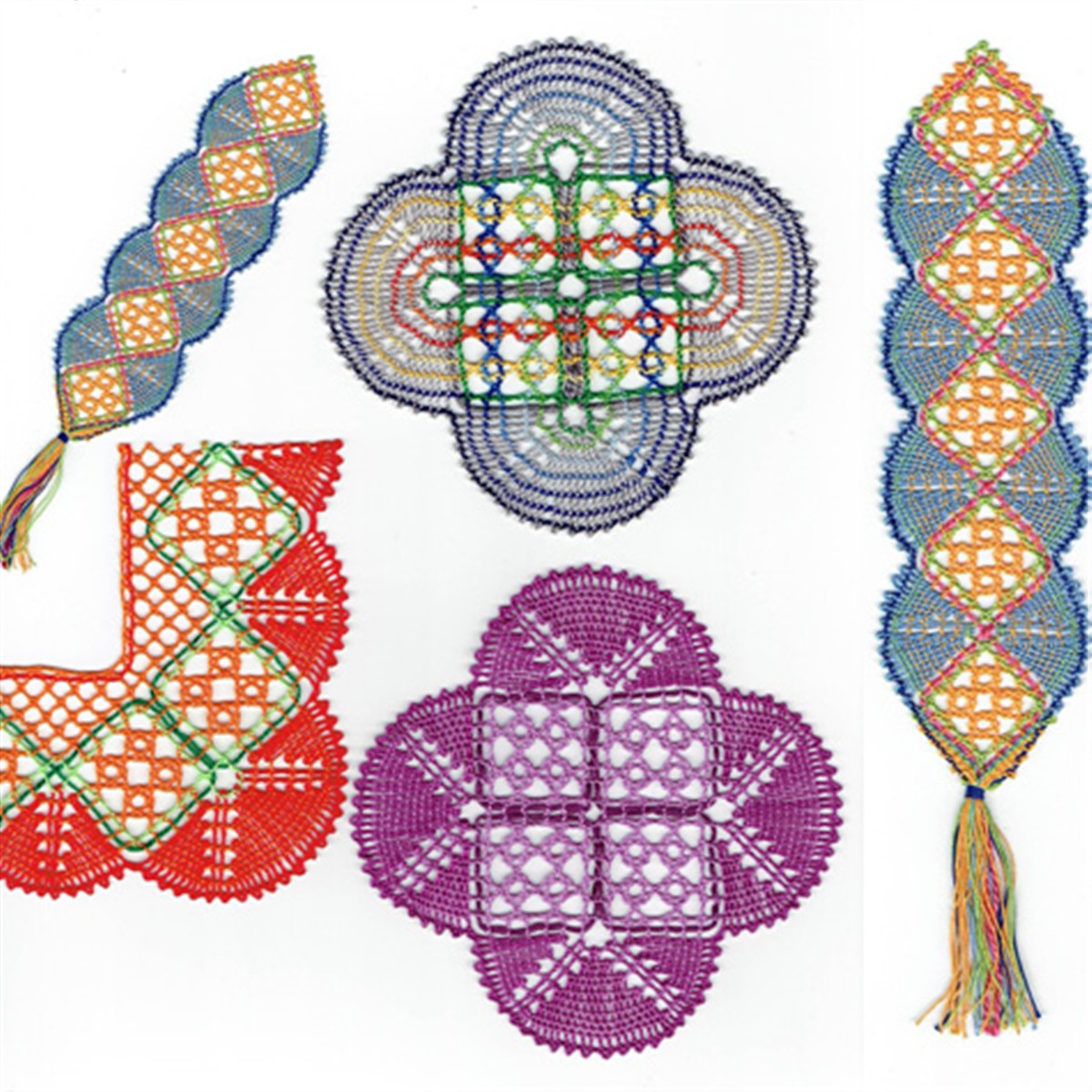
The technique remains alive in contemporary teaching. The Lace Museum in California includes it in its advanced workshops, along with gimp and Spanish fans. One of its exercises uses sixteen pairs of pearl cotton and another thicker pair for the outline thread. Using the same techniques, students create a bookmark, a corner, a border, and a square.
Another exercise combines canvas stitch paths, spiderwebs, and a rose background. This mix beautifully demonstrates its versatility: the rose background can occupy a quiet strip, surround a figure, or act as a transition between elements of varying density. It's not just a pretty repetition, but a tool for organizing space.
Looking at a Torchon piece, we can look for small, repeated centers from which diagonal lines radiate like petals. Side lighting and a contrasting background color help to follow these patterns. If the rosettes form a continuous, open network, we are likely looking at some variation of a rose background.
Learning to see it transforms the experience of contemplating lace. Where there was once a mesh, decisions of rhythm, tension, and proportion emerge. The roseground reminds us that the background is never an empty space: it can support the drawing and, at the same time, flourish within it.
© El Mundillo de Eva 2026