Rauma: Finnish lace that went from sustenance to celebration
Rauma: Finnish lace that went from sustenance to celebration
On the west coast of Finland, a town of wooden houses has made the sound of bobbin lace part of its identity. Rauma lace, known in Finnish as RaumanpitsiIt was born linked to the work and economy of many women. Today it continues in cushions, museums, workshops and in a festival that every summer invites the whole city to celebrate threads.
Rauma is an ancient port city. Contact with merchants, sailors, and other Baltic centers facilitated the exchange of materials, fashions, and knowledge. Museum records place its reputation as a center for bobbin lace at least in the 18th century, although the exact origin of the local technique remains a mystery.
During the 18th and 19th centuries, lace was much more than just an adornment. It provided a livelihood for many households and was especially linked to women's work. Lace could be sold through merchants and reach customers far from where the threads were woven. Behind every delicate edge lay hours of concentration, practice, and domestic organization.
Recent research has expanded this story thanks to archives and collections. The city of Rauma has highlighted the study of early designs preserved by the Finnish Economic Society between 1807 and 1812, along with pieces from museums and private collections. These materials allow for the comparison of motifs, the reconstruction of trade networks, and a better understanding of who made the lace and how it circulated.
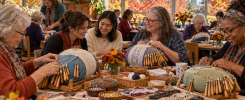
The delicate beauty of a lace edging can conceal all the work that precedes it. Before beginning, the thread must be prepared and wound, the bobbins chosen, the pattern established, and the pairs arranged. Then come the crossings, the turns, and the pinning, repeated with a steady rhythm. The care of the tools and the posture are also part of the lacemaker's skill.
A piece preserved in Finna helps to name this variety. It is the lace of a coif in which a double background appears called Riksi, related to examples gathered in Rauma in 1836. Details like this show that the tradition was not a static repertoire: the lacemakers mastered concrete structures, adapted designs and recognized their work by the way they constructed backgrounds and motifs.
With industrialization and changing fashions, handcrafted production lost its economic importance. However, lacemaking did not disappear. During the 20th century, it gradually transformed from a means of livelihood into a living artisanal tradition, taught, studied, and practiced by choice. This shift allowed for the preservation of skills that machines could imitate superficially, but not in their human connection.
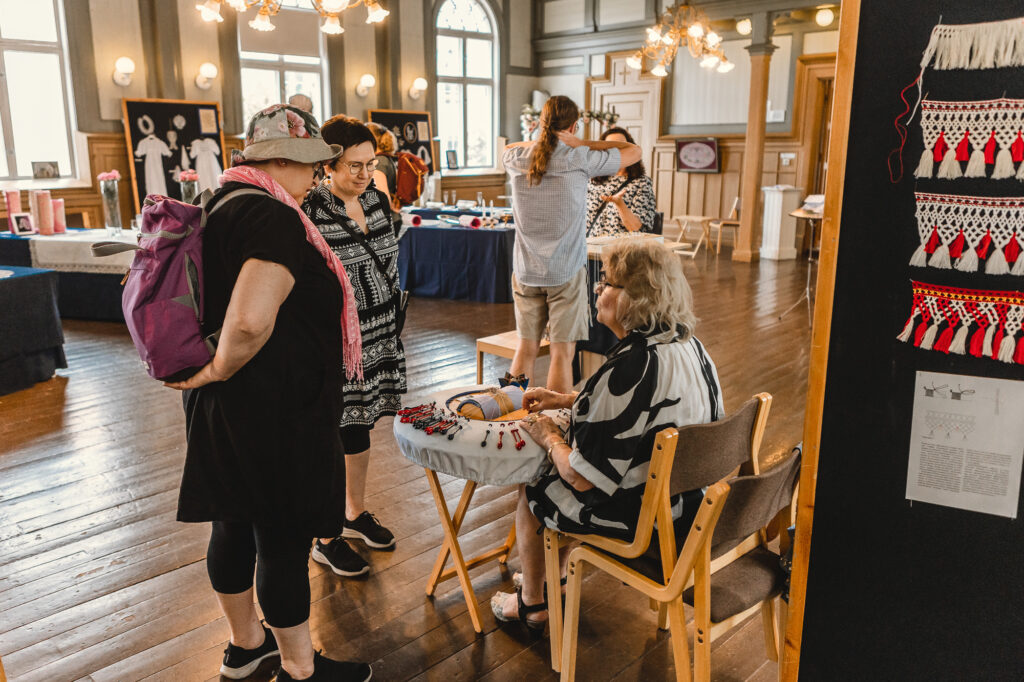
The Rauma Museum plays a central role. For over 130 years, it has been collecting exhibits and has among its special responsibilities the safeguarding of the local lace-making tradition. The exhibition The Story of Rauma LaceInstalled in the home of the shipowner Marela, the exhibition presents its history and its current continuity. There, lace is viewed alongside the lives of those who made it, not as an anonymous surface.
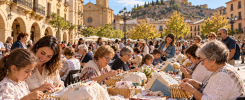
The best proof that the Raumanpitsi Lace Week is still alive. The first edition was born in 1971 from an exhibition of lace treasures kept in people's homes. Over the years it has grown into an urban festival that combines exhibitions, demonstrations, gatherings and activities in different corners of Rauma.
Since 1990, the Night of Black Lace has added a special atmosphere to the celebration. A lace-making competition and a bobbin lace café are also organized, offering an introduction to the technique for both those already familiar with it and those simply curious. In 2026, the city celebrated its 56th edition, an extraordinary continuation for a festival born from domestic crafts.
To speak of Rauma lace is to speak of beauty, but also of women's work. The collections allow us to rediscover names, tools, and organizational structures that were long forgotten behind the finished pieces. Each piece bears the mark of a skill learned through generations and of a small economy sustained with patience.
Rauma has managed to transform that memory into an open experience. Her lace remains in the museum, but it also returns to people's hands and the streets. Among the wooden houses of the old town and the Baltic horizon, the sound of the bobbins continues to tell how a craft born to help people make a living ended up giving an entire community one of its most cherished symbols.
© El Mundillo de Eva 2026