The spirit point: the small leaf that transforms bobbin lace
The spirit point: the small leaf that transforms bobbin lace
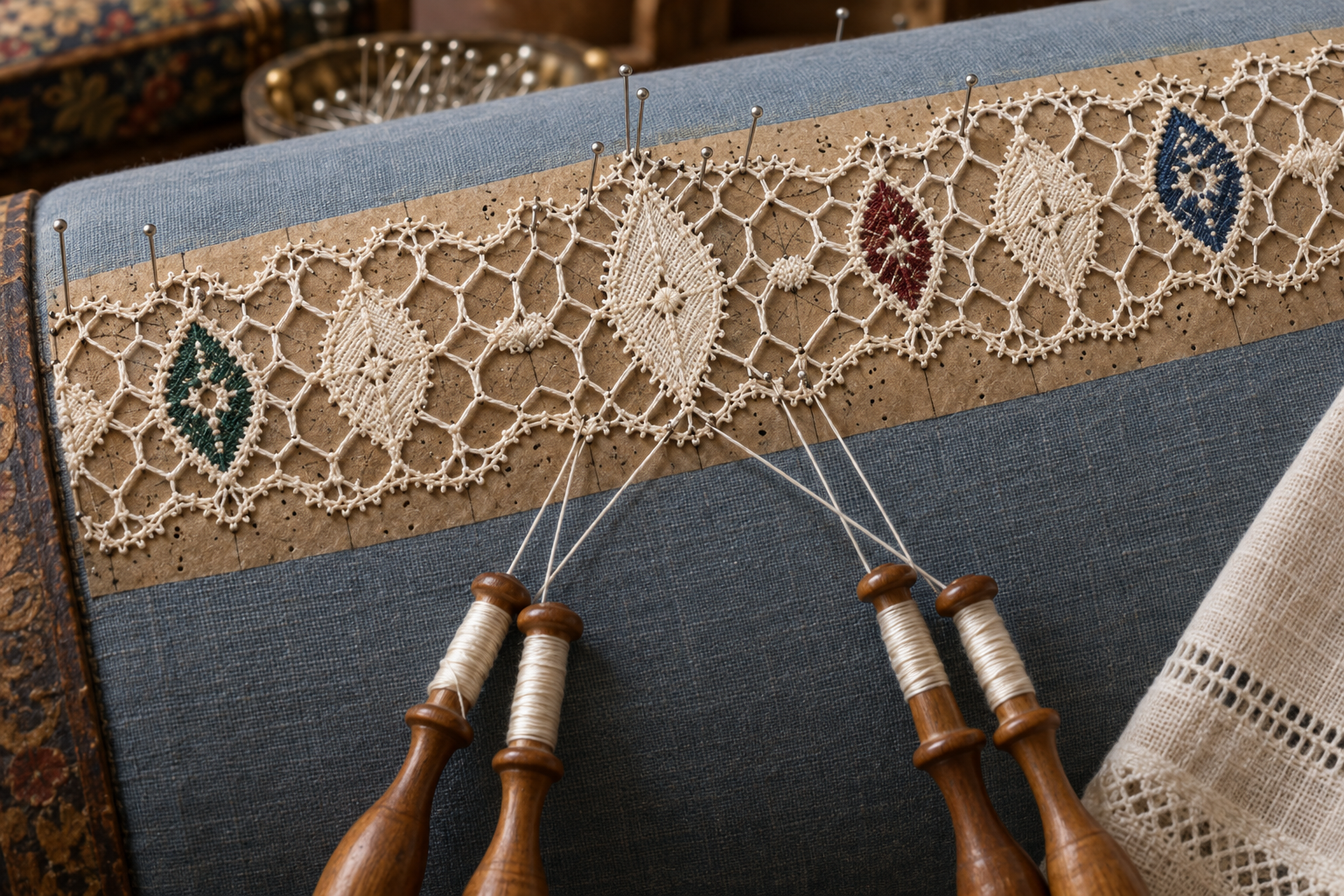
Among the open braids of some lacework appear small, compact shapes reminiscent of a leaf, a grain of wheat, or a petal. They seem simple, yet they concentrate a great deal of the lacemaker's skill. They are the spirit points, known in French as points d'espritTiny woven motifs that add weight, rhythm, and luster to a delicate work. They are especially recognizable in Cluny lace and can become the signature of an entire style.
The basis of the spirit stitch is a small group of threads that are interwoven to form a dense area. Official Canadian textile terminology defines it as a small, densely woven figure, square or other shapes, that appears as an isolated stitch on mesh backgrounds, as decorative fill, or alongside braids in guipure lace. In the Le Puy tradition, it can take the form of a square, oval, rectangular, rhomboid, or crescent shape.
Their function goes beyond mere decoration. Within an open structure, these shapes create visual pauses and help guide the eye. A succession of leaves can define a curve; a rhombus can close an intersection; several separate dots enliven a background without making it feel heavy. The contrast between the concentrated thread and the surrounding air is precisely what makes them so expressive.
The stitch is usually worked with two pairs of bobbins. A traveling thread passes successively over and under the other two, while the lacemaker adjusts each pass so that the figure widens and then narrows again. The result can resemble a perfectly closed leaf. Maintaining symmetry requires that each pass falls into place without flattening the previous ones.
The difficulty lies in the hands. If the tension changes abruptly, the lace warps, becomes too open, or loses its ends. The position of the bobbins is also important, because the thread needs to advance steadily. That's why lacemakers speak of a "gesture" or a "touch": the instructions explain the path, but the final form depends on a coordination learned through repetition.
The Hôtel de la Dentelle considers the spirit stitch one of the hallmarks of Brioude's Cluny Policromo. Its founder, Odette Arpin, studied lace from various origins and developed a particular way of executing these forms. The quality of this technique came to be recognized among specialists as a signature of the workshop, later passed on to her team and those trained there.
Silk and color further expanded its possibilities. A leaf can stand out in red, blue, or gold among braids of another hue, or be integrated into a gradation that lends movement to the piece. Thus, a traditional motif ceases to be a mechanical repetition and becomes a design unit. Changing its size, orientation, or color alters the rhythm of the entire composition.
Although closely associated with Haute-Loire, the name appears in lace from other regions. The Metropolitan Museum, for example, holds a British lace from Buckinghamshire dated 1844 and cataloged as bobbin lace with Paris stitch and spirit stitch. The Italian ENAPI collection also documents its presence among the techniques used in lace from the Occitan valleys of Piedmont.
The term can cause some confusion because it's also applied to machine-made tulles dotted with small dots. Therefore, it's advisable to examine the complete structure and the piece's specifications before identifying it. In hand-laid bobbin lace, the compact form is integrated into the thread pattern and interacts with braids, backgrounds, and pins; in a machine-made fabric, the word might simply describe the effect of dots on the net.
To observe these patterns, place the lace on a plain background and look for small areas where the thread is concentrated. Notice if they grow from a point, widen in the center, and then close again. Then check how they intertwine with nearby braids. A magnifying glass helps to follow the thread's path, although the overall shape is best seen with the naked eye and side lighting.
It's also worth comparing several sheets. The minute differences reveal the tension, the material, and the hand of the person who worked it. In silk, the surface reflects light differently than in linen or cotton; in color, each stitch acquires an almost painterly presence. The more you look, the clearer it becomes that these tiny figures hold an important part of the lace's character.
The spirit stitch perfectly encapsulates the beauty of bobbin lace: a few threads, precise movements, and a result brimming with character. Its small size invites you to approach, yet its repetition creates entire pieces. Behind each stitch lies tension, muscle memory, and countless hours of practice. Perhaps that's why it has such a evocative name: in a tiny space, the very spirit of the craft seems to be concentrated.
Sources: TERMIUM Plus, terminology of the spirit point, Hôtel de la Dentelle, workshop and Cluny Polychrome of Brioude, The Metropolitan Museum of Art, Buckinghamshire lace y Italian Ministry of Culture, Piedmont lace.
© El Mundillo de Eva 2026