Whole stitch and half stitch: two rhythms that change the lace
Whole stitch and half stitch: two rhythms that change the lace
In bobbin lace, a tiny difference can completely change the appearance of a piece. Adding or removing a cross transforms a compact area into a lighter one, alters the visual direction of the threads, and modifies how light passes through the design. This gives rise to two fundamental techniques: the whole stitch and the half stitch.
The basic movements are performed with two pairs, that is, four bobbins. When crossing, the two central threads exchange positions; when twisting, each pair rotates on its own axis. With these two actions, repeated in different orders, a large part of the lace vocabulary is constructed.
In the most common terminology, the whole stitch or linen stitch is formed with a cross, a turn, and another cross. The half stitch consists of a cross and a turn. Some schools name the movements differently or begin counting them from a different position, so a good lacemaker learns to observe the structure, not just memorize a phrase.
When a working pair moves back and forth between several passive pairs, the entire stitch creates a surface reminiscent of a tiny fabric. The threads are neat and close together, and the motif gains substance. This is why it is frequently used to fill in leaves, petals, ribbons, and figures that need to be clearly legible against a more open background.
It may look simple, but it requires attention. If the working couple pulls too tight, the border shrinks; if it's too loose, loops appear and the motif loses definition. Pins mark changes in direction, while the hands distribute the tension so the block maintains a consistent width.
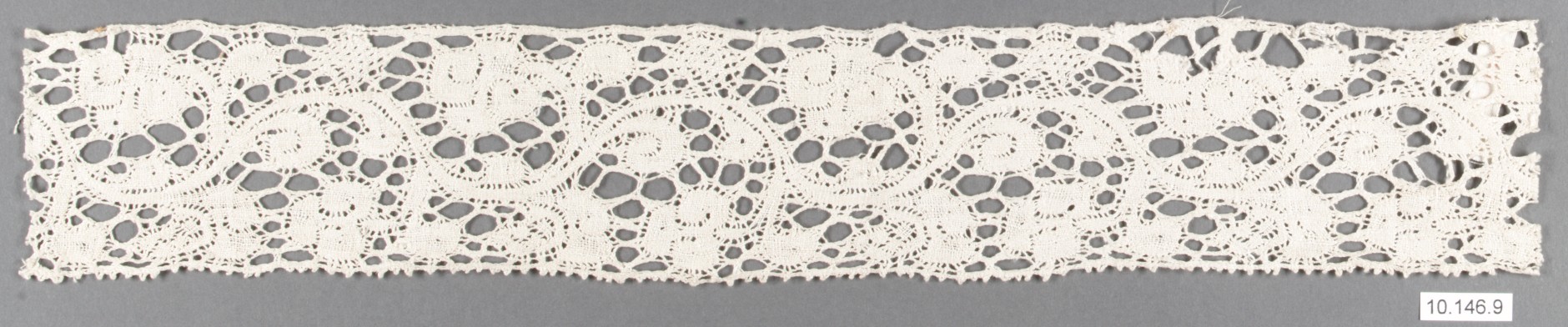
The half-stitch creates a more open and oblique texture. The pairs of stitches continually change function, and the threads appear to shift diagonally, creating a less compact surface. Light enters more easily, and the design acquires a soft vibrancy, almost as if it were shaded.
This effect is especially beautiful when combined with areas of whole-knit stitch. A flower can have dense petals and a light center; a ribbon can alternate between firm and transparent sections. The difference lies not in changing the material, but in rearranging the same threads in a different sequence.
To distinguish between the two, it's helpful to look at the path of the threads. In a full stitch, you'll usually see a pair of threads crossing the pattern like a weft, while the others remain in a more stable direction. In a half stitch, on the other hand, the angle changes constantly, and the surface shows small diagonal crossings.
A magnifying glass and a side light are very helpful. It's not necessary to follow every thread from the beginning: simply compare an opaque area with a more transparent one and look for a clearly recognizable pair. Old samplers were valuable precisely because they brought together many solutions in a single piece and allowed them to be studied side by side.
For beginners, alternating between whole stitch and half stitch is an excellent exercise. The former teaches you to keep the edges straight and to work a strong pair of yarn. The latter forces you to distribute tension between threads that change position. In both cases, your fingers gradually learn how much to support and how much to pull.
The way you correct the lace also changes. In whole stitch, it's usually easier to identify the loose stitch. In half stitch, uneven tension can shift several rows before becoming visible. Working slowly, keeping the bobbins tidy, and checking each pin prevents a small imbalance from becoming a major deformation.
Historical lace patterns blend these structures in very different ways. An 18th-century Flemish piece might combine dense and transparent areas to separate flowers, leaves, and backgrounds. In other styles, linen stitch dominates the ribbons; in others, half stitch is used to add shading or lightness to the motifs.
Understanding them changes our perspective. We no longer see just a white lace strand, but decisions: where the eye should rest, which part needs firmness, and which area needs space. Crossing, twisting, and crossing again seems like a small gesture, but in the hands of a lacemaker, it becomes drawing, texture, and light.
© El Mundillo de Eva 2026