The spider stitch: the little star that orders bobbin lace
The spider stitch: the little star that orders bobbin lace
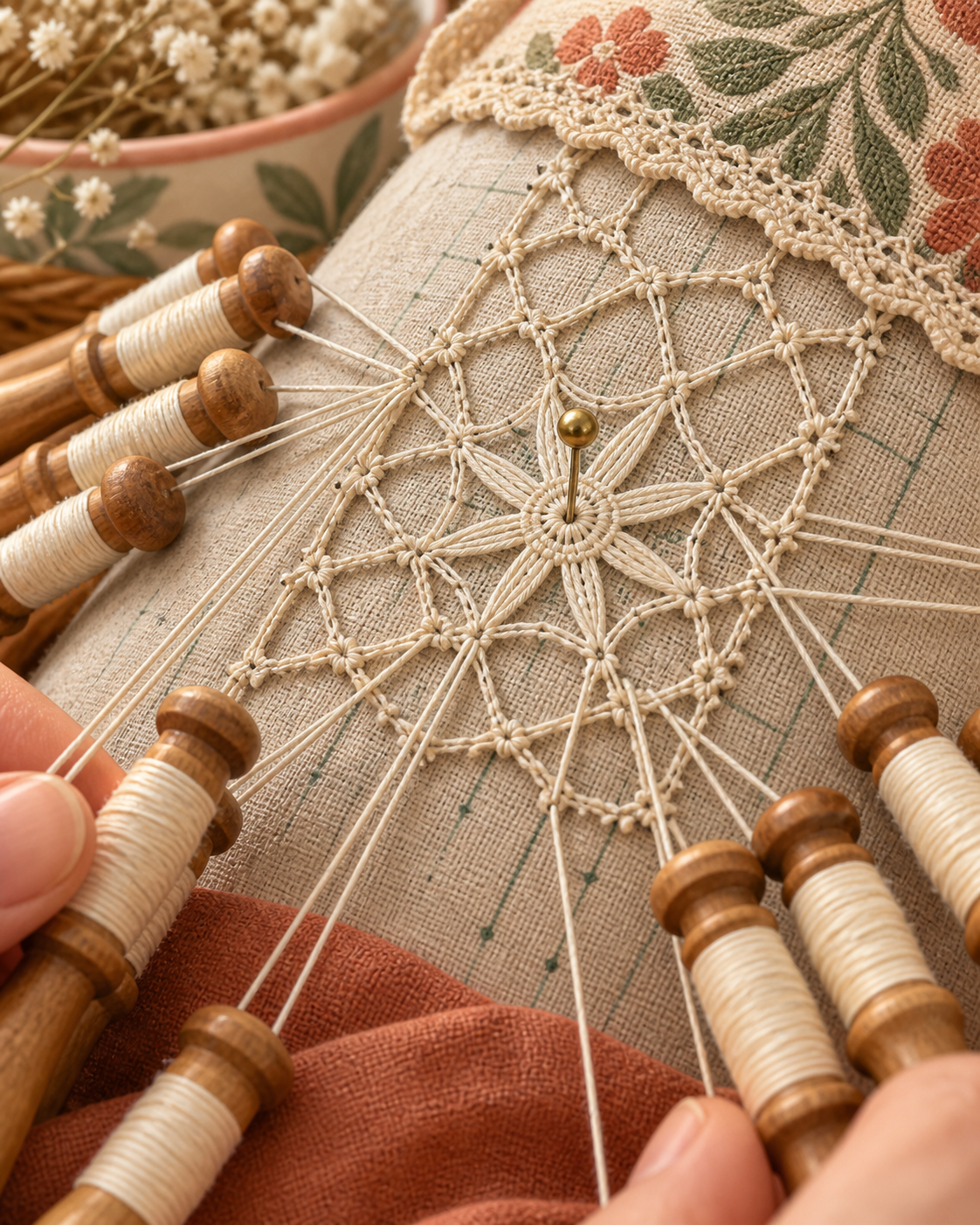
In some bobbin lace patterns, a small star appears that seems almost a secondary detail. However, this motif has an important purpose: to organize the background, fill a space, and transform a network of threads into a rhythmic landscape. It is commonly known as spider, or spider stitch, and it is one of those resources that help to understand why lace combines such precision with a surprising feeling of lightness.
The Powerhouse Museum's technical glossary defines the spider stitch as a compound stitch: a group of stitches that replaces a section of mesh or lightens a denser, more intricately worked area. Its most recognizable feature is a central hole, made by a pin, from which several "legs" emerge. The number of these legs can vary depending on the size of the space the motif occupies. It is not, therefore, a rigid design, but rather a small structure that adapts to the pattern.
The same source distinguishes the snowflakesOr snowflakes, like spiderweb-like motifs, though with a more complex construction. On a torchon cloth, it's easy to see how these figures repeat themselves, creating a kind of geometric constellation. Up close, they aren't just white patches: they are successive decisions about which pair passes over, which turns, and where the next section is fixed.
Bobbin lace is worked on a cardboard pattern placed on a firm pillow. The threads, wound onto bobbins, are crossed and twisted while pins hold each step in place. The museum's glossary summarizes the system in two basic movements, cross y twistThese actions are always performed in relation to two pairs of threads. From these actions arise the stitches that we recognize in a finished piece.
To give you an idea, a half stitch combines a cross and a turn; a full or canvas stitch adds another cross. The difference seems minimal when written, but it changes the density, direction, and lightness of the thread. In a spiderweb design, the interest lies in coordinating this small vocabulary around a center. The result resembles a flower, a star, or a wheel, depending on the scale and the thread used.
If you're learning, it can be helpful to observe the pattern before you start lacing the bobbins. First, locate the central pin and notice how many spokes lead to the mesh surrounding it. Then, follow a single pair, without trying to cover the entire figure: you'll see that the design is easier to understand when you follow the threads step by step.
It's also important to distinguish the background from the decoration. The mesh unites the design elements; the spider occupies part of that mesh and acts as a visual pause. In other works, it appears alongside a thicker thread, called gimp, which marks the edge of a motif. That contrast between fine lines, dense areas and small gaps is what gives a border depth.
The Museu Marès de la Punta explains that bobbin lace first developed in Flanders at the end of the 16th century and that, over time, styles linked to specific cities and regions emerged. Among the names it lists are torchon, guipure, Valenciennes, Mechelen, Binche, Honiton, and the laces of Milan and Genoa. Not all of these styles use the same stitches or create the same effects, but they all share the concept of constructing an openwork fabric through crossings and turns.
That's why a spider motif can seem both familiar and different at the same time. In a Mediterranean-inspired pattern, it will have a certain rhythm; in a Flemish or English piece, it might be integrated into a different mesh and on a different scale. The motif doesn't belong to a single location: it travels, changes its name, and adapts to the tastes, materials, and hands that craft it.
To appreciate the spider stitch, you don't need to start with a large lace pattern. Choose a simple sampler pattern, prepare the pillow at your leisure, and note down any questions you have about the number of pairs or the order of the stitches next to the pattern. Work a short repeat and observe it with side lighting: the raised areas and hollows are much easier to see than under flat light.
Another nice idea is to keep the first sample along with the date and pattern name to compare tension, radius regularity, and how each thread responds. This is my own recommendation; for the exact sequence, it's best to follow the pattern's instructions or those of a lacemaking teacher.
The next time you find a tiny star in a piece of bobbin lace, pause for a moment. That center, secured with a pin, encapsulates the essence of bobbin lace: a few carefully repeated actions capable of creating a surface full of air. The spider doesn't try to command attention, but without it, many backgrounds would lose their rhythm. And therein lies its charm: in making visible the intelligence hidden within a small detail.
Sources: Glossary of Lace Terms, Powerhouse Museum; guide to the Marès de la Punta Museum; technical explanation from the Metropolitan Museum of Art.
© El Mundillo de Eva 2026