Pottenkant: the thread vases that traveled from Antwerp
Pottenkant: the thread vases that traveled from Antwerp
In some antique Antwerp lace, the flowers do not bloom freely on the net: they emerge from small vases woven with thread. This repeated motif gave the lace its name. pottenkant, literally “lace of the pots”, a robust and recognizable bobbin lace border that unites the domestic world, Flemish commerce and the symbolism of flowers in the same linen strip.
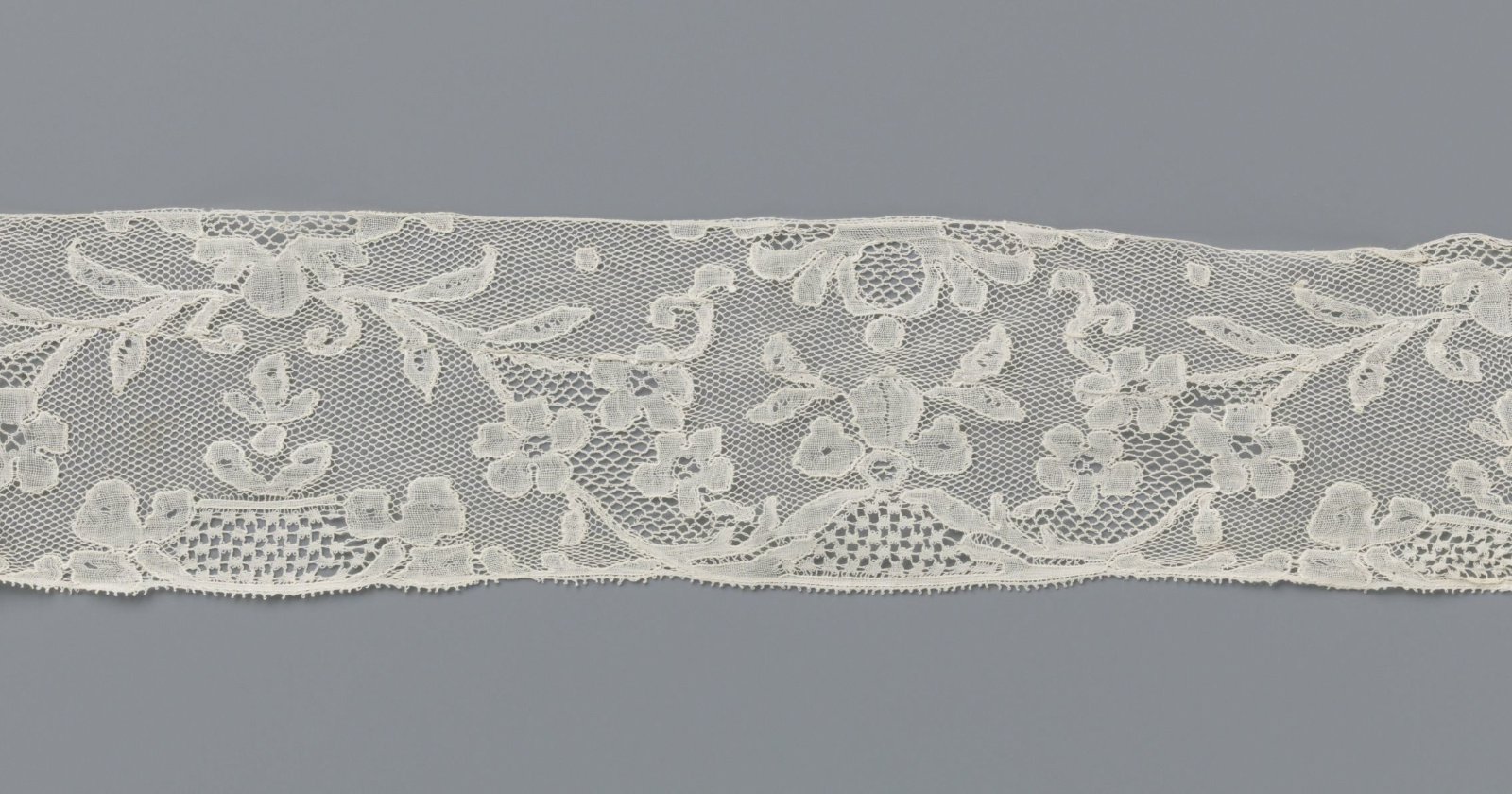
The pottenkant style is distinguished by its succession of vases, often with two handles, from which stylized stems, leaves, and flowers emerge. The design can vary considerably from one piece to another: some vases are immediately recognizable, while others almost transform into a geometric figure. The repetition creates a serene rhythm, like a row of pots placed by a window.
It is a continuous lace. The same threads run through the motifs and the background, without each flower being made separately and then joined together. A slightly thicker outline thread helps to define the shapes on the mesh and keep the design visible. Unlike very light laces that resemble mist, pottenkant lace usually offers a firmer presence, suitable for borders that need to maintain their shape.
The record of a piece preserved by the Rijksmuseum in Amsterdam The name of this lace is linked to the vase of lilies that appears in scenes of the Annunciation as a symbol of purity. This interpretation explains its presence in ornaments intended for religious use, although over the centuries the motif was simplified, transforming it into a decoration that could also be appreciated for its balance and beauty.
The museum exhibit was created in Antwerp between approximately 1890 and 1910. In it, stems curve, flowers fill spaces of openwork, and the vessels are integrated into a larger composition. It is a late piece that demonstrates the long life of a drawing style associated with the city long before that time.
Between the mid-16th and mid-18th centuries, Antwerp played a leading role in the creation and distribution of lace. The Plantin-Moretus Museum explains that the city was not tied to a single style, as was the case with Brussels, Bruges, or Mechelen. Its merchants offered diverse qualities and adapted production to the tastes of an international clientele.
This flexibility made Antwerp a major market, though it also made it more difficult to recognize everything that came out of its workshops today. Lace traveled to other countries under brand names or following the fashion of the destination. The pottenkant is a fortunate exception: its repeated vase pattern left a visual clue capable of tracing many pieces back to their place of origin.
Behind this trade were primarily girls and women. They worked in homes, schools, and religious communities, producing the lace rods that then circulated through mercantile networks supplying courts, churches, and wealthy families. The Plantin-Moretus archive preserves early evidence of this business. Even the daughters of the printer Christophe Plantin participated in the linen and lace trade with clients in Paris.
Looking at a pottenkant border is a little game of discovery. First, you notice the flowers; then the handles, the neck, and the base of the pot appear. If the design is highly stylized, your eye must fill in what the thread barely suggests. This ambiguity is part of its charm: a pot can look like a basket, a cup, or a simple rhombus until the repetition reveals the pattern.
El Metropolitan Museum of New York It also preserves another 18th-century Flemish fragment cataloged as a pottenkant from Antwerp. Together with the Amsterdam pieces, it allows us to trace the persistence of the motif and its variations. No lacemaker needed to depict a flower in a naturalistic way; a few solids, voids, and curves were enough to make the garden recognizable.
The pottery border reminds us that a humble motif can hold a grand story. These small vases encompass devotion, women's work, the port of Antwerp, and the tastes of distant buyers. Centuries later, they continue to flourish each time someone looks closely at the border and discovers that thread, too, can create gardens.
© El Mundillo de Eva 2026