The pricking: the map of holes that guides each bobbin lace
The pricking: the map of holes that guides each bobbin lace
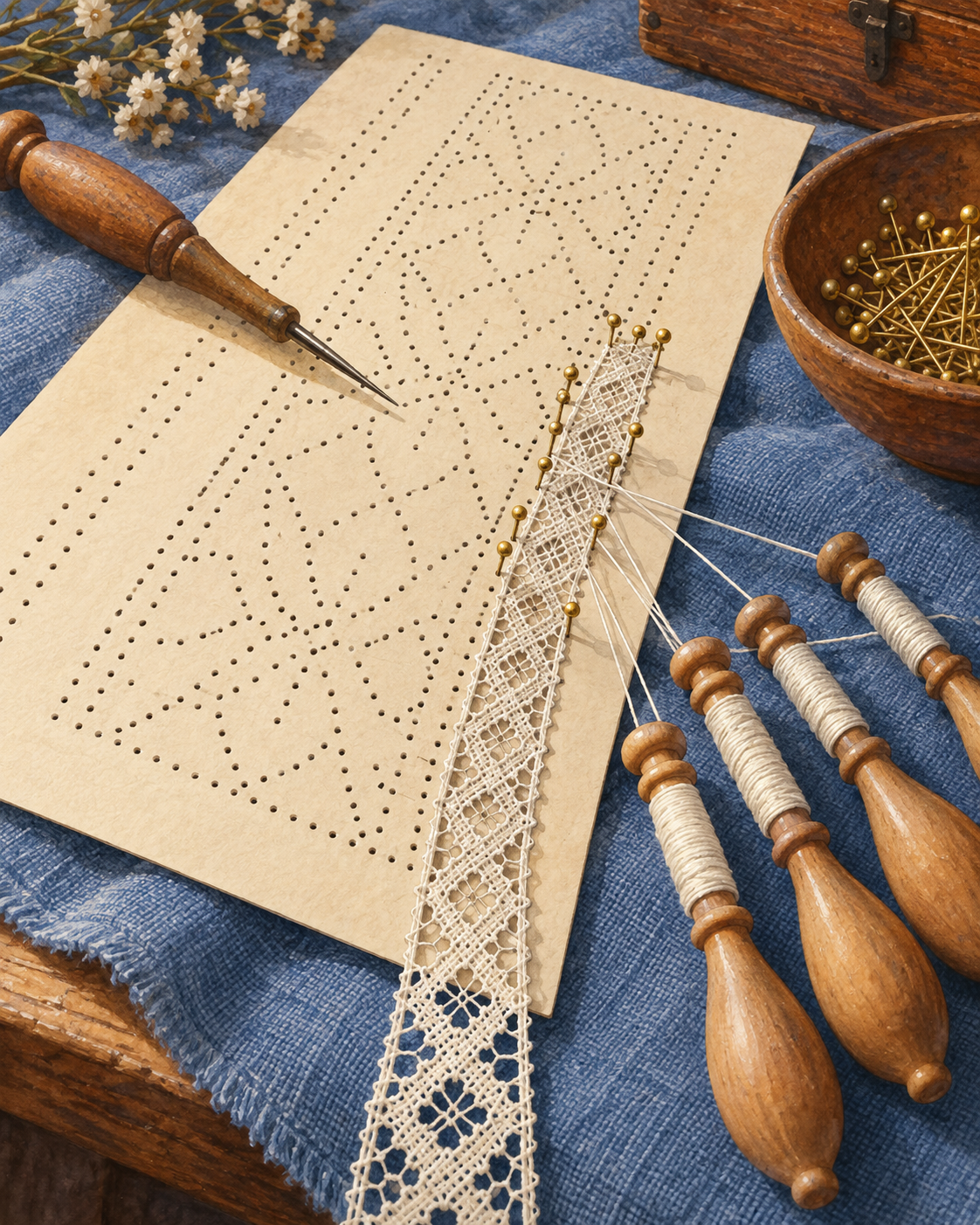
Before the thread begins to draw flowers, leaves, or tiny stars, someone has to prepare a map. In bobbin lace, that map is called choppedA card full of holes indicates where the pins will go and how the work will progress. It seems like a silent surface, but the rhythm, proportion, and much of the piece's personality are already hidden within it.
El South Tyrol Mining Museum He explains that the drawn patterns used to create the lace are called prickings. In Spanish, we often refer to it as "picado" because the pattern becomes a precise succession of perforations. Each hole functions like a small traffic sign: it indicates a change, a corner, a crossing, or the place where tension should be applied.
The perforation pattern is not a coloring page. It's a guide that should translate a design into practical decisions. Two patterns may appear similar at first glance, yet produce very different results if the spacing between the holes, the order of the lines, or the way a curve is resolved changes.
In many patterns, lace is constructed from the inside out. First, a small motif or central line is worked out, and then the surrounding elements are added. The pattern in the Italian museum features designs with names taken from everyday life, such as trees, leaves, snails, or insects. These names help to remember the design, but the stitching itself remains the true roadmap.
When a line changes direction, the thread needs support. A pin is placed at that point to secure and tighten the work. The hole may seem tiny, but it determines the shape of a corner and the regularity of a series of crosses. If the spacing isn't consistent, the motif can become too narrow, too wide, or lose its balance with the rest of the lace.
El Metropolitan Museum of Art She describes the method as a team effort: the bobbins cross and twist according to the design, and pins secure each step. A basic stitch might involve four bobbins, but the setup grows when several pairs work simultaneously on different parts of the pattern.
The stitching helps keep the conversation from becoming disorganized. It marks the places where the pairs meet, separates the motifs, and maintains the distance of the net. The lacemaker doesn't have to guess every move: she reads the path, recognizes the type of stitch, and makes decisions about the thread tension.
One of the unique aspects of lacemaking is its visual vocabulary. A design might resemble a flower, a branch, an animal, or a geometric shape. These names are used in different schools and regions, though they don't always have the same meaning. The tradition is preserved, but it also evolves when a lacemaker adapts a motif to a different width, thread, or a piece intended for a different purpose.
Traces of this adaptation can be seen in the old patterns. Some holes are more worn because the card was used many times; others have been reinforced or transferred to a new support. The surface thus tells a story parallel to that of the lace: it shows how it was taught, who repeated it, and which parts needed correction.
Preparing a lace pattern requires patience. You have to study the design, choose a scale, calculate distances, and decide where to concentrate or ease the work. An early mistake can affect the piece for many centimeters. That's why lacemakers test, compare, and, when necessary, correct the pattern before pinning it extensively.
Today, lacemaking can be done with digital tools, but its logic remains the same: to transform an idea into a sequence of dots that the hands can interpret. Paper retains something that no archive can fully replace. As it passes from one lacemaker to another, it wrinkles, creases, and becomes filled with small signs of use.
The next time we see a finished piece of lace, we can imagine it in reverse: not as a delicate surface, but as a path of holes, crosses, and decisions. Each motif was born twice, first in the initial lacework and then among the bobbins. In this double life lies one of the wonders of this craft: an almost invisible map ends up transformed into a fabric we can actually touch.
© El Mundillo de Eva 2026