The bobbin lace sampler that ended up in a museum: the curious story of Gertrude Whiting
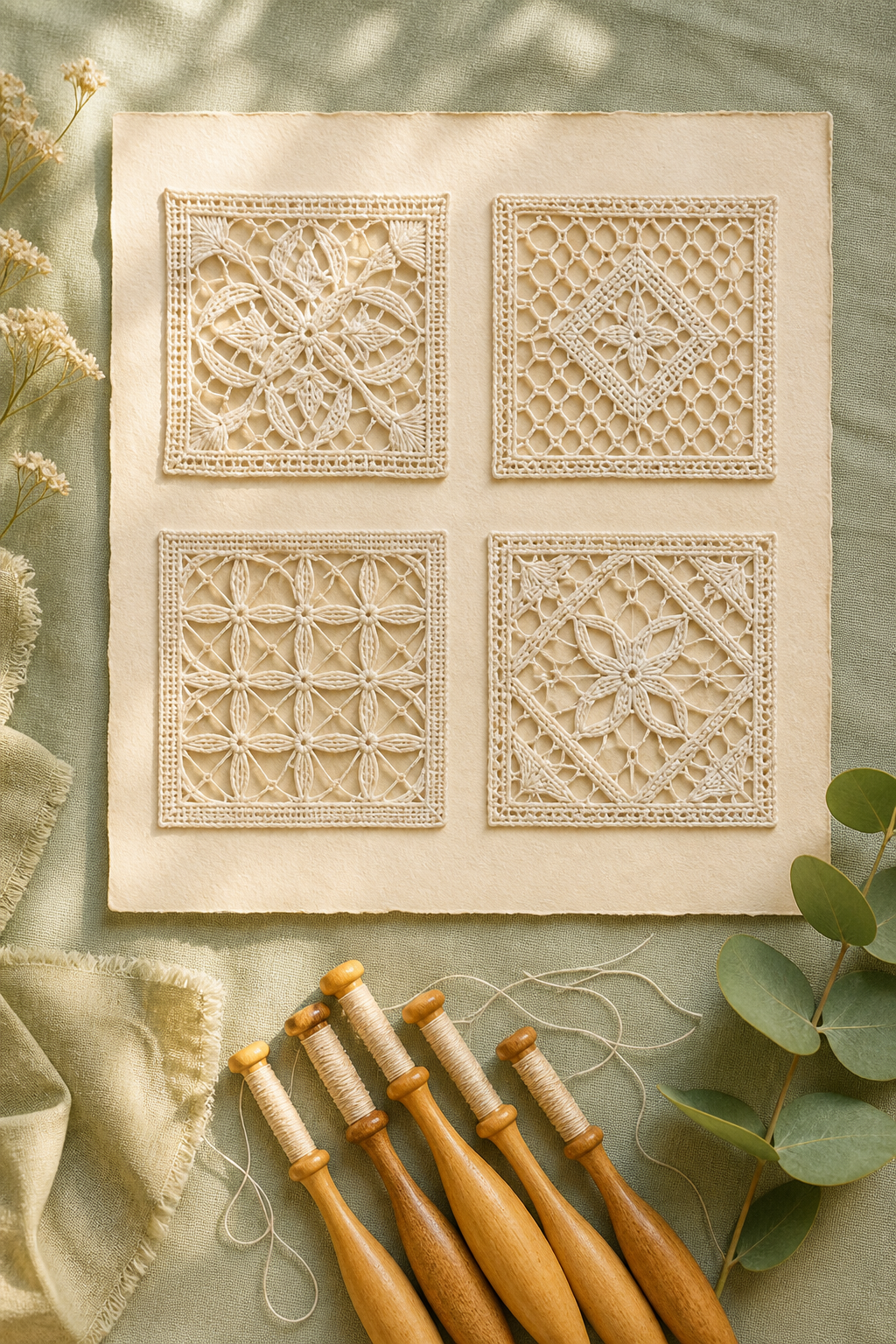
Do you keep those little samples you make before starting a project? Sometimes they end up in a box, mixed in with threads and papers, as if they were just an unimportant intermediate step. However, a sample can preserve something that a finished piece doesn't always explain: how we learned to solve it.
That's why the story of Gertrude Whiting and her bobbin lace samplerDone between 1912 and 1917Today, it is part of the collection of the Metropolitan Museum of Art in New York. The museum received it as a bequest from its creator in 1951, according to its collection card.
The beauty of this story is that it doesn't just take us to a museum. It also brings us back to our own world with a very personal question: what if those samples we're collecting were the beginning of our own little lace library?
El Metropolitan study dedicated to Whiting He explains that his piece brings together dozens of points for comparison. The frame also includes 27 bobbins of different origins and materialsTherefore, we are not dealing with a simple collection of ornaments: the tools are also part of the story.
The idea is easy to grasp for anyone who has ever tried to learn a stitch by looking at a photograph. We see the result, but we lack clues. Having different examples nearby allows us to pause, step back, and recognize differences that, individually, might go unnoticed. A sampler invites us to look slowly and ask questions.
Whiting accompanied his work with a manual published in 1920, A Lace Guide for Makers and CollectorsIt included instructions for reproducing the stitches and a precious curiosity: a photographic reproduction of the sampler, printed to scale on linen, which folded up and was stored in a pocket at the end of the book.
Imagine opening a book and finding that fold-out material. Today we're used to enlarging an image on a screen; that solution allowed you to view the entire document on a fabric surface. The study tool wasn't just the printed page: it could also be unfolded on the table.
His interest in sharing knowledge went beyond the book. 1916Whiting, along with Frances Morris, who was involved in the museum's textile department, launched The Needle and Bobbin Club. The first meeting took place at the Metropolitan. A shared passion thus found a space for meeting and studying.
To understand this, it's helpful to remember what distinguishes this technique. Metropolitan differentiates between needle lace and bobbin laceThe first is constructed with a single thread using stitches, while the second interweaves multiple threads arranged on bobbins. Its development is related to braiding.
On the cushion, the pairs cross and rotate following the design, while pins help hold the work in place. This combination allows for very different results. A small sample focuses our attention on one part of the process, without requiring us to complete a large project right away.
History also does not have a single, indisputable birth date. The Lace Guild She explains that these techniques evolved from other crafts and developed significantly during the 16th century. Pattern books helped to disseminate knowledge. Seen in this light, the idea of learning by observing, experimenting, and documenting has long been associated with lacemaking.
You don't need to create a museum-quality collection to take advantage of this idea. You can start with three small tests of stitches you're learning, following a pattern appropriate to your level and your teacher's guidance. This is a practice suggestion, not a reproduction of Whiting's method.
Next to each sample, note the yarn used, the pattern reference, and the difficulty you encountered. Also, add what helped you overcome it. That comment, which seems obvious now, might be exactly what you need when you return to the technique months later.
If you want to compare results, change only one thing at a time. For example, try the same motif with a different yarn that's compatible with the pattern, checking with a professional beforehand if you have any doubts. Then see how the appearance changes. The intention isn't to dictate which version is better, but to learn to recognize what you like and understand your choices.
And keep some imperfect evidence. Noting where you lost consistency or what part was most difficult also tells a useful story. A personal journal can show progress and difficulties, not just the results we'd proudly display.
En El Mundillo de Eva We like to think that a piece of work can convey more than just a drawing. A note, the name of the person who taught us, or a well-identified sample can help someone else continue learning. Whiting's story invites us to look again at that box of evidence: perhaps it's not full of scraps, but of knowledge waiting for its next conversation.
The images in this article are generated illustrations; they do not reproduce the historical sample nor serve as technical patterns. You can see the original piece in the museum's information sheet linked at the beginning.
© El Mundillo de Eva 2026