Mirecourt: the lace of Lorraine that wove together work and modernity

Mirecourt: the lace of Lorraine that wove together work and modernity
Mirecourt is known for its violins, but for centuries another sound filled the homes of this Lorraine town: the gentle click of bobbins. Women, girls, and entire families participated in a production that carried their lace throughout Europe. The tradition survived changing fashions and mechanization, and today it is once again being taught as an essential part of local heritage.
The Mirecourt tourist office places the European expansion of lacemaking between the 15th and 16th centuries. In Lorraine, its development was fostered by the dukes of the region. Very soon, the technique ceased to be solely a courtly adornment and entered schools, domestic workshops, and humble homes.
An important figure was Pierre Fourier, a priest from nearby Mattaincourt and founder of the Notre-Dame congregation. He encouraged the nuns to teach lacemaking in their schools and orphanages. Young women from wealthy families worked to prepare their trousseaus, while orphans, peasant women, and women from working-class households found in bobbin lace a way to earn an income.
Around 1790, thousands of lacemakers worked for merchants who distributed their production to Switzerland, Germany, Italy, and Spain. The work was often done at home, compatible with other jobs and the rhythm of rural life. Behind every lace piece was a chain made up of designers, thread suppliers, workers, intermediaries, and sellers.
A report from the jury of the 1867 Paris Universal Exposition praised Mirecourt's ability to create new designs, diversify its styles, and adapt quickly to changing fashions. It also highlighted the high quality and taste of its products. The center did not rely solely on replicating old designs; its strength lay in transforming traditional craftsmanship into new commercial offerings.
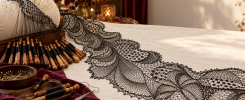
Mirecourt lace was made with bobbins on a cushion, using linen and later cotton. The pieces could be light and white, with small motifs, open backgrounds, and serrated edges. The skill of the lacemakers allowed them to produce everything from narrow lace to denser guipure, according to the needs of clothing, trousseaus, or ornaments.
In the 19th century, some initiatives revived ancient techniques to create what were known as art guipure lace. These experiments helped fuel the taste for geometric lace, which later circulated under commercial names such as Cluny. Mirecourt thus functioned as a collective workshop: it preserved inherited techniques but reorganized them to respond to a changing market.
The Metropolitan Museum of Art houses a 19th-century French lace border by Mirecourt. It measures 55,9 centimeters long and just seven centimeters wide. Against the gray background of the museum's photograph, a succession of points, small plant forms, and open wheels fill the space with a regular rhythm. The piece entered the collection in 1908 through the Rogers Fund and is cataloged as bobbin lace.
Its size is reminiscent of the everyday function of many tasks. Not all of them were monumental mantillas or ceremonial dresses. A narrow strip could transform the edge of a garment, a cap, or a piece of household linen. Multiplied meter by meter, this delicate fabric sustained a far-reaching economic activity.
Wars, changes in clothing styles, and competition from mechanized manufacturing gradually led to a decline in handcrafted production. The knowledge, however, did not disappear. In 1981, the Association Renouveau et Promotion de la Dentelle de Mirecourt was founded with the aim of preserving the heritage and passing on the technique.
The association runs a beginners' center, organizes courses, and also welcomes children to its weekly school. During the summer, it participates in exhibitions and demonstrations at La Fabrique, on the banks of the Madon River. Lacemaking is thus regaining a prominent place in a city where traditional crafts remain an integral part of its identity.
Mirecourt teaches that lace can be many things at once: ornament, household income, a fashion statement, and a shared heritage. Looking at her small wheels and leaves, we see more than just white thread. We see a network of learning and work that has spanned generations and continues to find new hands willing to carry it on.
© El Mundillo de Eva 2026