Mechelen: summer lace that outlines its flowers with silk
Mechelen: summer lace that outlines its flowers with silk
Mechelen lace appears drawn with the finest pen on an almost invisible net. Its flowers are recognizable by a silky outline that captures each petal and stem, while the hexagonal background allows light to filter through. In 18th-century European salons, it gained a reputation as a light lace, suitable for summer. Behind this airy appearance, however, lies one of the most delicate bobbin laces in Flanders.
All three names refer to the same Belgian city. Mechelen is its Dutch name, Malines the French, and Malinas the traditional Spanish form. The English word frequently appears in collections and old books. MechlinThe name ended up identifying a technique, although the lace was also circulated and made outside the city.
El Textile Research Center Leiden It is described as one of the oldest and most delicate bobbin laces produced in Flanders. It achieved particular popularity in European courts during the 18th century and was used primarily to adorn women's garments.
Malines belongs to the continuous lace tradition. Motifs and netting advance simultaneously on the bobbin, with the threads distributed between dense areas and open spaces. Individual flowers are not made to be applied later onto tulle. This unity requires anticipating how the pairs of threads for each leaf enter and exit without disrupting the rhythm of the background.
Its distinctive network forms small hexagons using twisted and braided threads. Regularity is essential: if the tension changes, the gaps no longer appear uniform and the transparency loses its serenity. From a distance, the background almost disappears; upon closer inspection, it reveals a minute architecture that supports the entire design.
The easiest sign to recognize is the cordonnet, a thicker, softly twisted thread that outlines the motifs. Traditionally made of silk, it creates a shimmering line around flowers, ribbons, and leaves. It doesn't form a heavy border. Its purpose is to delicately separate the dense stitches from the mesh and make the design legible.
This detail helps to distinguish Mechelen from ValenciennesIn Valenciennes, the motif and background are distinguished by their density, without an added cord to raise the outline. Mechelen also preserves its own hexagonal mesh, more open and luminous. They are related within Flemish lace, but speak with distinct voices.
Its lightness made it an ideal complement to light-colored clothing and fabrics. Against a dark background, the flowers and the cord stand out; against white or skin, the netting becomes discreet. That's why it appeared on collars, ruffles, caps, cuffs, and long drapes that framed the face.
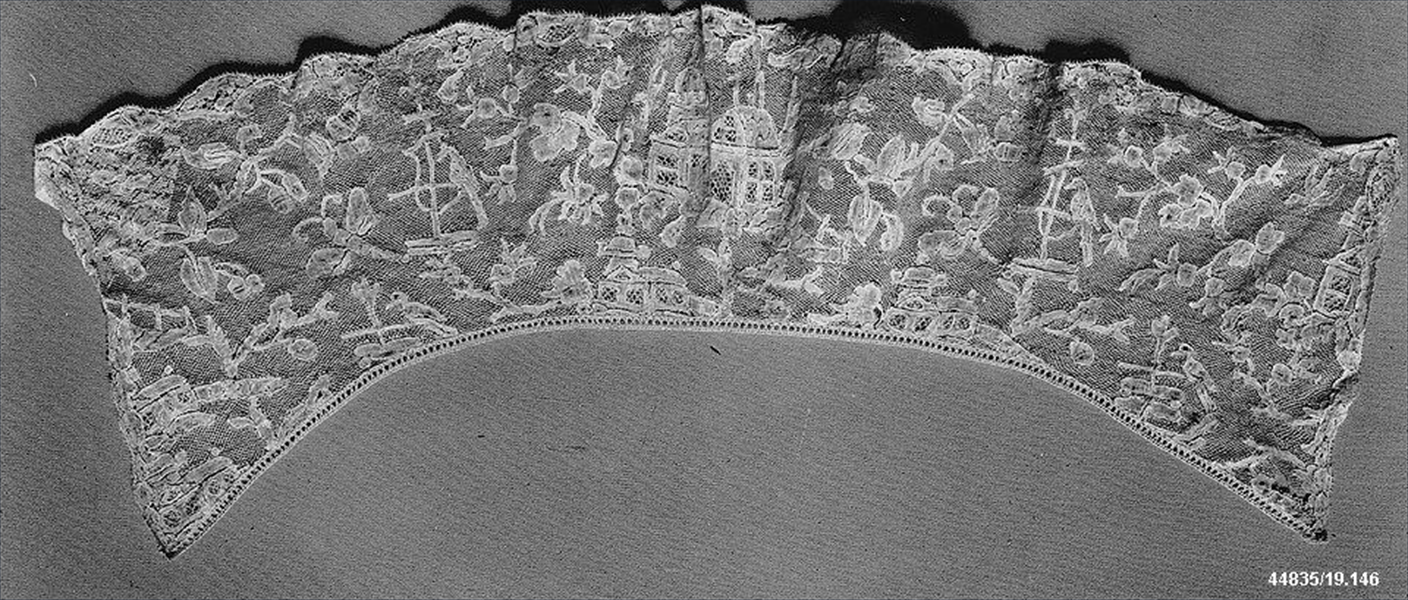
The Metropolitan Museum of Art preserves a Flemish collar from Mechelen, early 18th centuryMeasuring 41,9 by 12,7 centimeters, it reveals how a relatively narrow strip can encompass flowers, curves, and a vast number of crosses. The museum offers its image in the public domain, inviting viewers to observe the piece at their leisure.
The result may seem simple because no single area wants to dominate. But that's precisely where the difficulty lies. The background must remain uniform, the denser sections need clean edges, and the cord has to follow the curves smoothly. Many pairs are working simultaneously, and any imbalance is transmitted to the surface.
To understand a piece, it's best to place it against a dark background and follow three clues. First, look for the hexagonal mesh. Then, check if the flowers emerge from the same thread pattern. Finally, locate the silky line that embraces each motif. When these lines appear together, the transparency ceases to be a void and becomes Malinas's signature technique.
At the beginning of the 19th century, machine-made tulles and laces began to compete with these slow and costly techniques. Hand-made lace lost a significant portion of its market, although small groups maintained the craft. Museum collections today preserve collars, borders, and drapes that demonstrate the extraordinary quality achieved.
Looking at Mechelen after learning about its construction changes the initial impression. The flower no longer floats by chance: it is held by a calculated net, defined by a silk thread, and accompanied by the coordinated work of many bobbins. It is a lace of light, but also of discipline, one that conceals its effort to reveal only its grace.
© El Mundillo de Eva 2026