Lille: the light lace that made the background a cloud
Lille: the light lace that made the background a cloud
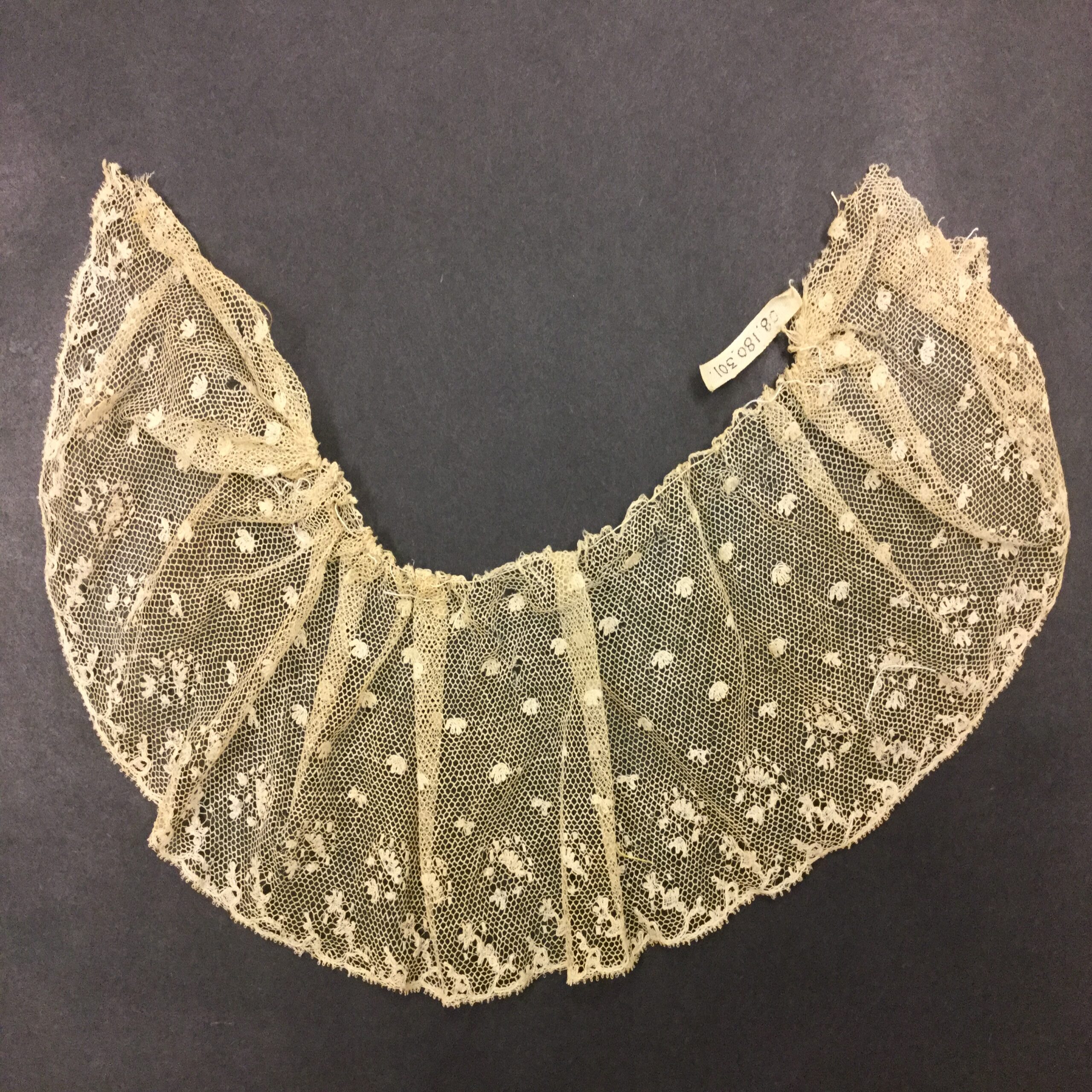
At first glance, Lille lace seems drawn on a mist. Its flowers and small curves float on a background so light they almost disappear, while a slightly thicker thread outlines the motif like a pencil stroke. This clarity, known as fond clairThis made bobbin lace a specialty admired during the 18th and 19th centuries.
Lille originated in Flemish territory, and its history changed borders several times. The city definitively fell under French influence during the reign of Louis XIV in the 17th century, but its textile culture maintained a distinct character that blends Flemish and French influences. Historical documents already mention lacemaking in Lille in 1582.
This dual heritage becomes clear when observing an antique piece. Lille lace shares the lightness of other northern European laces, but it developed a distinctive background and a way of outlining the designs that eventually came to bear the city's name. It was worked in both white and black, although the lighter examples allow for a particularly good appreciation of its structure.
In many laces, the flowers are the first thing that catches the eye. In Lille lace, the background deserves equal prominence. Its hexagonal mesh is fine, regular, and transparent. Four sides of each small hexagon are formed with pairs of twisted threads; the other two arise from the crossing of these threads. The result is an airy network that supports the design without competing with it.
A generally light and orderly motif unfolds across this mesh. A thicker, often only slightly twisted, outline threads stems, leaves, or curves. Large, compact masses are not common here. The grace lies in the line, the open space, and the feeling that the design moves effortlessly. This is why a narrow lace edging can be just as elegant as a larger piece.
Another much-loved feature is the spirit dots: tiny geometric shapes scattered across the background. They don't completely fill the surface, but rather delicately interrupt the continuity of the mesh. They resemble snowflakes, seeds, or small lights suspended among the main motifs.
In a well-balanced lacework, these stitches are not placed randomly. They follow the rhythm of the design and prevent open spaces from appearing empty. Anyone who works with bobbins knows how much a composition changes when even the smallest detail occupies the precise spot. Lille transformed this economy of means into a true visual signature.
Lille lace became widely popular in the 18th century. Its refined appearance made it suitable for embellishing clothing, headdresses, and borders. The technique was also practiced outside the city and gave rise to related variations in other European centers. Light-colored backgrounds traveled from workshop to workshop, and the term "Lille lace" came to be used to identify this family of laces.
Fashion and economics, however, never stand still. After the French Revolution, production lost part of its former market. During the 19th century, pieces continued to be made, some with increasingly simpler designs, while machine-made lace transformed the textile trade. Museums today preserve numerous fragments from that period: long borders, pieces for caps, and samples that allow for comparison of hands, threads, and qualities.
When examining an antique piece, it's best to start with the grid. If the background is hexagonal, very light, and uniform, you can then look for a more defined outline around the motifs. Scattered dots offer an additional clue. The design tends to breathe: there's more space than dense areas, and the shapes are perceived as soft silhouettes.
No single feature guarantees identification. Techniques traveled, were copied and adapted, and many old pieces lack documented provenance. Comparing them with catalogued examples is very helpful. The Metropolitan Museum of Art, for example, holds 19th-century French pieces from Lille that clearly demonstrate this relationship between transparent mesh, contour line, and light drawing.
Lille lace teaches that richness doesn't always depend on accumulating motifs. Its beauty arises from leaving space, maintaining even tension, and relying on a well-placed line. For a modern lacemaker, observing it can be a wonderful exercise: following the path of the thick thread, counting the stitches that support the net, and discovering how a few details order the entire composition.
Perhaps that's why it still feels so modern. Amidst so much exuberant lace, Lille chose to speak in a low voice. Its light background makes the air part of the work and demonstrates that, with bobbin lace, even a cloud can be drawn.
© El Mundillo de Eva 2026