Le Pompe: the 1557 book that brought bobbin lace to the printing press
Le Pompe: the 1557 book that brought bobbin lace to the printing press
In 1557, when bobbin lace was still a relatively new technique, a small Venetian book brought its designs into print. It was titled Le Pompe: Opera Nova And it contained pages of designs that could be transformed into bands, borders, and interlaced patterns. Those prints didn't explain each intersection as a modern pattern, but they helped the shapes travel farther than a swatch of yarn or a teacher's memory.
The Metropolitan Museum of Art holds a copy published in Venice by Giovanni Battista and Marchio Sessa. Its catalog entry identifies it as the first edition of the first book of patterns for bobbin lace. It contains thirty pages of designs made using woodcut, the printing method that carves the image into a wooden block.
The cover bears the mark of Matio Pagano, a printer and publisher associated with several Renaissance textile pattern books. The exact authorship of the drawings remains undetermined. This absence serves as a reminder that needlework books originated in workshops where designers, engravers, printers, and merchants could all contribute without revealing their full names.
Many lacemakers know the work as Le Pompe 1559The name was also popularized by a modern facsimile edition. However, the Met copy is dated 1557. Historical research distinguishes a first volume published that year and a second set that appeared in 1560; editions and dates circulated between the two, which explains why 1559 became so closely associated with the title.
The difference does not diminish the book's importance. On the contrary, it shows how quickly a collection of patterns could be updated when there was demand. The printing press allowed pages to be reproduced, sold, and a Venetian repertoire to reach hands that had never seen the original fabric.
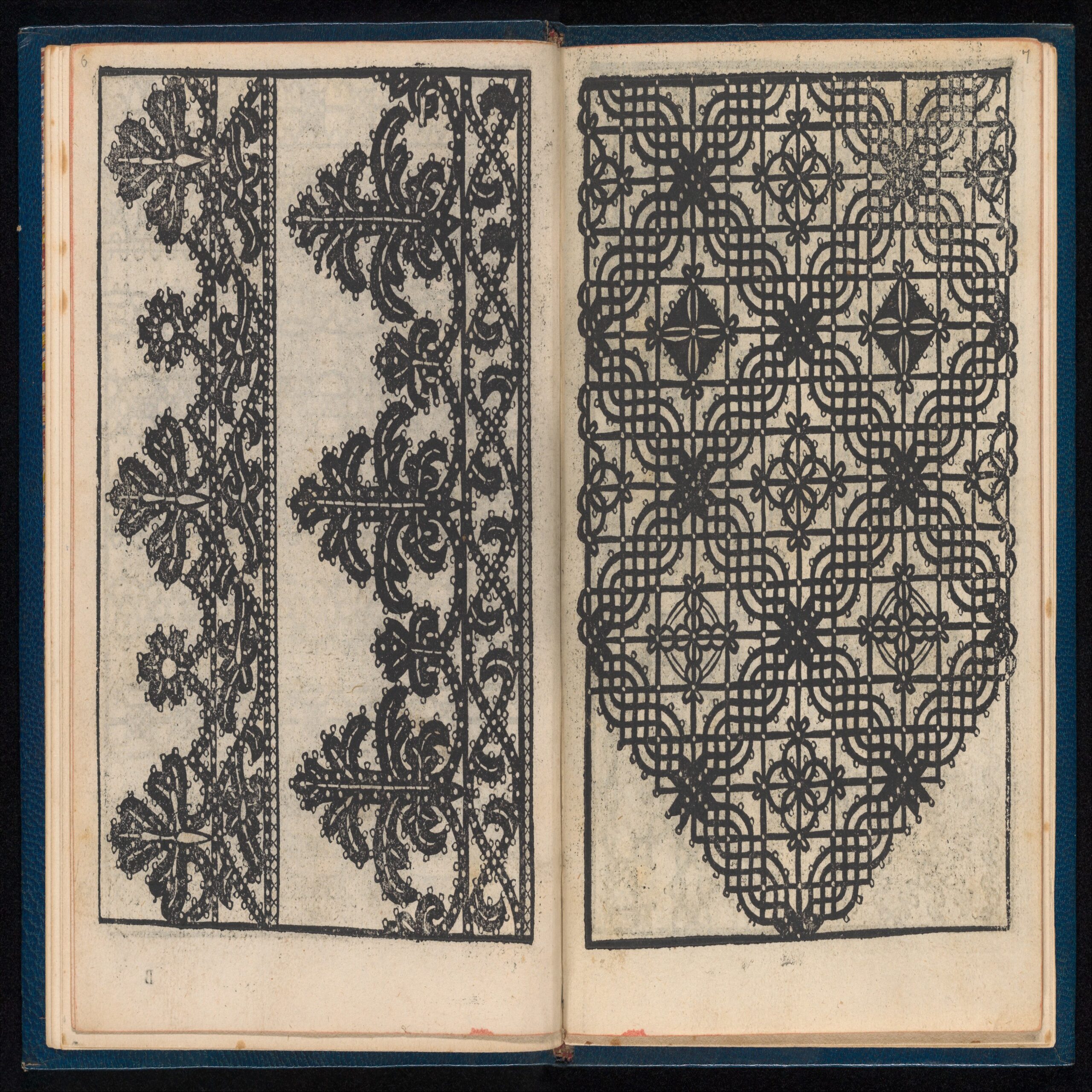
The pages feature geometric patterns, flowers, braids, and borders with repeating rhythms. The images are bold and black, designed so that the structure is understood on the page. They don't include diagrams of crosses, numbers of pairs, or step-by-step explanations like we expect today. The lacemaker had to translate the form to her materials and her knowledge.
This interpretive work could require changing the scale, deciding the path of the threads, or choosing between several technical solutions. A single drawing allowed for more than one reading. The patterns served as a starting point and as an ornamental repertoire, not as a recipe that guaranteed an identical copy.
A recent study on Italian lace from 1550 to 1650 has used historical sources and practical reconstructions to investigate the work behind these pieces. Its authors note that only three books from the 16th century were dedicated exclusively to bobbin lace. Le Pompe It was the first, followed in 1561 by a pattern book printed in Zurich.
Some early designs could be made with as few as four bobbins, while others involve patterns that continue to generate debate. Recreating them allows us to measure time, discover difficulties, and verify that the printed drawing does not always provide all the necessary information. The modern hand has to make decisions similar to those a Renaissance lacemaker would have made.
Pattern books played a role in the spread of lacemaking techniques across Europe. A motif could be copied, adapted to a different width, or combined with a local working method. Early Flemish lace, for example, shares stylistic features with Italian designs printed around the same time. The circulation of paper thus accompanied the circulation of threads, garments, merchants, and artisans.
The relationship with design also changed. The physical sample remained valuable, but the page offered an organized and reproducible archive. It could be saved, compared, and reused. Each print fixed an idea without preventing the next one from fitting in and transforming it.
The double-page spread held by the Met shows two ways of organizing space. On one side are vertical floral bands; on the other, a dense grid of loops and geometric figures. The printed lines are not actual threads, but they invite the viewer to follow paths, locate repetitions, and consider where intersections, turns, or open areas might be.
Almost five centuries later, Le Pompe It retains that capacity to provoke questions. It is a book, an archive, and an imaginary workshop all at once. Its pages remind us that bobbin lace didn't only grow around the cushion: it also advanced thanks to the printing press, which turned drawings into travelers and opened a window to Renaissance design.
© El Mundillo de Eva 2026