Idrija: 150 years teaching bobbin lace making
Idrija: 150 years teaching bobbin lace making
Some anniversaries are celebrated by looking at old photographs. The anniversary of the Idrija lace school also invites us to look at the hands of those learning today. In this Slovenian town, an institution founded in 1876 will celebrate its 150th anniversary in 2026 and continues to teach bobbin lace within its classrooms. The most beautiful aspect of the story is this continuity: behind every finished lace piece, there is someone who taught, someone who asked questions, and a new person capable of continuing the craft.
Local history brings together two trades that, at first glance, seem very different: mercury mining and lace making. According to the story published by the schoolThe oldest written reference that mentions this work in the Idrija region dates from 1696. That date documents its presence; it does not mean that we can point to it as the exact moment of its birth.
For a long time, the knowledge was passed down from generation to generation. But in the second half of the 19th century, Idrija merchants expanded the presence of their lace in the European market. As demand grew, so did the need for trained lacemakers. In 1876, the Vienna Ministry of Commerce established a school in the town. Its first teacher was a local woman: Ivanka Ferjančič.
La a profile dedicated to him by the institution She recounts that Ivanka furthered her training at a private lace-making school in South Tyrol. Upon returning, she worked on new patterns alongside her sister Antonija and brother Jožef. It wasn't simply a matter of repeating designs: there was also room to create and find new paths for Idrija lace.
Ivanka was a teacher and served on the governing body of the school. She died in 1879, a few years after its opening, but teaching continued with teachers she had trained. This detail allows us to understand her legacy without embellishing it with fabricated phrases: some of her knowledge lived on in other hands.
Those of us who have seen a craft explained recognize the value of that transmission. A pattern can preserve the drawing; a teacher helps interpret what is happening while we are doing it. There are doubts that are resolved by observing a movement slowly and trying it again.
La school celebrates its 150th anniversary as an institution that has operated continuously since its founding. Its current information indicates that around 500 children and young people, in addition to more than 150 adults, learn there. These figures give another dimension to the craft: we are not only talking about antique pieces carefully stored, but about people who dedicate time to learning.
Su educational presentation She explains that children's training is a leisure activity and that its departments are located in Idrija and other towns. It also offers different options for adults. The image is relatable: starting as a child, returning years later, or discovering bobbin lace for the first time are all paths that can be found around the same hobby.
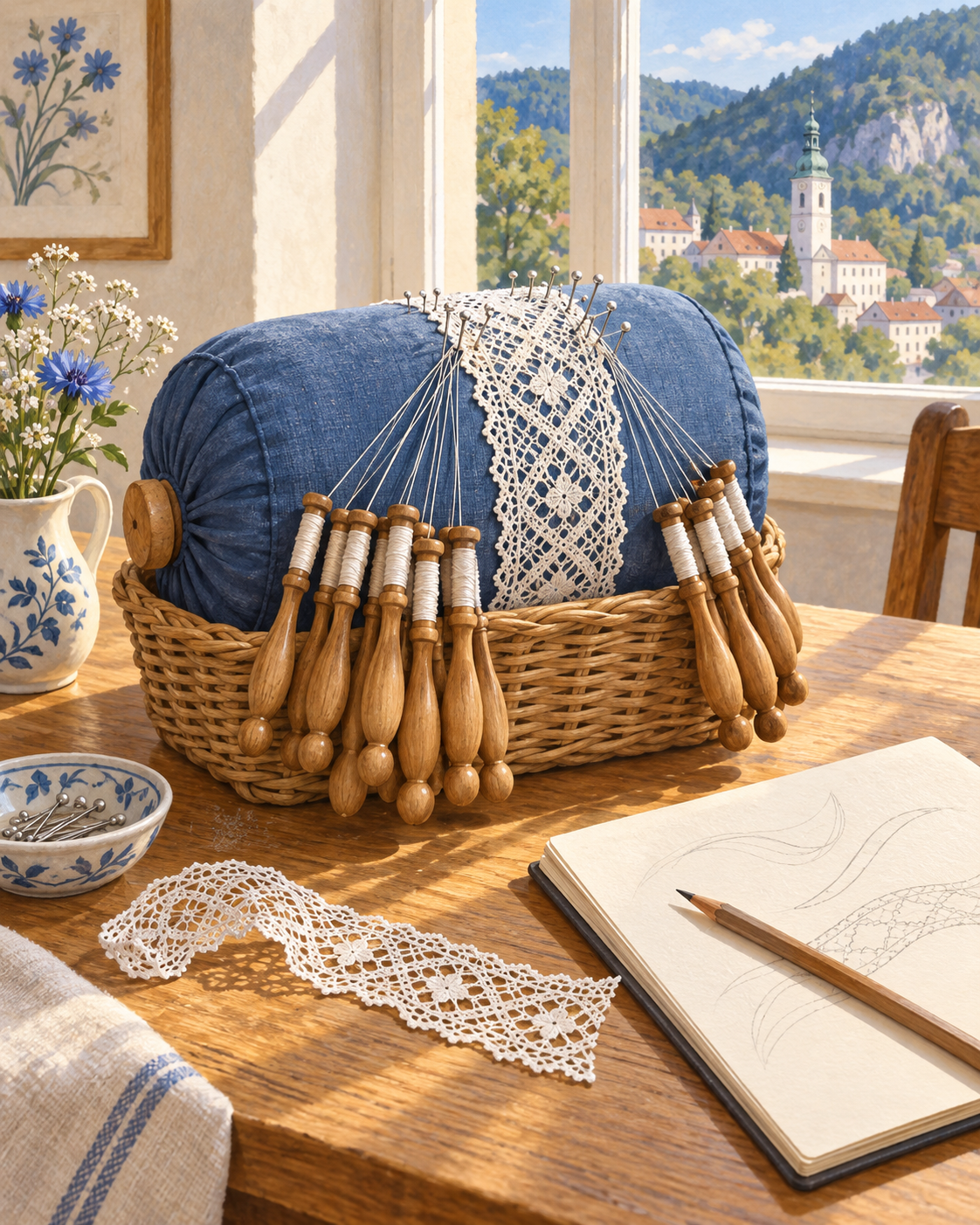
In 2018, bobbin lace making in Slovenia was added to the Representative List of the Intangible Cultural Heritage of Humanity. UNESCO fact sheet Describe patterns with local names and work on a cylindrical pillow, placed in a wicker basket or on a wooden base.
The recognition refers to the Slovenian practice and the knowledge that underpins it; it is not a distinction awarded solely to the school. UNESCO also highlights the family transmission and learning that takes place when lacemakers gather. It is a way of looking at heritage that places people alongside the finished pieces.
Idrija's story inspires us to propose a small gesture: dedicating a session to sharing something we know how to do. It could be preparing bobbins, demonstrating a part of the lace-cutting technique, or explaining how we organize our materials. It's our suggestion, without needing to turn it into a formal class or demand perfect work.
We can also keep a sample with the name of the person who taught us. That note doesn't add stitches, but it preserves something the thread alone cannot convey. When we see it again, we'll remember a voice, an afternoon, and perhaps that first doubt that seemed enormous.
Idrija celebrates 150 years as a school with a very easy-to-understand lesson: a trade finds a future when someone can learn it. El Mundillo de Eva We celebrate this chain of patience and generosity. The next person who comes to look at our bobbins could be about to begin their own story.
© El Mundillo de Eva 2026