Magic threads: the trick to closing lace without leaving a trace
Magic threads: the trick to closing lace without leaving a trace
There's a moment in circular lace that tests even the most steady hands: the end approaches the beginning, and all eyes are on the join. If the threads are too thick, the join is noticeable; if the tension changes, the pattern loses continuity. So-called "magic threads" don't make the work disappear, but they offer an ingenious solution: preparing small auxiliary loops that help hide the ends within the lace itself.
The name is charming, although the method is far from improvised. A magic thread is usually a loop of thin, strong, and highly visible sewing thread, placed at a predetermined point along the route. As work continues, the loop becomes temporarily integrated under certain crossings. Upon reaching the end, it serves to pull one of the final ends along the path it has created.
The idea is reminiscent of threading a guide through a conduit: the auxiliary loop goes in first, waits unobstructed, and, when the time is right, pulls the final thread inward. Then it is removed. What remains on the surface is the continuity of the lace, not a permanent tool. The Lace Museum presents this technique as a way to join the beginning and end without using a crochet hook or needle during the closing process.
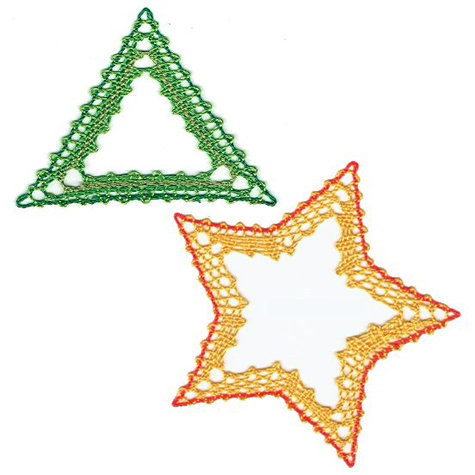
Magic threads shine in pieces where beginning and end must meet: frames, medallions, round ornaments, or closed lace. They can also help to finish off several pairs in a small space. A museum course applies them, for example, to a small piece that can become an ornament or piece of jewelry and that finishes most of its threads with pre-made loops.
However, there isn't a single recipe that works for all patterns. The placement of the loops, the number of crossings they must make, and the order in which they are pulled out depend on the structure. A Torchon background, a ribbon, or an area next to a cord don't all offer the same pattern path. Therefore, it's best to follow the specific diagram, note each loop, and practice first with a comfortable yarn weight.
The trickiest part isn't pulling hard, but keeping things organized. If all the auxiliary loops are identical, it's easy to confuse which end goes where. You can use different colors or small labels outside the work, as long as they don't add tension. It also helps to leave the loops long enough to manipulate without getting your fingers too close to the lace.
When inserting the end into the loop, the pull should be slow and aligned with the thread's path. A sideways tug can deform neighboring pins or overtighten a stitch. If resistance is encountered, it's wise to stop and check the thread's path. A discreet closure relies more on even tension than on concealing the maximum number of centimeters.
The appeal of this technique goes beyond mere trickery. It compels one to consider lace as a complete construction. Before placing the first bobbins, one must visualize where they will end, which lines must align, and which pairs can overlap. This planning explains why two pieces made with the same pricking pattern can exhibit very different closures.
In her program dedicated to beginnings and endings, specialist Susan Wenzel brings together a variety of solutions: whole-stitch starts, braided or knitted finishes, picot beginnings and endings, overlaps inspired by Flemish lace, and paths that follow a cord. Magic loops are, therefore, one tool within a wide range of options. Sometimes the best finish will be a seam; other times, a well-integrated overlap or braid.
To learn, it's worth preparing a simple circular swatch with slightly thicker yarn and contrasting colored auxiliary loops. Photograph its position, work slowly back to the beginning, and practice pulling the ends through one by one. After removing the pins, the swatch allows you to see if the splice maintains its rhythm and if any threads are too tight.
That small exercise transforms the mysterious ending into a comprehensible sequence. The real “magic” lies not in hiding a mistake, but in having left, from the beginning, the exact path by which each thread can return home.
© El Mundillo de Eva 2026