Gimp or cordonnet: the thread that draws the outlines of the lace
Gimp or cordonnet: the thread that draws the outlines of the lace
In some bobbin lace, a flower appears to be drawn with a darker or thicker pencil than the rest of the work. This outline is not an illusion: it is formed by a special thread known as gimp or cordonnet. While the mesh creates air and the dense stitches fill the petals, this thread runs along the edges and helps the motif to be read clearly.
The Powerhouse Museum's glossary of terms defines the gimp Like a thick thread, or a set of threads, used to highlight the edge of a motif, an interior area, or sometimes the entire design. It can be placed alone or as part of a pair. Its main purpose is not to fill a surface, but to mark a visible path within the lace.
The difference in thickness creates contrast without needing to change color. On a white piece, the outline casts a minimal shadow and separates the flower from the background. In black silk or dyed threads, you can also play with shine and texture. It's a simple technique to describe, but crucial when the design contains many small elements or a very delicate net.
The outline thread is loaded onto its own bobbin and advances along the line marked in the pricking. The pairs that form the mesh or motif hold it in place as they cross it. This allows it to be folded around a leaf, enter a curve, and emerge onto the next petal without having to weave a wide strip.
For a neat finish, tension is crucial. If the thick thread is too loose, it will ripple and lose its shape; if it's stretched too tightly, it can shrink the lace or stiffen a curve. Choosing a suitable thickness is also important: it should be distinct from the fine threads, but not obscure the stitches you intend to highlight.
One of the best-known examples appears in Mechlin lace. This Flemish tradition combines motifs worked in a fabric stitch with a very fine hexagonal mesh. The Powerhouse holds a sample in which the dense areas are surrounded by a cordonnet; its description explains that this thick thread is precisely called gimp.
Malines lace was an important type of lace from the early 18th to the late 19th century. Its lightness made it especially suitable for summer garments, while firmer needle laces were associated with colder seasons. The border helped the flowers stand out against the delicate background: it was like placing a frame around each small design.
The same principle appears in other families. In Bucks Point, the thicker thread meanders through the mesh and outlines floral motifs. The National Museum of American History describes a Regency Point cuff in which the gimp It explores the interior of the motifs. In Brussels pieces, it can separate petals and leaves or reinforce the junction between areas of different density.
Names are not always used in the same way. Drawstring It usually refers to the cord that outlines a design, and gimp This is the common term in many bobbin lace manuals. In needle lace, there is also a cordonnet constructed with stitches and relief. Therefore, when studying a piece, it is important to pay attention both to the terminology used in the description and to the specific technique: an outline may appear similar but have been made differently.
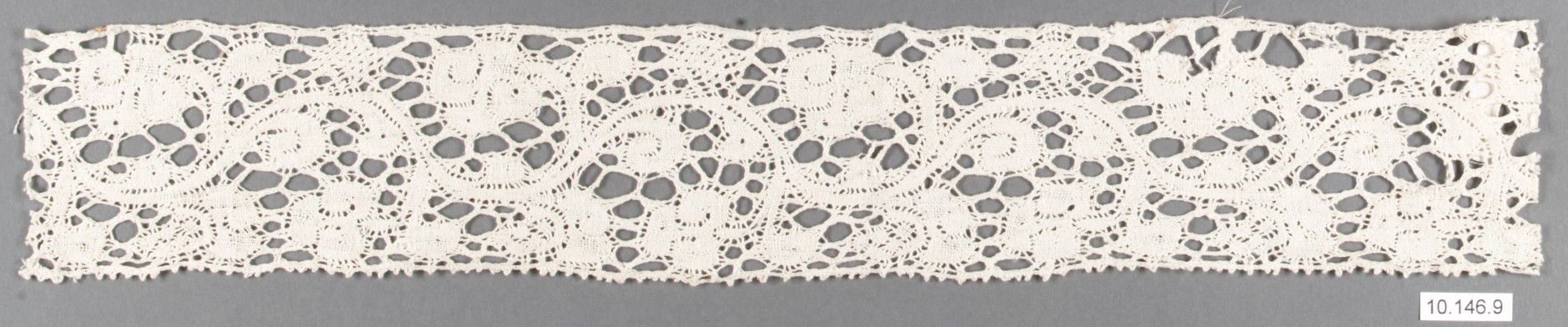
The best clue is to follow with your eyes a continuous line thicker than the threads of the net. In the 18th-century Flemish strip held by the Metropolitan Museum of Art, the dense curves stand out against large open spaces. Looking closer at the image reveals how a shift in visual weight organizes the repetition of the pattern, even though everything is done in the same light tone.
This profile should not be confused with a braid, a ribbon, or the foot used to sew lace to fabric. A braid is constructed by interlacing several threads and is usually a structural part; the foot occupies the joining edge; gimpInstead, it accompanies the motif and acts as its drawing line.
This thread demonstrates that the beauty of lace doesn't depend solely on accumulating difficult stitches. Sometimes, simply varying the thickness is enough to guide the eye and create depth. A flower becomes more recognizable, a curve gains vibrancy, and a delicate mesh no longer appears uniform.
When we find an old lace, we can play a game of finding its path. If a line circles the leaves, links the stems, and disappears again into the network, we're probably following the gimp: the small thread pencil with which the lacemaker draws within the lace itself.
© El Mundillo de Eva 2026