The tulle background: the hexagonal net that supports the bobbin lace
The tulle background: the hexagonal net that supports the bobbin lace
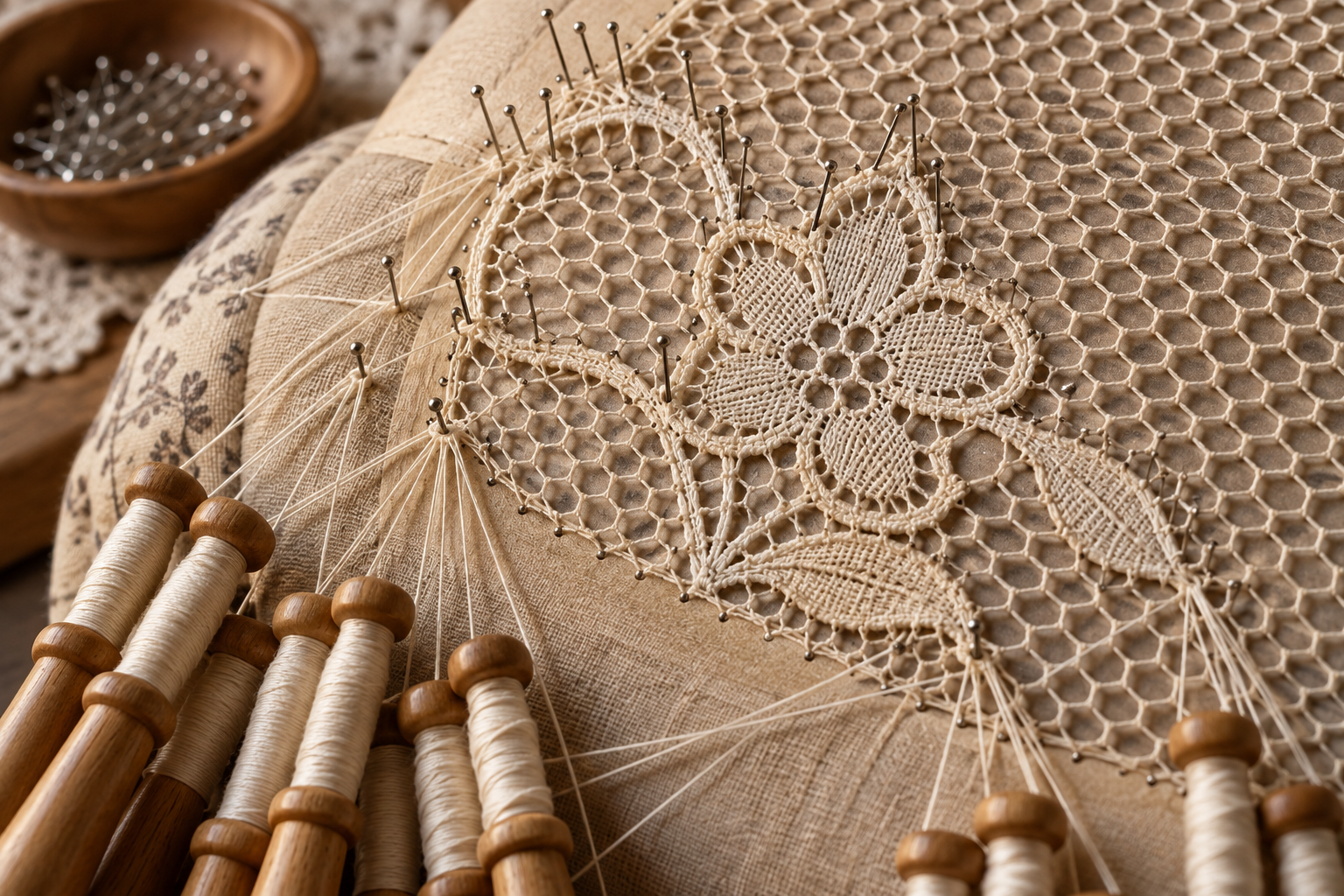
There are lace patterns that seem drawn in the air. The flowers, leaves, and ribbons are immediately recognizable, but between them remains a fine network that almost disappears when the piece is viewed from a distance. That space is not empty: it is the tulle backgroundA structure of small meshes supports the motifs and allows them to breathe. Its regularity is one of those understated wonders that reveal the patience and skill of a lacemaker.
In the vocabulary of lace, the ground fills the open spaces and holds together the denser parts. It can be compared to the soil in a garden: it rarely catches the eye at first glance, yet without it the flowers would be isolated. The tulle ground is recognized by its light appearance and by a succession of meshes, often hexagonal, that form a continuous and transparent surface.
The Textile Research Centre in Leiden describes Lille or tulle lace as a fine net that can be made by hand or machine. In handmade bobbin lace, this net is created by the orderly crossing and twisting of the threads. Each movement affects the next mesh, so maintaining the size and tension requires consistency. An area that is too tight shrinks the design; one that is too loose disrupts the visual rhythm.
To understand a piece of lace, it's helpful to distinguish three elements. The motif uses more thread and creates the visible shapes. The background opens up the space and connects them. In many laces, there's also a thicker thread, called a cord or outline thread, which defines flowers and ribbons. This edge reinforces the silhouette and helps the design stand out against the net without losing its lightness.
Mechelen lace offers a very clear historical example. This delicate Flemish tradition incorporated, from the beginning of the 18th century, a hexagonal background created simultaneously with the design and used an added cord to highlight the motifs. The overall effect is a beautiful balance: the lace appears ethereal, while the forms are clearly defined. Nothing is superfluous, but each type of thread serves a purpose.
When observing a background in progress, the bobbins don't all advance together. The pairs meet, cross, receive their turns, and continue to new positions indicated by the pins. The repetition may seem simple from the outside, but a regular lace depends on many details: the angle of the threads, the distance between the pricking points, and consistent tension throughout the entire piece.
That's why the background also tells the story of the work. Its small variations reveal the human touch, the change of direction, or the place where the lacemaker had to adapt to a motif. These aren't necessarily flaws. In a handcrafted piece, that slight irregularity can be a clue to how it was made and the time it took to grow.
The lightness of tulle quickly sparked the interest of industry. In 1808, John Heathcoat patented a machine capable of producing bobbin lace, a stable net that imitated the hexagonal background of bobbin lace. The invention transformed tulle manufacturing and allowed for the production of large surfaces onto which embroidery or other embellishments could then be added.
Distinguishing a handmade lace from a machine-made one requires experience and, sometimes, magnification. The Textile Research Centre points out that in certain continuous laces, the hand-woven background shows twists within the hexagonal structure, while the machine-made imitation has a different construction. Other differences can also affect the orientation of the edge, how it attaches to the body, and the appearance of both sides. No single clue is valid for all laces, but together they teach you to look more closely.
The next time you have a piece of lace in front of you, try placing it on a plain-colored surface and letting the light hit it from the side. Look at the whole piece first, and then get closer to the netting. Are all the stitches a similar size? Do they change when they surround a flower? Is there a border thread that separates the dense areas? Does the border belong to the same piece or does it look added on?
These questions transform a quick glance into a brief journey through the construction process. They also explain why a highly transparent piece might require as much lacework and concentration as a more compact one. The background isn't simply waiting time between one motif and the next: it's design, structure, and technique.
In bobbin lace, the most discreet details often hold a lesson. The tulle background demonstrates that lightness is constructed and that an almost invisible network can support the entire composition. When we learn to recognize its threads, the lace transforms before our eyes: we no longer see only the flowers, but also the carefully woven air that holds them together.
Sources: Textile Research Centre, lace terminology, Textile Research Centre, hand and machine lacemaking, Textile Research Centre, history of the bobbinet, Textile Research Centre, Mechelen lace y The Metropolitan Museum of Art, bobbin lace display.
© El Mundillo de Eva 2026