The lace of Lefkara: the white geometry that a village in Cyprus holds
The lace of Lefkara: the white geometry that a village in Cyprus holds
Some crafts appear to be drawn with a ruler, yet they are born from many hours of patience. In Lefkara, a village in the mountains of Cyprus, white thread is transformed into tablecloths, handkerchiefs, and small pieces brimming with geometric patterns. The tradition is known as lefkaritika and was inscribed by UNESCO in 2009. Its history speaks of influences, family learning and a community that has managed to preserve a craft without leaving it standing still.
La UNESCO fact sheet This places the origin of this lace-making tradition at least in the 14th century. Lefkara is located in southeastern Cyprus, in a mountainous area where stone houses and narrow streets are part of the everyday landscape. There, the work was not done in an isolated corner: it was done sitting together, in the street or under covered courtyards, while the women chatted.
That detail matters as much as the date. A craft may preserve its stitches, but it also preserves a way of being. In Lefkara, learning meant watching how the mother or grandmother worked, recognizing the pattern and repeating it until the hands found their own rhythm.
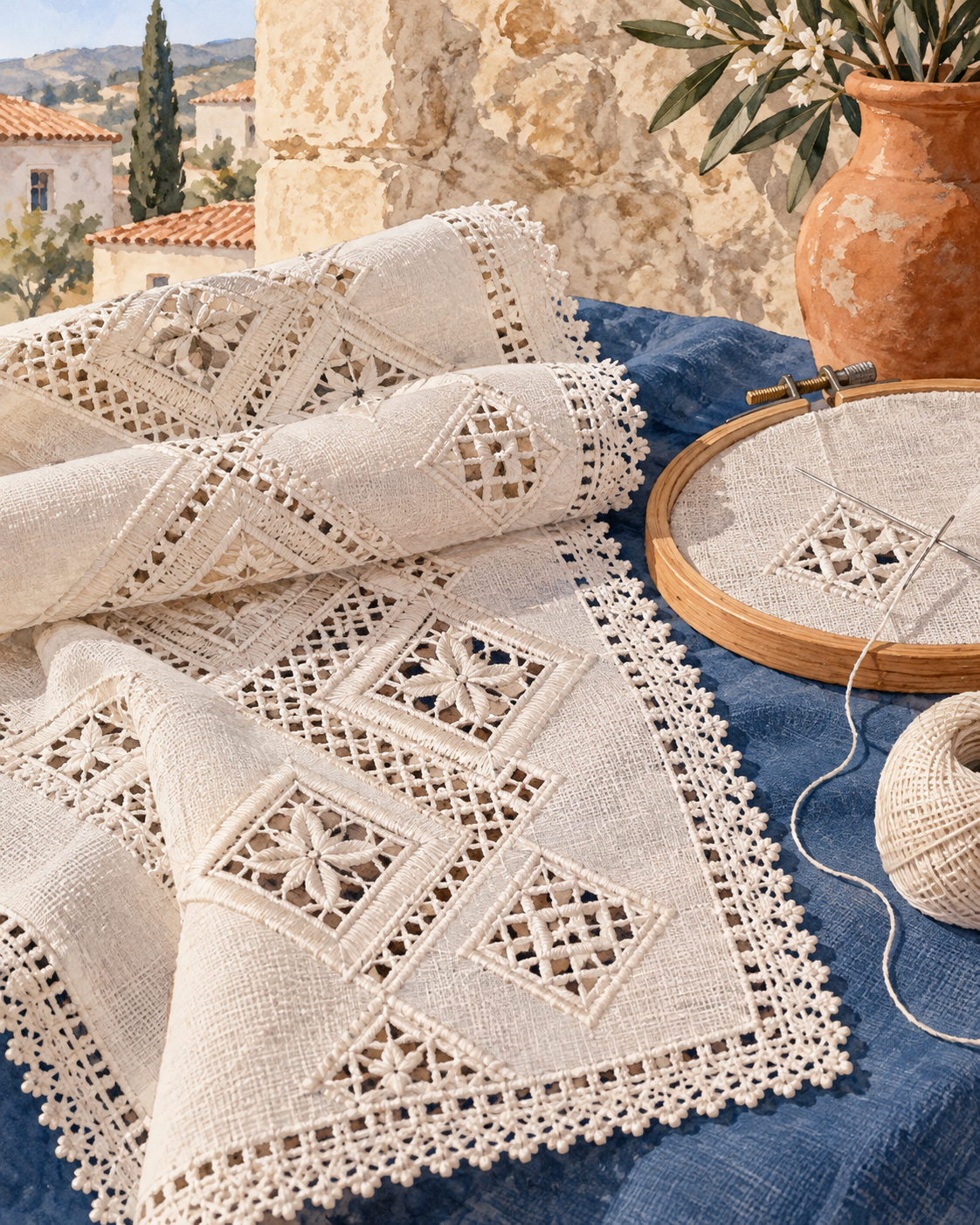
Lefkaritiko combines four main techniques: hemming, cutting, satin stitch fillings, and needlepoint edging. You don't need to be an expert to appreciate the result. Simply look at a piece and observe how dense areas alternate with open spaces, how a border organizes the composition, or how a small motif is repeated with variations.
UNESCO explains that the designs combine influences from local crafts, the embroidery of the Venetian courtiers who ruled Cyprus from 1489, and ancient Greek and Byzantine geometric motifs. This is not a haphazard mix. It is the way a community incorporates outside influences and transforms them into its own unique style.
That's why Lefkara lace has something of a map about it. On a napkin or a tablecloth, the memory of the Mediterranean, patterns learned at home, and the imagination of the lacemaker can all coexist. Each artisan starts from a recognizable tradition, but also adds a small personal touch.
The pieces are made with cotton thread on linen. The learning often begins with informal instruction: a child observes, asks questions, and tries things out. Later comes instruction from the mother or grandmother, who helps the child understand the order of each step. UNESCO itself describes this transition from daily life to formal learning.
This transmission explains why lacemaking is not just a technique. It's also a conversation between generations. As someone laces, they can recount who taught them, what piece they remember from their childhood, or what design they prefer. The pattern is preserved on paper, but the experience is stored in the voice and in the memory of the hands.
El Official Cyprus Tourism website She recommends visiting the Lefkara Handicraft Center, the Museum of Traditional Embroidery and Silversmithing, and the workshops where you can observe the artisans at work. She also describes the village as a place of winding streets, tiled roofs, and traditional architecture. It's an environment that invites leisurely strolls, exploring the spaces where the craft remains an integral part of local life.
Cyprus Tourism also mentions an annual Lefkara Festival in August, featuring music, dance, theater, and craft exhibitions. As dates and programs are subject to change, it's advisable to check the official schedule before traveling. The visit is greatly enhanced when one understands that the work is not merely a decorative souvenir, but a practice that continues to attract new audiences.
When we observe a lefkaritiko, we can begin with the simplest thing: looking for the rhythm. There are squares, lines, leaves, and small linen windows that repeat like a breath. Then we can ask ourselves which part is made with thread and which belongs to the base fabric. This calm observation brings us closer to the technique without turning it into a list of names.
We can also take this idea back to our own world. Each region has its own materials, designs, and teaching methods, but all require shared time. Lefkara lace reminds us that tradition isn't about exactly replicating an old piece. It's about learning enough to keep creating.
Perhaps that's why these white creations are so luminous. They let the light through the gaps, yet retain the mark of those who made them. In Lefkara, each stitch unites a house, a family, and a Mediterranean landscape. And when the thread is pulled taut again on the linen, the story finds another place to continue.
© El Mundillo de Eva 2026