Vologda lace: linen ribbons that depict the Russian winter
Vologda lace: linen ribbons that depict the Russian winter
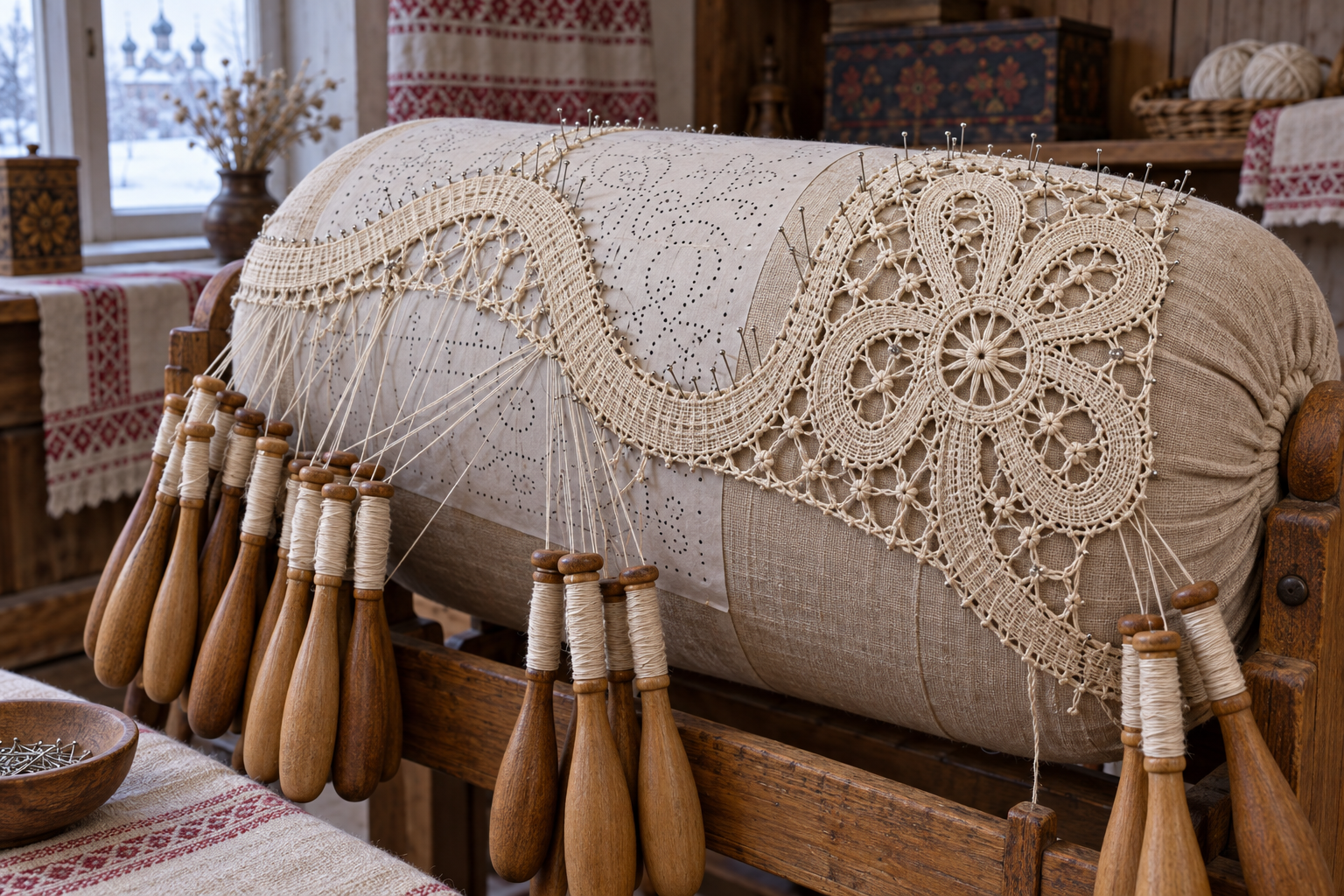
Some laces appear drawn with a ribbon in the air. In Vologda lace, a strip of linen advances, twists, and returns to form flowers, leaves, and sweeping curves. A delicate net holds the whole piece together. The result is both strong and delicate: a white lace with clean lines, born in northern Russia and now one of the country's most recognizable bobbin lace traditions.
The most striking feature of Vologda lace is its continuous ribbon. Instead of distributing the focus across a uniform mesh, the design relies on a denser band that meanders across the background. This ribbon outlines petals, stems, and medallions; the interior spaces are filled with braids and open links. A more pronounced cord can reinforce the outline and add volume to the motif.
El Cleveland Museum of Art She describes one piece from her collection as a continuous bobbin lace from Vologda: the ribbon forms vegetal and figurative motifs, while a braided background connects the lines. This combination allows the design to be read from afar and, upon closer inspection, reveals a second, much finer pattern.
The traditional material is linen, used in its natural color or bleached. Information from Vologda Lace Museum It is called "northern silk" because of its luster, strength, and flexibility. Cotton, silk, and metallic threads have also been used, but white linen remains associated with that frosted image that accompanies many pieces.
The motifs reinforce the connection to the landscape. Snowflakes, snow-covered fir trees, and frosted branches appear alongside flowers, birds, and plant arrangements. The museum notes that the lace has been compared to a melody and a frozen song. This isn't a technical description, but it aptly expresses its rhythm: the ribbon repeats and varies like a musical phrase.
Official Russian sources place the tradition at least in the 17th century. The Russian Museum holds early examples in gold and silver, while the earliest surviving linen pieces date from the turn of the 19th century. In 1820, a lace factory was established in Kovyrino, near Vologda, by the landowner V.A. Zasetskaya.
During the second half of the 19th century, the craft grew rapidly. In 1893, there were approximately 4.000 lacemakers in the province; by 1912, the number had reached around 40.000. Many learned from childhood. For some families, it was a steady source of income, and for others, a respected skill practiced at home. The lacework soon began to travel, receiving recognition at exhibitions in Philadelphia, Chicago, Paris, and Brussels.
The repertoire was not limited to flowers and birds. Russian museum It shows how, during the 20th century, artists incorporated airplanes, stars, tractors, and parachutes. Later, trees, fruit, and large poetic compositions made a strong comeback. The traditional technique thus served to convey new ideas without losing its sinuous line.
This change reminds us that lacemaking is also design. The lacemaker interprets a pattern, determines the tension, and guides the pairs of bobbins so that the ribbon maintains its width as it turns. When two parts must meet, the links maintain the structure without concealing the empty space. This interplay between dense areas and transparency defines its character.
In 2025, “Vologodskoye Kruzhevo” was entered into the International Register of the Lisbon System for designations of origin and geographical indications. Russian intellectual property agency She then highlighted its floral motifs on openwork backgrounds, the small nets, and the serrated edges. The protection recognizes that the name is linked to a specific place and body of knowledge.
Vologda also maintains a museum dedicated to lace, as well as competitions and gatherings that bring together new generations. To contemplate one of these pieces is to follow a path of linen: the ribbon guides the eye, the background adds air, and each curve preserves the memory of thousands of hands. That is why its white is not cold. It is full of movement, history, and life.
© El Mundillo de Eva 2026