Milanese lace: the baroque ribbon drawn with bobbins
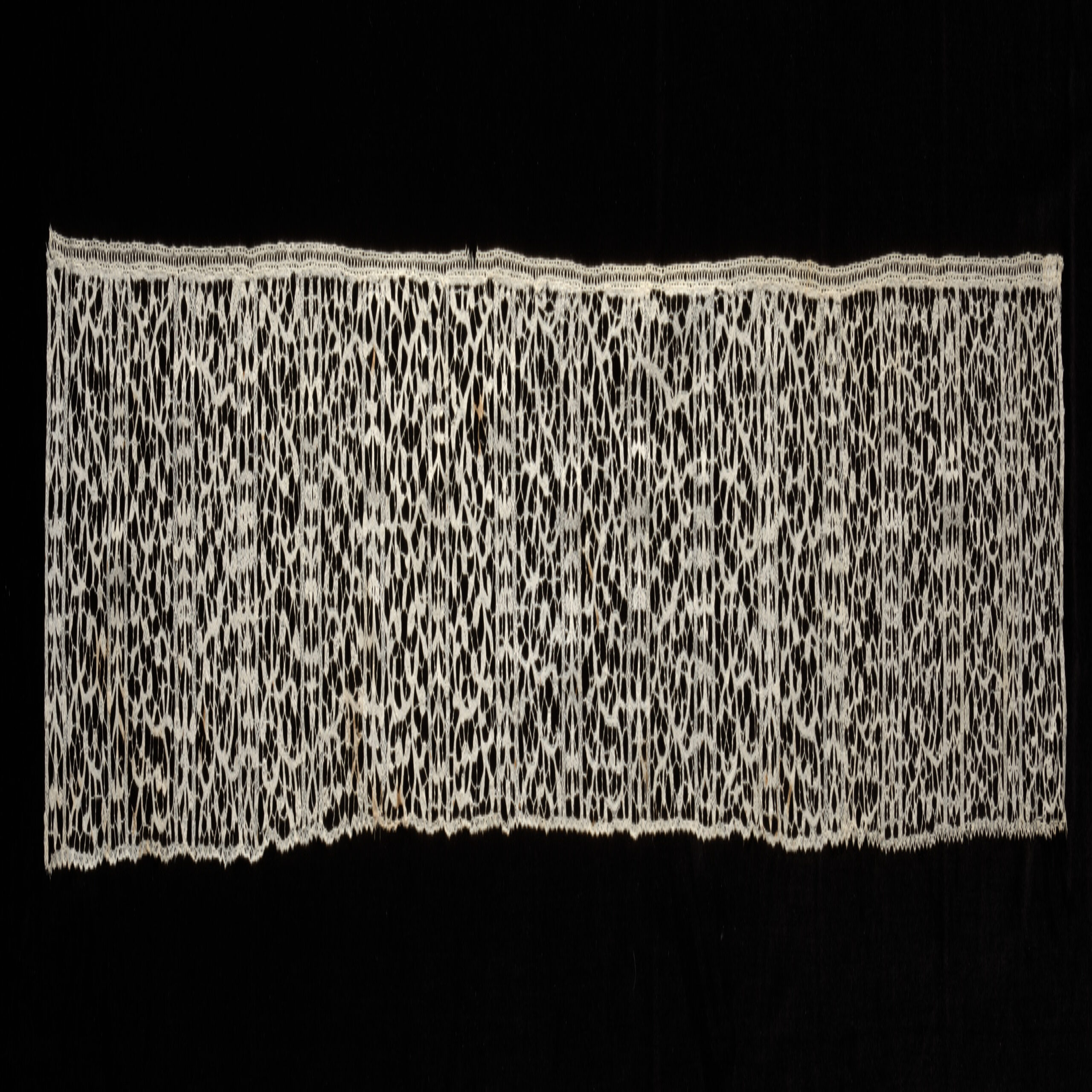
Milanese lace: the baroque ribbon drawn with bobbins
Milanese lace unfolds as if a linen ribbon had learned to walk. It widens, twists, forms a leaf, crosses over itself, and re-emerges as a stem. Around it appear light backgrounds, small braids, and fillings that balance the spaces. This combination gave rise to point di Milano an unmistakable presence among the Italian laces of the 17th and 18th centuries.
The star of the show is a narrow band worked in a fabric stitch. Instead of repeating a uniform grid, this band follows the contours of flowers, leaves, and scrolls. When it needs to change direction, the pairs of stitches are arranged around the curve; when the motif calls for more width, additional threads are added and the band can fan out.
El Powerhouse museum It preserves an Italian ribbon dated around 1740 that perfectly illustrates this construction. Two floral motifs are repeated as opposing images and originate from a continuous ribbon that folds, loops back, and crosses over itself. There is no seam between the layers at the points of intersection: the weaving itself resolves the join.
Milanese designs adapted to the Baroque taste for undulating forms. Stems grow in spirals, leaves curl, and flowers appear to move. The ribbon creates the visible skeleton, while the interior spaces receive lighter stitches. Thus, a single piece alternates between dense and transparent areas without losing continuity.
The Powerhouse steering wheel features half-stitch fills, spiderwebs, small woven leaves, and variations of braided backgrounds. The outer space uses a diamond mesh. Some pairs leave the tape to construct these backgrounds and then reintegrate them, a decision that requires planning the route well in advance of each turn.
One of the most captivating details appears when two sections seem to overlap. The lacemaker must maintain the visual flow of the path without creating an awkward bulge. The pairs that remain behind continue discreetly, while those in the foreground retain a clean edge. The result is reminiscent of a ribbon of fabric laid across a table, even though it is all constructed from thread.
This drawing style allows you to recognize the technique even in a fragment. It's best to follow the densest band with your eyes. If you can trace it for a considerable distance, passing through leaves and scrolls, you're looking at one of the keys to the Milanese style. The small backgrounds change, but the band holds the whole together.
Museum collections preserve examples attributed to Milan from the 16th and 17th centuries. Cleveland Museum of Art catalogs a large flounce from the 16th-17th centuries as bobbin lace Punto di MilanoIts design alternates stripes of stems, flowers and geometric motifs, a composition designed to complement a larger garment or fabric.
The Metropolitan Museum of Art holds Milanese borders from the late 17th and early 18th centuries. One of its edges of the 18th century It measures over a meter and a half in length. These dimensions remind us that lace was not used in isolation: it adorned sleeves, collars, cloths, and other objects where the movement of the body or the fabric made every curve visible.
The fabric-stitched ribbon offers a compact surface, but it doesn't work alone. Within the motifs, you might find half-stitches, small webs, spiderwebs, or elongated, leaf-like shapes. Each filling receives light differently. The fabric stitch appears solid; the half-stitch becomes softer; the braids allow the background to show through.
These differences help to separate petals and leaves without adding color. Everything can be done on light linen, and yet the drawing still has depth. The texture does the job that shadows would do in a painting.
To observe it, it's helpful to start with a wide curve and follow it until you discover where it narrows or incorporates new pairs. Then you can look for the crossings and see which section appears to be ahead. Finally, it's worth examining the backgrounds: a rhomboidal mesh, a braided area, or a denser filling explains how the void is supported.
It's also important to remember that historical names don't always serve as precise boundaries. Designs traveled, lacemakers adapted their techniques, and merchants used geographical designations to classify styles. Museum attributions, dates, and the technique used for each object offer a more reliable guide than an isolated label.
Milanese lace demonstrates how much a single ribbon can tell. Its design combines pattern and structure: it's not placed on top of the background, but rather emerges alongside it using the bobbins themselves. Each curve requires distributing the threads, measuring tension, and anticipating the next turn.
When we contemplate a finished piece, our gaze travels across it almost unconsciously. It follows a stem, circles a flower, and crosses a scroll. That sensation of movement is its most enduring secret: a lace that transforms the thread into baroque calligraphy.
© El Mundillo de Eva 2026