Ipswich: the American lace that came into Hamilton's hands
Ipswich: the American lace that came into Hamilton's hands
Among Alexander Hamilton's papers, something unexpected has been preserved: small strips of black lace made by women from Ipswich, Massachusetts. They arrived there as proof that the young American nation also knew how to transform thread, time, and skill into an industry. More than two centuries later, those samples continue to give names and textures to hundreds of almost anonymous workers.
It is not known exactly when lacemaking began in Ipswich. National Museum of American History It documents that by 1768 it already had enough value to pay for goods: a merchant noted that five yards of printed cotton would be paid for with lace made by a family over five weeks.
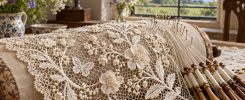
The work was done at home, in intervals that had to fit between family care and other obligations. Women and girls handled a cylindrical cushion filled with seagrass or straw, covered with linen woven at home. On it they placed a pattern of parchment or canvas-covered cardboard, stuck in pins, and crossed threads attached to simple bobbins of wood, cane, or bamboo.
In 1789, Congress commissioned Treasury Secretary Alexander Hamilton to conduct a survey of manufacturing in the newly formed United States. Reverend Joseph Dana compiled the data from Ipswich and, in January 1791, reported surprising activity: some six hundred people They made lace with varying degrees of dedication.
Between August 1789 and August 1790 they had produced 41.979 yardsThe work was valued at over 1.869 pounds, although transport and profit margins reduced the amount that ultimately reached the lacemakers. In a small town, this production represented a considerable economic contribution and confirms that it was not simply a domestic pastime.
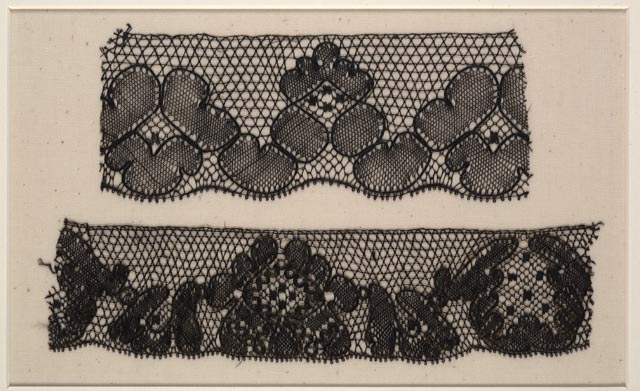
Dana sent thirty-six samples for examination: twenty-two of black silk and fourteen of white linen. She proposed that they then be sent to the president and his wife, although they were kept with Hamilton's correspondence. Library of Congress It preserves twenty-one of the black samples, made between 1789 and 1790.
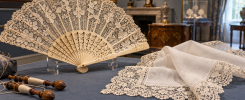
Ipswich lace was generally a narrow lace intended for cloaks, hoods, shawls, and other garments. Black silk created an elegant and practical embellishment on dark fabrics, while white linen offered a lighter look. The fine threads were probably imported from Europe, as local production had not yet reached the required quality.
The surviving pieces show continuous designs, with geometric motifs and backgrounds constructed using crosses and loops. A black border held by the Smithsonian uses what is called Kat Stitch The Parisian background is used, and the knitted background is reserved for specific fillings. The understated color allows the structure to be clearly seen: rhombuses, diagonals, and small shapes follow one another like textile writing.
The story takes on a face thanks to Elizabeth Lord Lakeman, born in Ipswich in 1767. Her cushion, bobbins, and pattern came to the Smithsonian through a great-granddaughter. Lakeman worked with them for much of her life; the work that remained on the cushion dates from around 1860, when she was already an elderly woman.
The pattern is large enough to encircle the cushion, which has a circumference of approximately 75 centimeters. This detail explains a characteristic of the work: by advancing a long lace strand, the pricking could wrap around the cylinder, allowing for continuous production. Brass pins were valuable, and materials were used sparingly, even covering the cushion with scraps of old clothing.
At the beginning of the 19th century, fashions changed and machine-made lace arrived. Ipswich tried to adapt with net factories in 1824 and 1828; some lacemakers decorated, mended, and washed these fabrics, but the businesses closed a few years later. The hand-making industry never recovered its former size.
However, the samples sent to Hamilton prevented that story from disappearing. Today, they allow us to reconstruct patterns and study specific stitches, but also to measure a collective effort that rarely left a signature. Each strip of black silk preserves more than just a design: it holds the hours that hundreds of women found amidst their other tasks to sustain a livelihood through bobbin lace.
© El Mundillo de Eva 2026