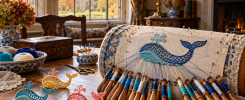
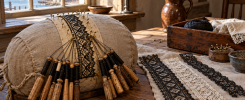
Honiton: Devon flowers made motif by motif
Honiton: Devon flowers made motif by motif
In Honiton, the lace flowers don't always start out as a single unit. They are first worked as small, independent pieces—a rose, a leaf, a fern, a bird, or a butterfly—and then brought together to form collars, veils, and scarves. This method of constructing the design has made the lace of this Devon region one of the most recognizable English styles.
Honiton lace is a fine, handmade bobbin lace. Although named after a single town, its historical production extended throughout East Devon. The Allhallows Museum in Honiton explains that accurate records exist from the early 17th century and that the name likely became established because the town was a major trading center and an important stop on the route to London.
There was never a large lace factory in Honiton. It was a cottage industry: many lacemakers worked from home, often to supplement the modest incomes of families who worked the land or the sea. Merchants and manufacturers distributed the orders, assembled the pieces, and took them to market. Behind every elegant adornment, therefore, was a network of patient labor spread across villages and homes.
Its most characteristic feature is the sprigA motif of a flower, leaf, or other figure is made independently. Several motifs are then sewn or linked onto a background to create a larger piece. This system allows the work to be divided among different lacemakers and enables the creation of very free designs, almost as if preparing a thread herbarium before arranging the plants on the page.
The Devon countryside offered a familiar repertoire. Wildflowers, branches, ferns, insects, and birds were all captured in the sketches with an increasingly naturalistic approach. In the 19th century, relief effects also appeared: raised petals, prominent veins, and tiny layers that added volume to the essentially white work. The result may seem fragile from a distance, but up close it reveals a surprising richness of texture.
In the oldest pieces, both the motifs and the background could be made by hand. This netting required many hours and increased the overall cost. With the arrival of machine-made netting during the 19th century, handcrafted motifs could be applied to a more affordable base. This combination helped maintain the visual appeal of the style, although mechanization also drove down the price of handwork and worsened the precarious situation of many lacemakers.
That's why it's important to look at each piece carefully. The word Honiton can describe lace entirely worked with bobbins, as well as compositions in which hand-stitched motifs are applied to a machine-made network. Its identity lies, above all, in these individual motifs and the way they are arranged, not in a single background design.
Honiton lace was already prized by wealthy customers in the 17th and 18th centuries, but it received a remarkable boost when Queen Victoria chose Devon lace for her wedding dress in 1840. The Metropolitan Museum of Art notes that this choice further enhanced its popularity in the mid-19th century. Veils, ruffles, collars, cuffs, and handkerchiefs were then adorned with intricate floral and creature designs.
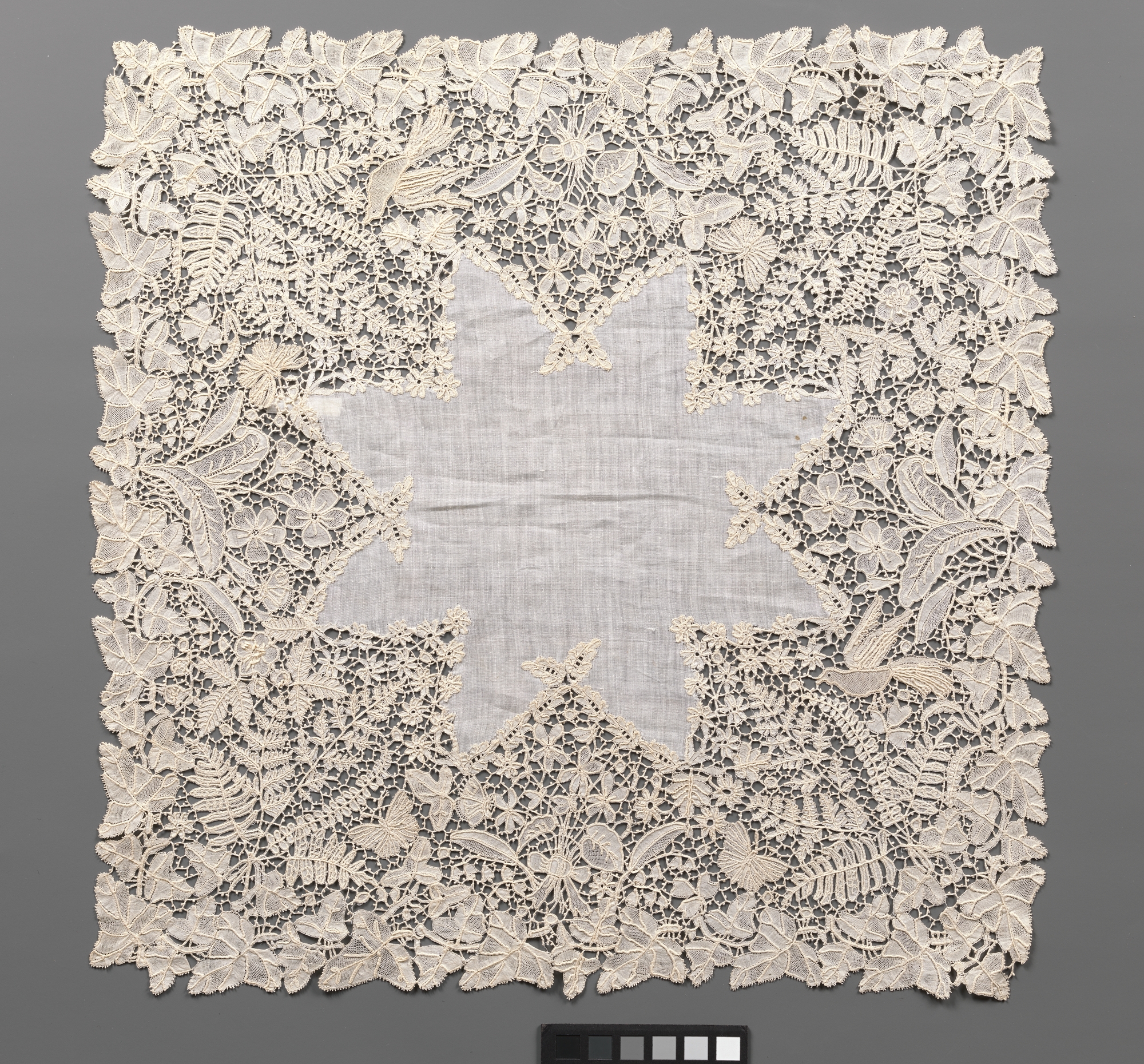
The historical piece accompanying this article is a handkerchief from the second half of the 19th century, possibly designed by Emma Radford, an award-winning lacemaker and designer from Devon. Made of linen and cotton, it combines naturalistic motifs with relief work. Its design allows us to understand how small fragments could form a complex surface without losing their individuality.
To recognize a Honiton, it's worth first looking at the outlines of each flower or animal. Then you can follow the connections between motifs, observe if any petals are raised, and compare the dense areas with the background air. In many works, the drawing seems to float; in others, the sprigs They are grouped together to form an almost sculptural scene.
The time required helps explain its value. Allhallows Museum estimates that a single square centimeter can take up to five hours, while a collar or a large scarf could take close to a thousand. Today, commercial production is very limited, but the technique remains alive among enthusiasts and associations. Each new motif repeats an old Devon gesture: looking at a flower, translating it into crosses and loops, and leaving it ready to join the others.
© El Mundillo de Eva 2026