Genoese lace: rosettes of thread born by the Mediterranean
Genoese lace: rosettes of thread born by the Mediterranean
Before Genoa became synonymous in our imagination with palaces, ships, and narrow streets opening onto the Mediterranean, its lacemakers were already transforming thread into wheels, leaves, and points of astonishing strength. Genoese bobbin lace found its own voice in the 16th and 17th centuries: geometric, bold, and elegant, capable of complementing the most sumptuous dresses without losing the artisanal flair of a trading city.
In Renaissance Italy, needle lace and bobbin lace developed almost simultaneously and influenced each other. Italian heritage research explains that lacemakers in Genoa drew inspiration from Venetian needle lace designs and sought to reproduce their effects with bobbins. It wasn't a simple copy: by changing the tool, the way the surface was constructed also changed.
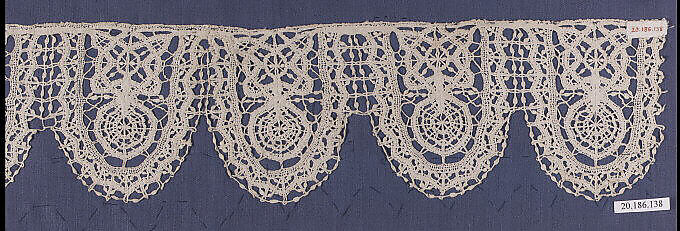
The result was guipure lace, created without a uniform net background, where the motifs are held together by links and denser woven sections. This structure gives Genoese lace a distinct presence. The shapes are legible from a distance, but upon closer inspection, tiny crosses, small openings, and textural variations reveal the painstaking work involved.
At the end of the 17th century, Genoa became famous for its rosoniLarge circular motifs, reminiscent of a flower seen from above or the stone rose windows of a church, were set within rounded points and used to adorn necklines, collars, and sleeves. Their design was distinctive enough to stand out against velvets, silks, and dark fabrics.
The collections of Genoa's museums preserve examples of these early rosettes, while pieces now held by other museums allow us to trace their journey beyond Italy. A 17th-century Genoese lace edging in the Metropolitan Museum of Art serves as a reminder that the work of the city's professional lacemakers was highly sought after throughout Europe.
Another characteristic detail is the armellettaThis technique compacts the threads to form small, seed-like leaves. These dense pieces are integrated into open compositions and help to establish a rhythm between circles, triangles, and links. They are not a decorative addition placed at the end; they arise from the bobbin lace's own movement.
Working with motifs like these requires planning where the pairs meet and where they separate. The design alternates between firm areas and empty spaces and needs consistent tension so that each wheel retains its shape. Therein lies much of its charm: the lace appears robust and architectural, even though it's made only of thread.
To read a Genoese piece, it's best to start at the center of each circle and follow the radii to the edge. Then the compact leaves and the small bridges that hold the whole together appear. This way of observing helps to distinguish the construction from mere decorative effect: each void has a function, and each dense area leads the eye to the next motif.
In the 17th century, lace was not solely for women's clothing. Collars, cuffs, and other trimmings were part of prestigious men's attire, and Genoese lace had a significant clientele among nobles and gentlemen. Rosettes framed the face and hands, two areas highly visible in portraits and at ceremonies.
Its widespread distribution speaks to Genoa's position as a port and commercial center. Threads, designs, and fashions traveled along the same routes as other valuable goods. A small piece could carry with it the knowledge of many women and present, in another European court, an image of refinement linked to Liguria.
Over time, Ligurian production changed. The Museums of Genoa indicate that during the 19th century, the work was concentrated mainly in towns on the Levante Riviera, such as Rapallo and Santa Margherita. There, bobbin lace coexisted with other renowned crafts of the region, including macramé.
Looking at a Genoese rosette today reveals an early and bold stage in the history of lace. Its circles don't try to disappear on the fabric; they proudly occupy their place. Between each wheel and each leaf lies the memory of hands that knew how to transform geometry into adornment and thread into a miniature Mediterranean architecture.
© El Mundillo de Eva 2026