Duchess Lace: a bobbin garden built flower by flower
Duchess Lace: a bobbin garden built flower by flower
Duchess lace resembles a garden suspended in mid-air. Its flowers and leaves don't rely on a uniform net covering the entire surface. Each motif is worked with bobbins, freely curved, and then linked with small braids, bars, or joining stitches. The result has relief, movement, and an almost sculptural presence that explains its success in 19th-century Belgian fashion.
Museum collections place the Duchess in Belgium, especially in Brussels and Bruges, during the second half of the 19th century. Her name also appears as Duchesse lace o Duchess laceMore than a single drawing, it describes a way of constructing lace using motifs made in parts.
El Sydney Powerhouse Museum It retains a Belgian border dated around 1865. Its technical data sheet identifies bobbin lace flowers worked with variations of fabric stitch, half-stitch reliefs, contour threads, and raised areas. This combination helps to understand why the surface seems to change when the light hits it from the side.
In continuous lace, the same pairs of stitches run through both motif and background as the work progresses. In Duchess, the flowers, leaves, and ribbons can be worked as separate units. They are then arranged according to the overall design and connected where needed. Empty space is an active part of the composition.
This freedom allows each petal to be oriented in the most flattering way. A leaf can be tilted, a ribbon twisted, and a flower placed in the center without all the threads having to pass through the entire piece. The lacemaker manages smaller groups of bobbins, but needs to imagine from the beginning how each fragment will fit into the whole.
The motifs are joined by small bars, braids, and almost invisible stitches. Some connections are straight and discreet; others become part of the design with loops or picots. The joining must be firm without sacrificing lightness, as a bridge that is too tight would distort the flower, and a loose one would leave the lace unstable.
The finest pieces feature raised details created with guide threads, rolled seams, and thicker stems. These details visually separate the different shapes. On dark velvet, the white curves are easily discernible; on a light-colored fabric, the volume becomes softer and more elegant.
A particularly refined variation is the Duchess of Brussels. It can incorporate floral centerpieces and small details made with needle lace. National Museum of American History Describe, for example, a Brussels Duchess style border with bobbin lace structure and needlepoint floral centers.
It's not about hiding one technique inside another. Each contributes what it does best: bobbins create leaves, ribbons, and curves with relative speed; the needle fills tiny spaces with very fine stitches. The combination transforms lacemaking into a conversation between tools.
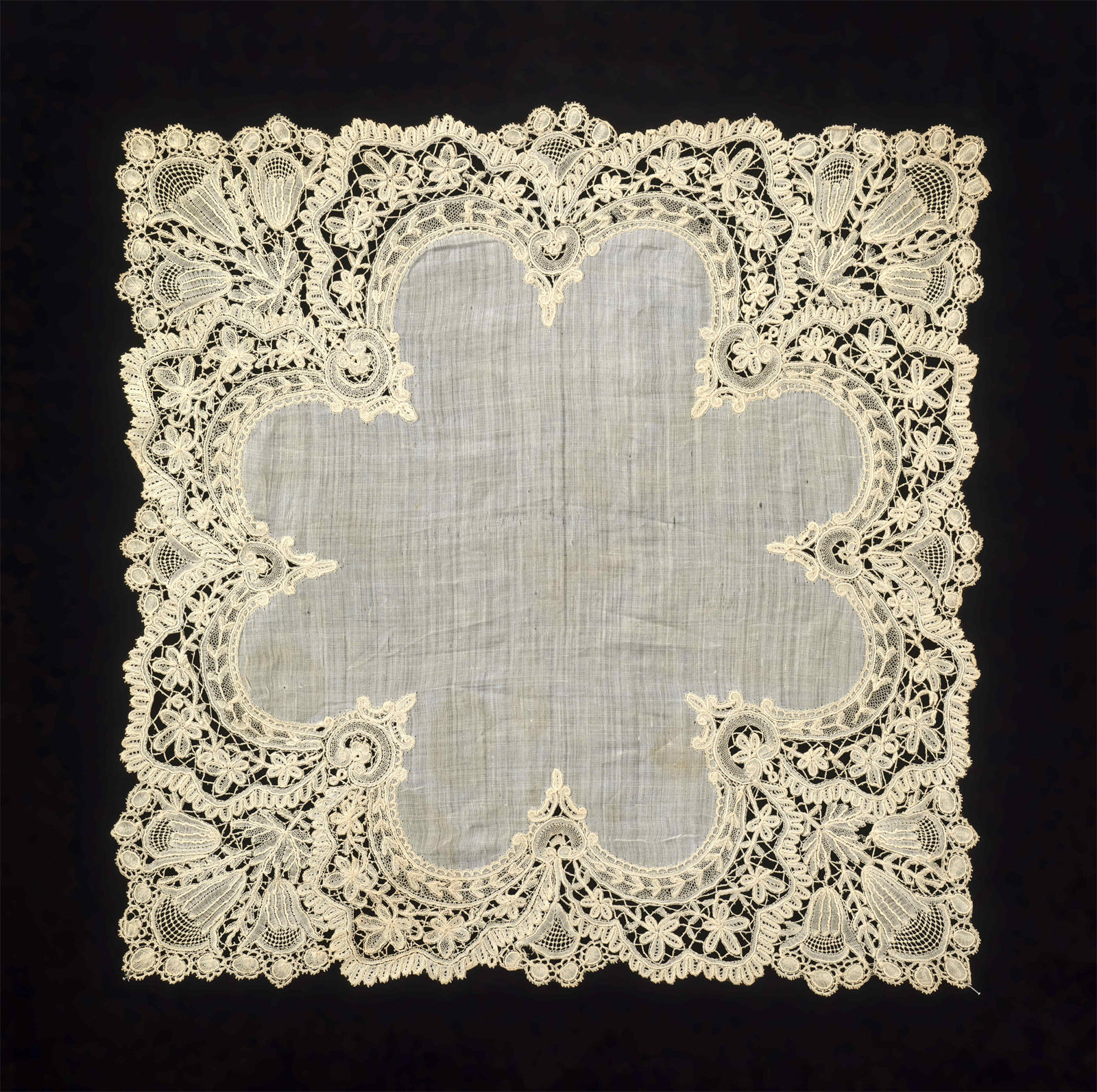
The Duchess adapted well to 19th-century embellishments. Her motifs could be arranged around a corner, follow a curve, or grow to form a collar. The Metropolitan Museum of Art holds a Belgian handkerchief from the last quarter of the 19th century whose edge demonstrates that ability to fit into four corners without losing visual continuity.
The piece surrounds the central linen with large flowers and leaves, connected by open bridges. Each corner concentrates the design and, at the same time, leads it to the next side. It is a lesson in composition: the lace was designed for a specific object, not cut from a repetitive strip.
To begin, look for large flowers with well-defined shapes and no regular grid extending across the entire piece. Then, trace the small connections between motifs. If some floral centers feature different stitches, there may also be needlework involved.
The reverse side offers another clue. There, the seams that join the pieces are more visible. They are not a defect: they are part of the construction method. The neatness of these joins indicates the skill of the person who assembled the piece and explains why a well-made work appears to have been created in a single, precise moment.
The Duchess notes that bobbin lace doesn't always progress as a continuous band. It can also be composed like a bouquet, motif by motif, until the gaps are balanced. Its beauty lies in this arrangement: dense flowers, delicate leaves, small bridges, and needlework details that support one another.
Looking at it up close changes the first impression. What seemed like a spontaneous decoration reveals a work of planning, adaptation, and stitching. Each fragment retains its personality, but only finds its final place when joined with the others.
© El Mundillo de Eva 2026