Continuous lace and piece lace: two ways to construct a lace
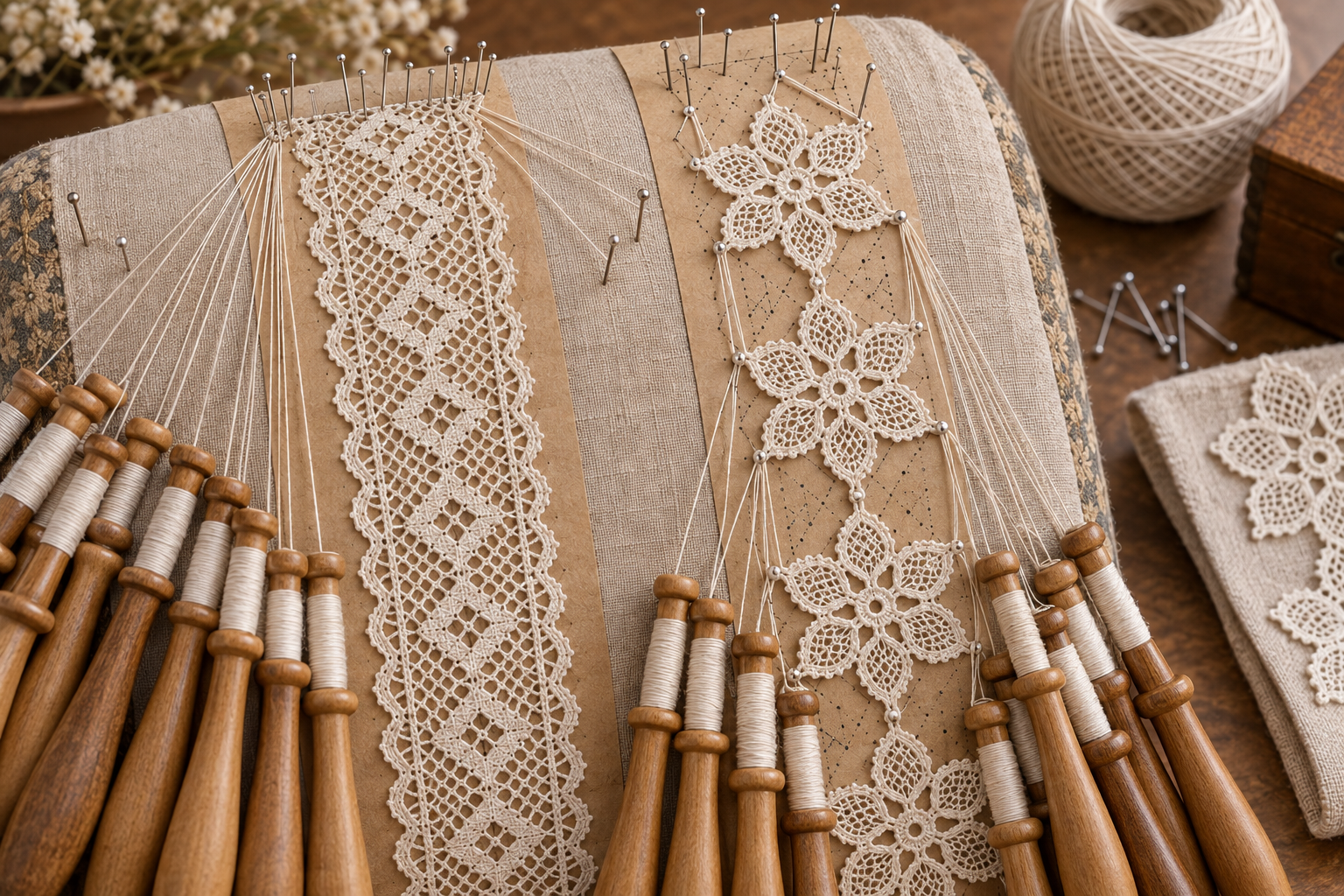
When we look at a finished piece of lace, we usually focus on the design: a flower, a leaf, a wavy border, or a very fine net. However, before that motif appears, there's a construction decision that completely changes the way the work is done: will it all be done in one go, from beginning to end, or will separate motifs be created and then joined together? This difference allows us to understand two main ways of organizing bobbin lace and helps us to better read the patterns.
In continuous lace, the piece is formed in an uninterrupted sequence. The lacemaker begins at one end and, following the pattern, keeps the pairs moving as the band grows. The design may alternate backgrounds, braids, leaves, and other figures, but the work maintains a material continuity: each section builds upon the previous one.
This method of working has a beautiful practical consequence. The border and the background are worked simultaneously, so the tension must remain balanced throughout. If one stitch is too loose, the unevenness can spread to the next; if it's too tight, the lace loses its shape. That's why the rhythm of the hands, the placement of the pins, and the reading of the pricking pattern are just as important as the repertoire of stitches.
Continuous bands are very versatile. They can be used as lace edging for a sheet, towel, or garment, or they can also form part of a larger piece. Upon completing a section, the lacemaker can repeat the module, change the finishing touch, or adjust the length without losing the overall aesthetic. The pattern acts as a guide, indicating where the pairs intersect, turn, or twist.
In non-continuous lace, also called piece lace in some contexts, the decorative elements are made independently. A leaf, a flower, or a bouquet is worked on its own pattern and then placed alongside other motifs. The pieces can be joined using small bars or bridges, a background net, or by sewing them onto a base that holds them in place.
The feeling while working is different. Each motif has a clearer beginning and end, allowing you to concentrate on its outline and internal details. Once the piece is finished, you check how it fits with its neighbors: the distance between leaves, the direction of the stems, and the remaining space are all part of the design. Here, the composition is like assembling a small string garden, where each flower must find its place.
The joints serve both a technical and an aesthetic function. A bridge that is too long can leave the motif loose; one that is too short can make the whole feel lighter. The background mesh, when present, distributes the tension and creates a transparent surface. Therefore, the joints are not a secondary addition: they enable individual pieces to behave as a complete unit.
A simple clue is to follow the thread with your eyes. In a continuous band, the edges of the motifs are usually integrated into an uninterrupted path. In a piece made up of individual sections, you'll notice changes in direction, small bridges, or areas where the background supports the decorative elements. It's not always easy to distinguish this in an antique piece, because the finish can hide the joins, but the reverse side and edges often offer clues.
The way the work is repaired or preserved also changes. If a continuous band breaks, it may be necessary to reconstruct a section, respecting the sequence of the design. In patterned lace, sometimes it's possible to work on a specific piece or replace a damaged joint. In both cases, it's important to work carefully, observe the original thread, and avoid tension that could distort the piece.
The concept of "lace" doesn't involve two rigid categories that exhaust the variety of lace. Between them lie mixed solutions, local adaptations, and traditions that use different names to describe similar constructions. The important thing is to understand that design doesn't reside solely in the pattern: it also lies in the path the pairs follow and in the way the motifs support one another.
The next time you have a lace pattern in front of you, look for that path. Ask yourself if the work unfolds like a ribbon that never stops, or if it gathers small shapes delicately joined together. That perspective transforms each lace pattern into a map of decisions, patience, and skill. And when you return to the cushion, perhaps you'll read the pattern with different eyes: not just as a collection of stitches, but as the tiny architecture that allows the thread to become lace.
Sources: TRC Leiden, Introduction to Bobbin Lace y SFO Museum, Lace: A Sumptuous History.
© El Mundillo de Eva 2026