Cogne lace: bobbin lace without patterns in the heart of the Alps
Cogne lace: bobbin lace without patterns in the heart of the Alps
In Cogne, a village in the Italian Alps surrounded by the mountains of Gran Paradiso, lacemakers work with a surprising aid: memory. Their lace is created without a pattern pinned under the needles. Their hands recall the order of the crossings, the learned shapes, and the path the thread must follow. This is how the art is preserved. Cogne lace, a bobbin lace tradition intimately linked to the landscape and life of this corner of the Aosta Valley.
Local tradition places the origin of lacemaking with the arrival of Benedictine nuns from Cluny. Sources do not entirely agree on the date: the page dedicated to Cogne's pizzo It speaks of the 16th century, while the information in the permanent exhibition mentions 1665. Both explain that the technique was later passed on to the women of the valley and incorporated into traditional clothing.
What is most extraordinary is not only its antiquity, but the way it was passed down. For generations, it was taught from mother to daughter through observation and direct practice. There was no manual that could replace the hours spent at the lace-making cushion. Each new lacemaker learned the rhythm, proportions, and motifs by watching someone else work, repeating until the technique was ingrained in her hands.
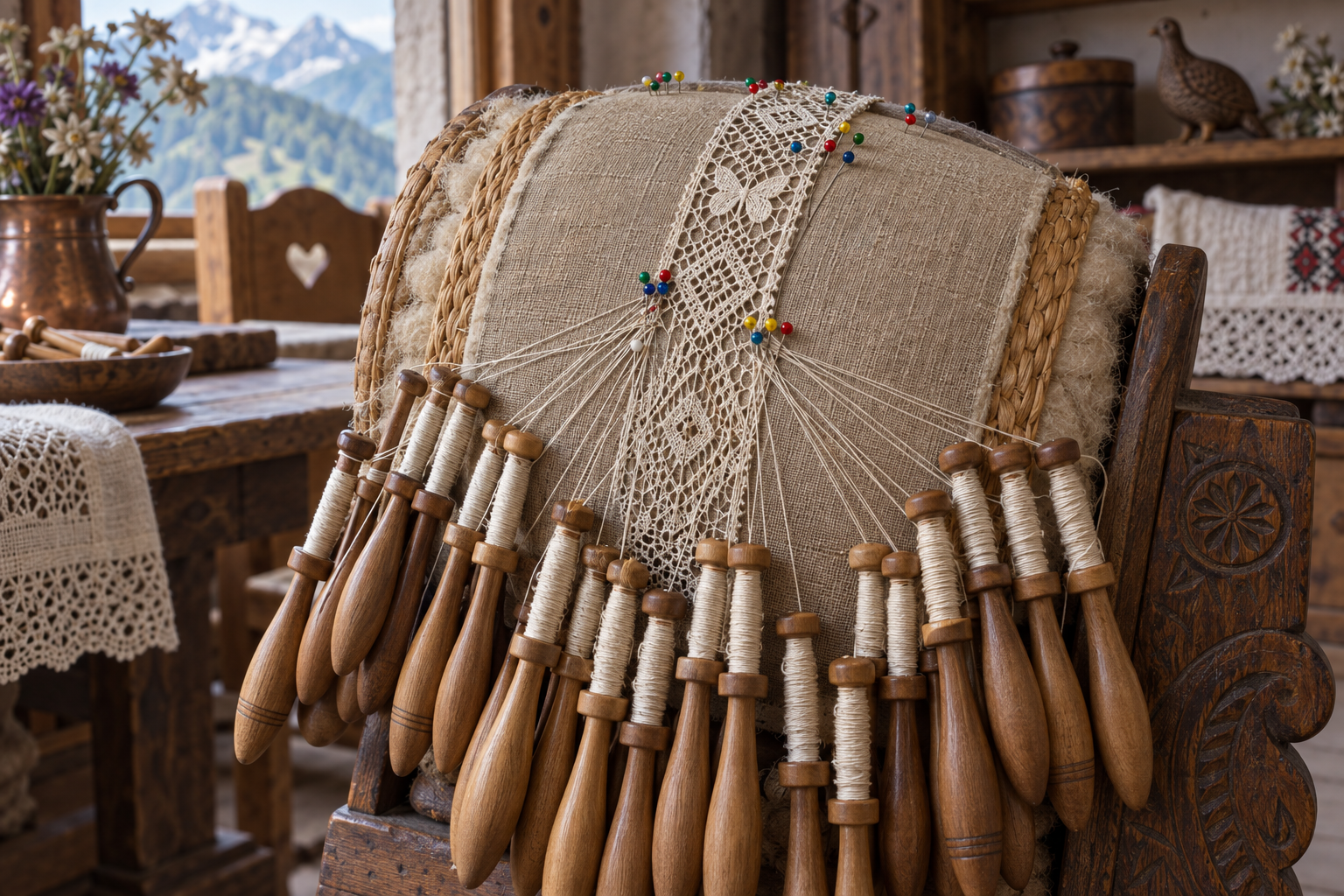
In much of bobbin lace, the pricking acts as a map: it marks where to place the pins and helps preserve the design. In Cogne, however, the lacemakers construct the motifs from memory, without a cardboard template. Pins with multicolored heads hold the work in place, but the sequence lives on in the knowledge of the one who interlaces the threads.
This system doesn't mean improvising without rules. It demands a very deep understanding of the structure. The lacemaker must anticipate the width, maintain the tension, and remember when a pair crosses, twists, or changes direction. She can also introduce small variations. That's why each lace pattern belongs to a common tradition and, at the same time, retains a personal touch.
The traditional team has an unmistakable presence. permanent exhibition of Cogne lace describe the coesseinA circular cushion filled with straw and wool. It rests on the cavalot, a small piece of carved wooden furniture that may bear a rosette, the monogram of Christ, the year of manufacture and the name of its first owner.
These details transform the tool into a familiar and personal object. The stand witnesses many hours of work and can be passed down from one generation to the next. Numerous bobbins with linen thread are arranged on the cushion. Its color is usually the natural tone of raw linen, although sometimes it is bleached to obtain a lighter lace.
Although the technique may have arrived from elsewhere, the stitches acquired a local vocabulary. Among the names collected by Aosta Valley Tourism are teppa cleire, the “clear land”; joue de perni, the “partridge eyes”; and pavioula, the “butterfly”. These are expressions that bring lace closer to the ground, animals and small scenes of the alpine environment.
The width of the piece depends on the number of bobbins: the more bobbins involved, the wider the band can be and the more complex it is to maintain order. The stylized forms of flowers and animals are repeated faithfully enough to be recognizable, but without the rigidity of a template. Therein lies much of its character.
The Les Dentellières de Cogne cooperative keeps this tradition alive and brings together dozens of lacemakers. Their shop on rue Docteur Grappein displays and sells handmade lace. Regional tourist information recommends checking directly for opening days outside of the advertised season—a useful precaution when planning a visit.
La Cogne lace It reminds us that a pattern can be preserved in another way. Instead of being fixed on paper, it travels in the voice, the gaze, and the repeated gesture. Each lace stitch is an exercise in shared memory: a linen line that links today's lacemakers with those who, centuries ago, learned the same movements at the foot of the Alps.
© El Mundillo de Eva 2026