Appliqué lace: handmade flowers on a machine-made net
Appliqué lace: handmade flowers on a machine-made net
In the mid-19th century, some lace flowers began to grow on an unexpected surface: a machine-made net. It wasn't a simple industrial imitation. The leaves and bouquets were still created by skilled hands, with bobbins or needles, but then they were sewn onto a regular tulle. This is how Brussels appliqué lace developed, a hybrid solution that changed the timing, price, and scale of the pieces.
In continuous lace, the design and background are worked together on the cushion. In piecework lace, the motifs are worked separately and then joined using bars or a hand-woven net. Appliqué introduces another possibility: placing these individual flowers on a finished background and securing them with tiny, almost invisible stitches.
The Sydney Powerhouse Collection dates the expansion of bobbin and needlework motifs applied to machine-made tulle to around 1840. The technique was particularly associated with Brussels and was also used in Honiton for large garments. It saved a tremendous amount of work in the background without sacrificing relief or the richness of the ornamental details.
The machine could produce meters of netting with unparalleled regularity, while the lacemakers focused their time on petals, leaves, ribbons, and stems. Then, a composition was created, assembling the motifs onto the tulle. The result allowed for the creation of ruffles, veils, shawls, or flowing dresses with designs that were both dense and delicate.
This division of labor did not eliminate manual dexterity. Each motif required a precise stitch, a careful selection of stitches, and meticulous tension control. Furthermore, the pieces had to be arranged rhythmically, adapted to curves and corners, and sewn together without the joining thread dominating the design. The mechanical netting was the stage; the flowers remained the protagonists.
At first glance, it may seem that all lace originated at the same time. Closer observation reveals the differences. Tulle displays a very uniform mesh; the motifs feature areas of linen stitch, half stitches, thicker outlines, and small raised details. Discreet stitches may appear along the edges of the flowers, securing them to the background.
A Belgian border from around 1850, held by the Powerhouse, combines bobbin lace floral garlands with a machine-made network of diamonds. The denser stitches create highlights and shadows, some outlines are reinforced with thick thread, and the surface includes small raised details. Even the straight foot of the lace was machine-made. The piece measures 44,5 centimeters long by 8,5 centimeters wide: a small catalogue of technical collaboration.
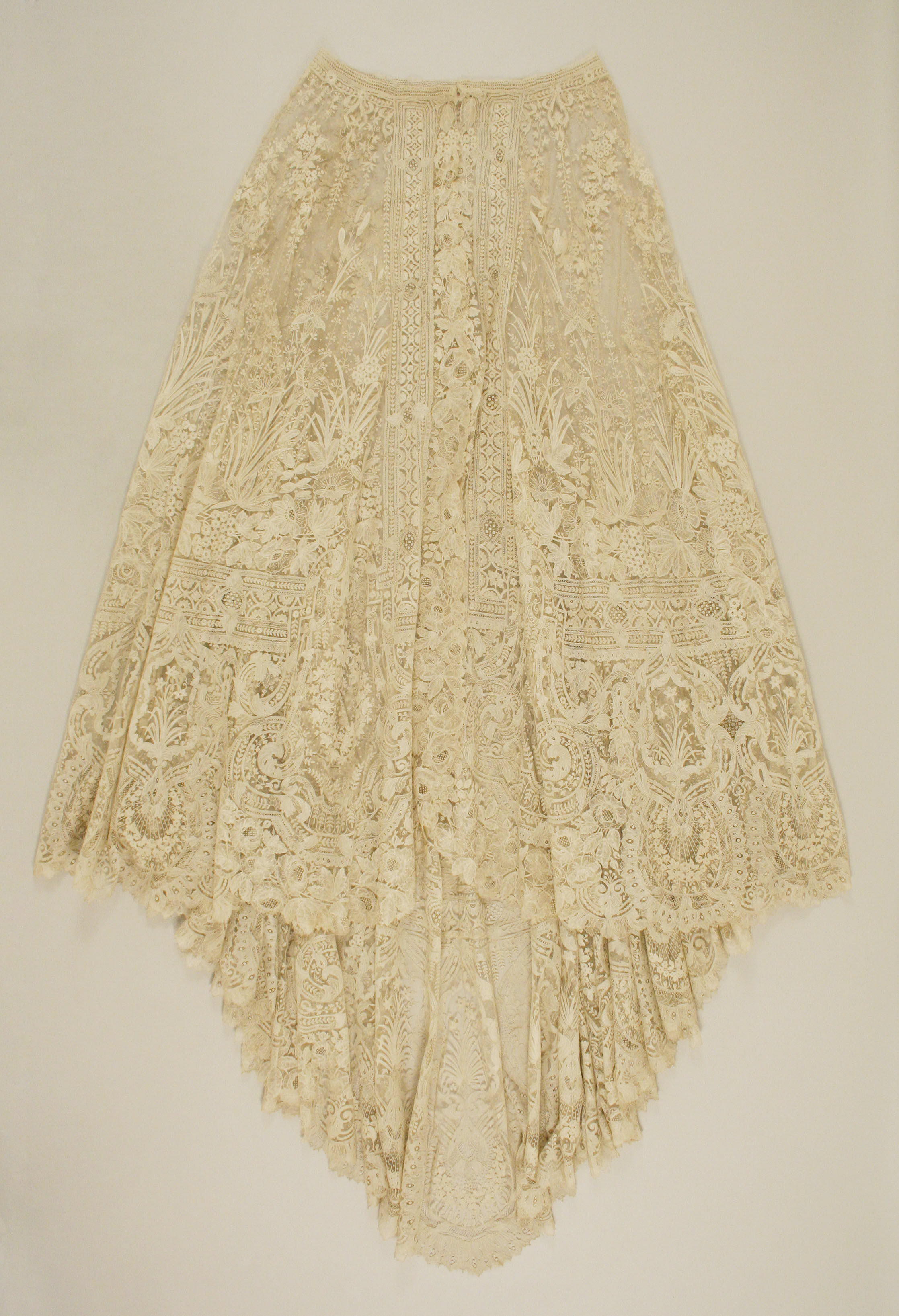
The Metropolitan Museum of Art houses a late 19th-century Brussels skirt that combines bobbin lace and needle lace. Point de Gaze and mechanical tulle. The front part measures 109,2 centimeters and the tail reaches 158,1. On the clear net unfolds an abundant composition of flowers, vertical stripes and symmetrical motifs.
Its size helps illustrate the system's advantage. Working on that entire background by hand would have required many more hours. The tulle allowed the artist to conserve energy for the areas that would attract attention. At the same time, the combination of techniques made it possible to achieve different textures within a single garment.
During the 19th century, mechanization transformed the textile market. Machines produced increasingly complex nets and designs, and many lacemakers lost part of their work. Apps offered an intermediate response: they took advantage of industrial speed but preserved a space for artisanal knowledge and the specialization of different workers.
This combination presents conservation challenges today. The tulle can weaken under the weight of the motifs, the appliqué seams can come loose, and each material ages differently. When storing a piece, it's best to support the entire surface and prevent the flowers from pulling on a fragile net.
The appliqué lace reminds us that the history of bobbin lace didn't progress through a simple substitution of machine for hand. There were adaptations, partnerships, and ingenious solutions. A regular net and a meticulously crafted flower could be found on the same skirt. Viewing them together allows us to appreciate both the industrial precision and the small human decisions that still bring the design to life.
© El Mundillo de Eva 2026