Cluny: the French guipure that turns braids into architecture
Cluny: the French guipure that turns braids into architecture
Some laces seem to float, while others stand with an almost architectural certainty. Cluny lace belongs to this latter group. Its braids trace firm paths, the open spaces allow the design to breathe, and small, pointed leaves add rhythm to the work. It is a bobbin lace that is easy to recognize once you learn to observe its structure.
Cluny lace is a bobbin lace technique worked continuously. This means that the motif and the joins are worked together on the same cushion, without a separate background mesh. The different sections are linked by braids, bars, and joining points, so that the gaps also form part of the design.
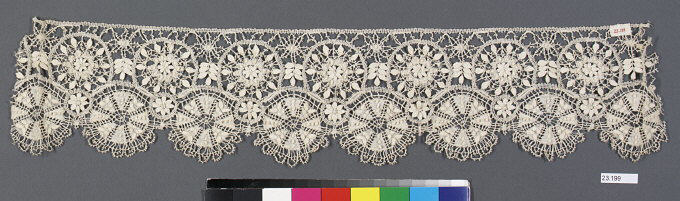
In contrast to the airy delicacy of tulle, Cluny lace typically uses a more visible linen thread and has a more robust appearance. Its patterns combine geometry, wheels, fans, and stylized plant forms. Among its most beloved features are the narrow, pointed leaves woven in multiple pairs, known to many lacemakers as guipure leaves or tallies. They radiate from centers and curves like small ears of wheat.
This construction gives it presence without making it heavy. A border can alternate very compact areas with large openings and still maintain a stable edge. The result works especially well on pieces that need to show the design from a distance: collars, cuffs, shawls, tablecloths, or parasol decorations.
Despite its name, the style we now recognize as Cluny lace was established in France during the 19th century. It is primarily associated with the Le Puy-en-Velay region, a major lace-making center, and also with Mirecourt. The name refers to the renowned Cluny Museum in Paris and the revival of antique designs that fueled the historicist taste of that era.
This story should be approached with caution: the name evokes the Middle Ages, but the modern style is not simply medieval lace preserved unchanged. Nineteenth-century decorative arts looked enthusiastically to the past, studying collections and reworking historical repertoires. Cluny transformed this inspiration into patterns suitable for the production of its time.
Its style spread quickly. Besides France, it was used in English lacemaking regions and eventually became part of the international repertoire of bobbin lace. It shares a structural family with other braided guipure laces, such as certain laces from Le Puy, Bedfordshire, or Malta, although each tradition maintains its own proportions, motifs, and ways of arranging the pairs.
The first clue is the absence of a regular mesh covering the entire background. Instead, braids appear, jumping from one motif to another. The second lies in the contrast: tightly woven areas alongside large, well-defined gaps. Then come the wheels, the geometric teeth, and those long leaves that resemble grains of wheat.
It also helps to observe the texture of the piece. The linen defines each line and creates a more pronounced relief than very fine silk lace. Even in a photograph, the border appears substantial, which explains its excellent performance as a edging and its use in clothing accessories.
The Metropolitan Museum of Art holds a French border from around 1850 made of linen and bobbin lace. It measures approximately 45,7 centimeters long by 10,2 centimeters wide. It features repeated medallions, flowers, and fans joined by braids, a composition that allows the viewer to follow the rhythm of the pattern almost like a musical phrase. The museum also holds a large square Cluny shawl from the 19th century, proof that this technique could be developed far beyond a simple lace border.
Working in Cluny lace requires understanding which pairs build up, which ones travel, and where a joint needs reinforcing. The leaves require controlled tension so they are full, pointed, and similar to one another. The braids must maintain a constant width, while the crosses must hold the work together without closing the spaces provided by the design.
Perhaps therein lies its charm. The Cluny lace doesn't conceal the threads; it makes them the protagonist. Each bar explains how the whole is held together, and each gap reminds us that, in lacemaking, even emptiness is designed. To look at it closely is to discover a small, flexible architecture, constructed with bobbins, patience, and an admirable economy of means.
© El Mundillo de Eva 2026