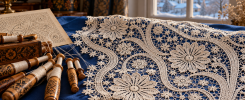
Château-d'Œx 2026: bobbin lace comes to life amidst the Swiss mountains
Château-d'Œx 2026: bobbin lace comes to life amidst the Swiss mountains
In Château-d'Œx, bobbin lace takes center stage in the Alpine autumn. The Musée du Pays-d'Enhaut opens its demonstration room on several Fridays in October and December 2026, allowing the public to watch the region's lacemakers at work. It's a simple and engaging experience: stepping into the world of lacemaking, listening to the sound of the wood, and discovering how the threads are gradually transformed into lace.
The next demonstrations are scheduled for Fridays, October 9, 16, 23, and 30, and Fridays, December 4, 11, and 18. All will take place from 14:00 PM to 17:00 PM. There will be no sessions in November because the museum is closed for its annual shutdown—an important detail for anyone planning a trip.
The activity takes place at the Musée du Pays-d'Enhaut – Centre Suisse du Papier Découpé, located at Grand Rue 107, 1660 Château-d'Œx. The tourist guide does not indicate a specific fee for the demonstration, so it is advisable to check admission conditions and any last-minute changes directly with the museum by phone at +41 26 924 65 20 or by email at info@musee-chateau-doex.ch.
The exact date when bobbin lace began in the Pays-d'Enhaut is unknown. Material evidence of this craft emerged in the attics of old houses, where patterns for fine lace and black caps were preserved on cardboard. These small traces allowed for the recognition of a craft that had been part of local life, even though it had left hardly any written records.
At the beginning of the 20th century, when the craft was in danger of disappearing, several lacemakers founded the Association des Dentellières du Pays-d'Enhaut. They revived old designs and also created their own models, giving the craft a continuity that did not depend solely on repeating the past. In 1976, with the association once again weakened by a lack of new members, Anne Rieben took up the mantle.
The initiative had repercussions beyond the valley. After an initial meeting held in Château-d'Œx in 1982, a Swiss federation of lacemakers was founded. Today, around fifteen members of varying ages continue the craft in the Pays-d'Enhaut region, presenting it as a vibrant art form, open to contemporary designs and new learning.
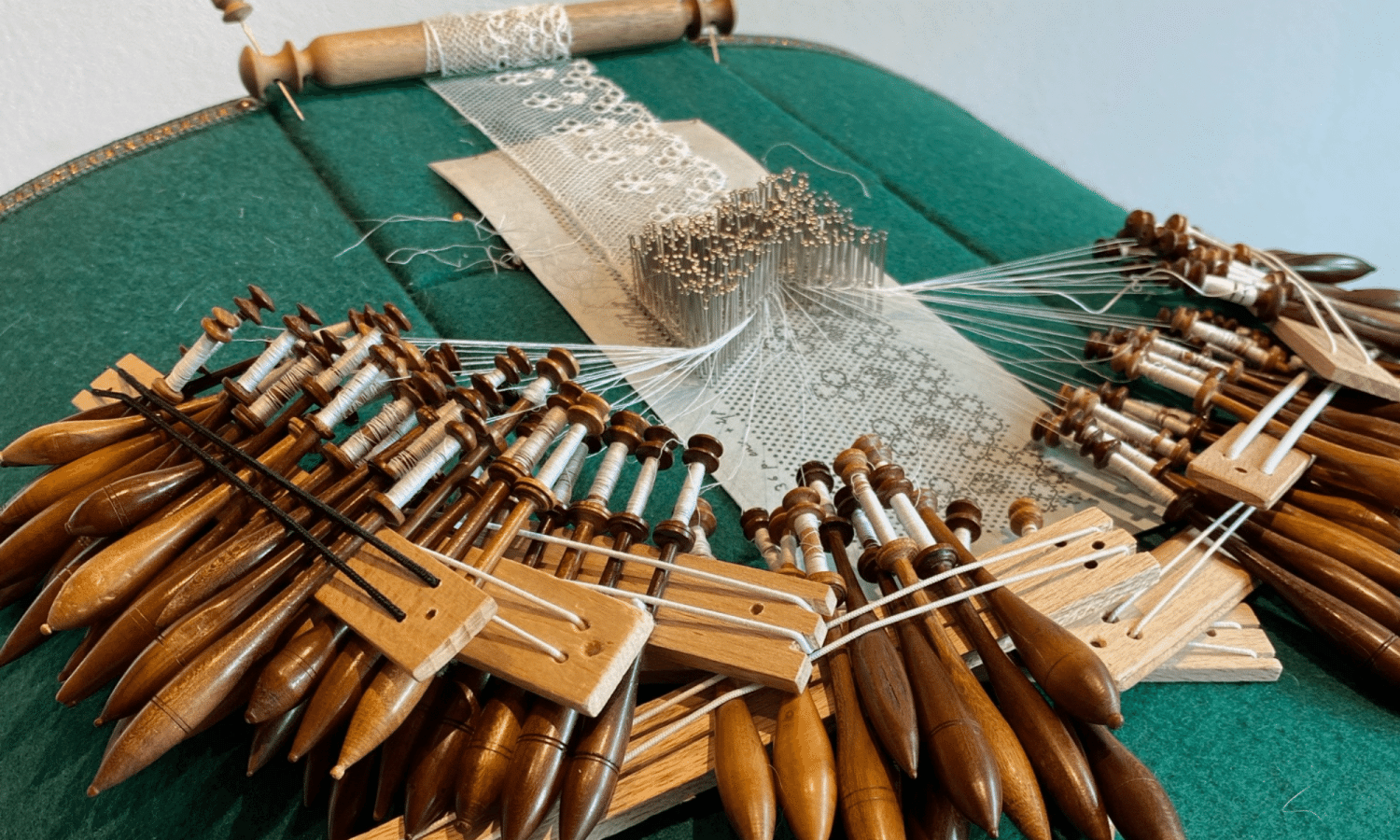
Watching a demonstration helps to understand details that a finished piece hides. Hands move pairs of bobbins, cross and twist the threads, place pins, and control the tension without losing sight of the design. The group works with white and colored threads, so each step is clearly visible as the weave develops.
It's also a good opportunity for conversation. Those who already make bobbin lace can observe the tools, the pricking, and the way the pairs are arranged; those approaching for the first time discover that lace doesn't appear all at once, but rather as a succession of small decisions. The museum also indicates that the lacemakers offer introductory sessions by prior arrangement for those who want to move from watching to trying.
The three-hour duration allows you to enter and calmly observe the different phases of the work. In the same space, you can see the finished section, the drawing still covered in pins, and the pairs awaiting their next move. This comprehensive view helps you understand why regularity matters so much and how a slight error in tension can change a line that seemed minimal.
The surroundings complete the experience. The museum preserves objects related to the lives of mountain farmers and artisans, recreates traditional domestic spaces, and houses the Swiss Center for Paper Cutting. This latter tradition shares with lacemaking a taste for emptiness, symmetry, and detail: sometimes it is drawn with thread and other times with scissors.
After the visit, Château-d'Œx invites you to stroll leisurely among chalets, artisan shops, and landscapes opening up to the mountains. The town is internationally known for its hot air balloons, but these Friday afternoons reveal a more intimate side of the valley. Indoors, around a verdant globe and countless wooden bobbins, history continues to unfold, thread by thread.
To make the most of your visit, it's worth setting aside time for the other galleries and the village itself. The Château-d'Œx train station connects the site to the MOB railway line, and a stroll through the village center allows you to combine heritage, crafts, and scenery all in one afternoon. In December, the mountain atmosphere adds a particularly inviting light to your visit.
© El Mundillo de Eva 2026