Chantilly: the black lace that turned silk into shadow
Chantilly: the black lace that turned silk into shadow
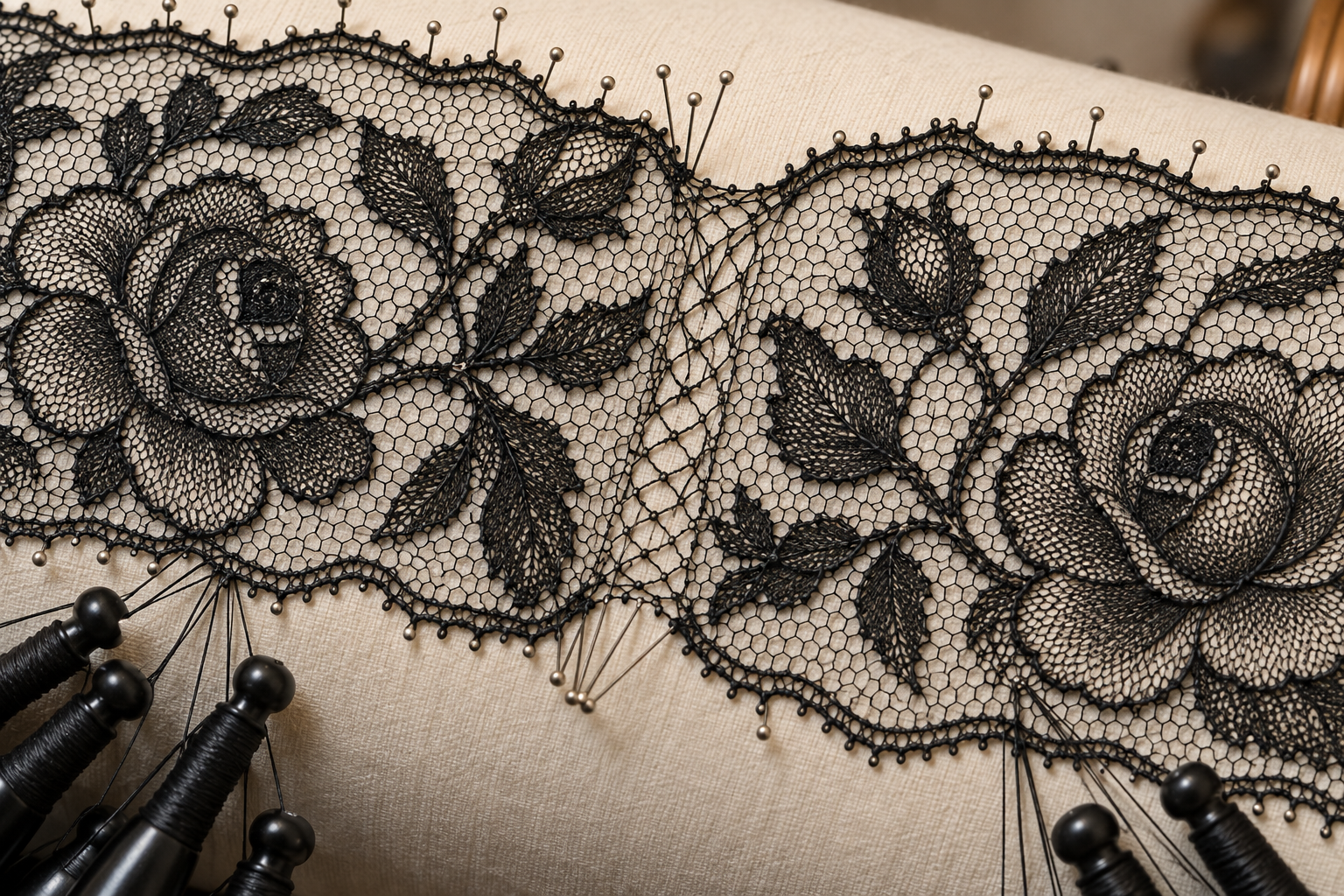
On a light fabric, Chantilly lace seems to paint a garden in black ink. Roses, leaves, and garlands spread across an almost invisible mesh, while denser areas create shadows within the petals. This combination of dark silk, transparency, and naturalistic motifs made Chantilly one of the most coveted bobbin laces of the 19th century.
The history of lace making in Chantilly dates back to the 17th century. Chantilly Dentelle Museum He explains that Anne of Bavaria, Princess of Condé, created a lacemaking school in 1694. Around her grew a network of workers, merchants, designers and lacemakers that turned lacemaking into an important economic activity for the town.
The first pieces were known as blondesThe name didn't refer to a pattern, but to the pale, lustrous yellow hue of natural silk. At the beginning of the 19th century, this thread began to be dyed black. Thus was born what became known as "black lace," which over time would simply adopt the name of the city.
Traditional Chantilly lace is made with bobbins and silk. Its background consists of a very light hexagonal mesh that allows the design to breathe. Bouquets, roses, leaves, medallions, and undulating borders appear on this mesh. A contour thread helps to separate the motifs from the mesh, but the lace's character arises primarily from its variations in density.
In some areas, the threads cross openly and transparently; in others, they come closer together to produce a darker tone. This technique, known as wire rackIt allows you to model a leaf or petal almost as if it were shaded with a pencil. A piece preserved by the Brussels Fashion and Lace Museum It shows this alternation and describes it as a succession of crosses and twists of the bobbins.
Shawls, mantillas, and ruffles could reach enormous sizes. Metropolitan Museum of ArtFor example, it preserves a 19th-century Chantilly shawl almost three meters long. Working on that entire width at once would have required an unmanageable number of bobbins.
The solution involved creating relatively narrow bands and then joining them with a very discreet seam. The design was arranged so that the flowers and backgrounds flowed seamlessly from one band to the next. When the work was well executed, the eye followed the motif without noticing where one hand ended and another began. This arrangement allowed the same garment to be divided among several lacemakers.
In 1825, according to the local museum, around a thousand women worked in the lace industry of Chantilly and the surrounding area. The fashion for black silk spread throughout Europe and found a particularly prominent ambassador in Empress Eugénie de Montijo. During the Second Empire, Chantilly shawls, capes, fans, parasols, and large ruffles adorned dresses and crinolines.
Its success led to the style being produced in Bayeux, Caen, and Belgian centers as well. The name ceased to denote only a place of origin and came to describe a recognizable type of black lace. A flounce of the Condé MuseumDated around 1840–1850, it brings together roses, lilies of the valley and leaves on a loose net: a small silk garden more than two meters long.
During the second half of the 19th century, mechanized manufacturing rapidly displaced handwork. Machines could reproduce the overall look faster and at a lower cost. Handcrafted production disappeared from Chantilly, although lace continued to be industrially produced in northern France and its name remained associated with fashion.
The city museum, established in 1985, houses nearly a thousand pieces and explains the entire process, from drawing and cutting to bobbin lace work. It also connects this heritage to contemporary design. Haute couture designers continue to use Chantilly lace because its black color doesn't create a flat surface: it allows the skin or the fabric underneath to show through, making the shadow an integral part of the garment.
Looking closely at an antique Chantilly lace reveals that its elegance depends on meticulous craftsmanship. The mesh supports, the thread outlines, and the varying densities create volume. There is no added paint or embroidery; only silk patiently crossed until a handful of black threads begins to resemble an illuminated garden.
© El Mundillo de Eva 2026