Cantù: Lombard lace that speaks in its own words
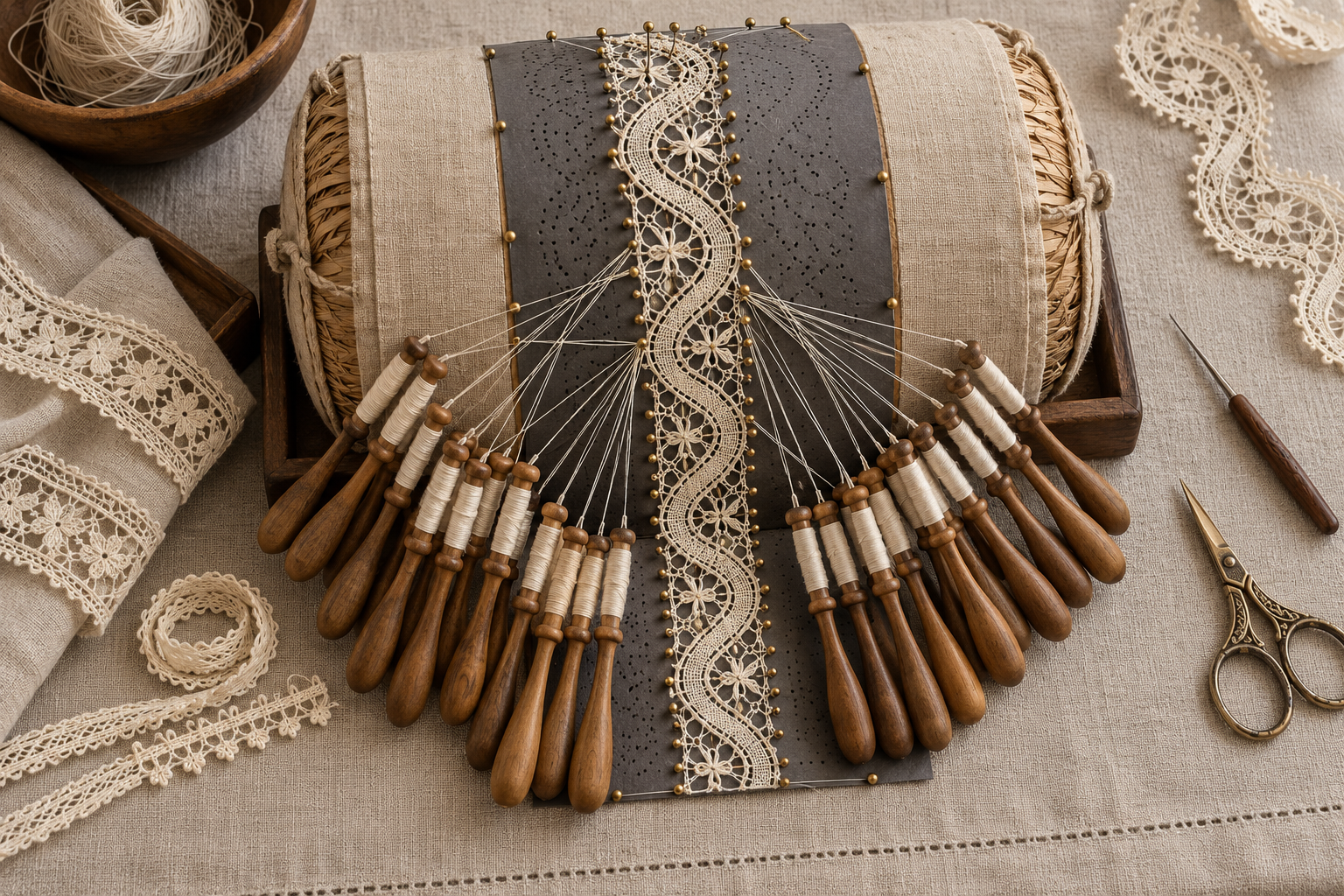
In Cantù, in northern Italy, lacemaking has its own vocabulary. Bobbins are here, the cylindrical cushion is ul cussin and the small perforated cardboard that guides the work is called mapThese words tell an important story: pizzo canturino is not a museum piece frozen in time, but a knowledge shared for generations in homes, workshops and schools in Lombardy.
An ancient tradition with historical prudence
Local tradition attributes the arrival of lace to the Benedictine nuns of Cluny. However, the very City of Cantù It notes that there is insufficient documentation to prove that origin. However, there is a reference to a knitted cuff, dated towards the end of the 17th century, and documents from 1688 concerning female educational centers in local monasteries.
Telling the story with such caution doesn't diminish its beauty. On the contrary, it allows us to separate legend from fact and observe how the craft grew. At the end of the 18th century and throughout the 19th, production reached a remarkable level and provided work for generations of women, often as an essential supplement to the family income.
From home to art school
El Archive of Ethnography and Social History of Lombardy It is estimated that at the beginning of the 19th century, around seven hundred women worked in Cantù as pizzo (lace). The work was divided among many households and then brought together in the city for sale. The name pizzo di Cantù, applied to the production of a wider area, also derives from this concentration.
In 1882, the School of Applied Arts for Industry opened, with one section dedicated to furniture and another to lace. Drawing united both crafts: before moving the bobbins, it was necessary to understand the form, organize the patterns, and translate an idea into the precise language of perforated cardboard. In 1900, Manifatture Riunite Merletti was founded, a sign of a larger-scale, organized production.
The little world of the tombolo
Lace is worked on a cylindrical cushion filled with straw. This cushion rests on an easel and is held at an angle by a board. The threads, usually cotton, linen, or silk, are wound onto wooden bobbins and crossed in pairs. Pins secure the stitches and help maintain the shape.
Under the threads is placed the mapwhere the drawing has been perforated by a specialist. That task, called trimmingIt's not simply about making holes: it involves deciding where the structure will rest and how the path will be interpreted. In some steps, a small crochet hook is also used to make joins or retrieve loops.
Many hands before one single piece
Tradition distinguishes several roles. The draftswoman creates the project; the spuntatrice She arranges the points on the cardboard; the lacemaker interprets that map on the cushion. Sometimes we think of lacemaking as a completely individual task, but a piece can bring together the knowledge of different people before reaching its final form.
For a long time, girls learned at home or from teachers who ran small domestic workshops. Work was done on commission, with threads and patterns supplied by merchants or manufacturers. The skill required was immense, although the pay did not always reflect the time and effort involved.
How to recognize the singing style
There is no single stitch that encapsulates the entire tradition. The regional inventory includes continuous thread lace and varieties such as Milano Antiguo, Venezia or Cantù Classico, Mimosa, Rosalin, and Punto Ornamenta. They share a focus on design, the combination of dense and open areas, and a technique that can be adapted to garments, tablecloths, curtains, or wall coverings.
A piece cataloged by Lombardy Cultural Heritage It beautifully showcases this style: natural linen, bobbin lace with continuous threads, a ribbon in fabric stitch, and connections made with small bars. The sinuous motif forms a pomegranate. The design appears free-flowing, yet each curve depends on very controlled tension.
From domestic luxury to merletto d'arte
In the first half of the 20th century, large tablecloths, bedspreads, curtains, and religious pieces were produced, which carried Cantù's fame beyond Italy. In the 1930s, the so-called Merletti d'arteFigurative works born from dialogue with artists and architects. Lace ceased to be limited to the inherited repertoire and explored new compositions.
That adaptability remains one of its strengths. The material may be humble and the technique repeated for centuries, but the design remains open to every era. Today, the community includes professional and amateur lacemakers, teachers, designers, pattern-piercing specialists, and apprentices.
A heritage that continues to evolve
Current transmission relies primarily on schools and local associations. The Cantù International Lace Biennial, held since 1992, has also created a space for studying history, showcasing works, and connecting tradition with contemporary creation. The city is also working on a museum dedicated to furniture and lace, two arts that share design and patience.
Looking closely at Cantù's pizzo canturino reveals a complete chain of decisions: the design, the holes, the choice of thread, the position of each pin, and the movement of the pairs. Its true richness lies not only in the finished piece. It resides in the knowledge that allows it to be repeated, explained, and transformed without losing Cantù's voice.