Bucks Point: English flowers held on an air net
Bucks Point: English flowers held on an air net
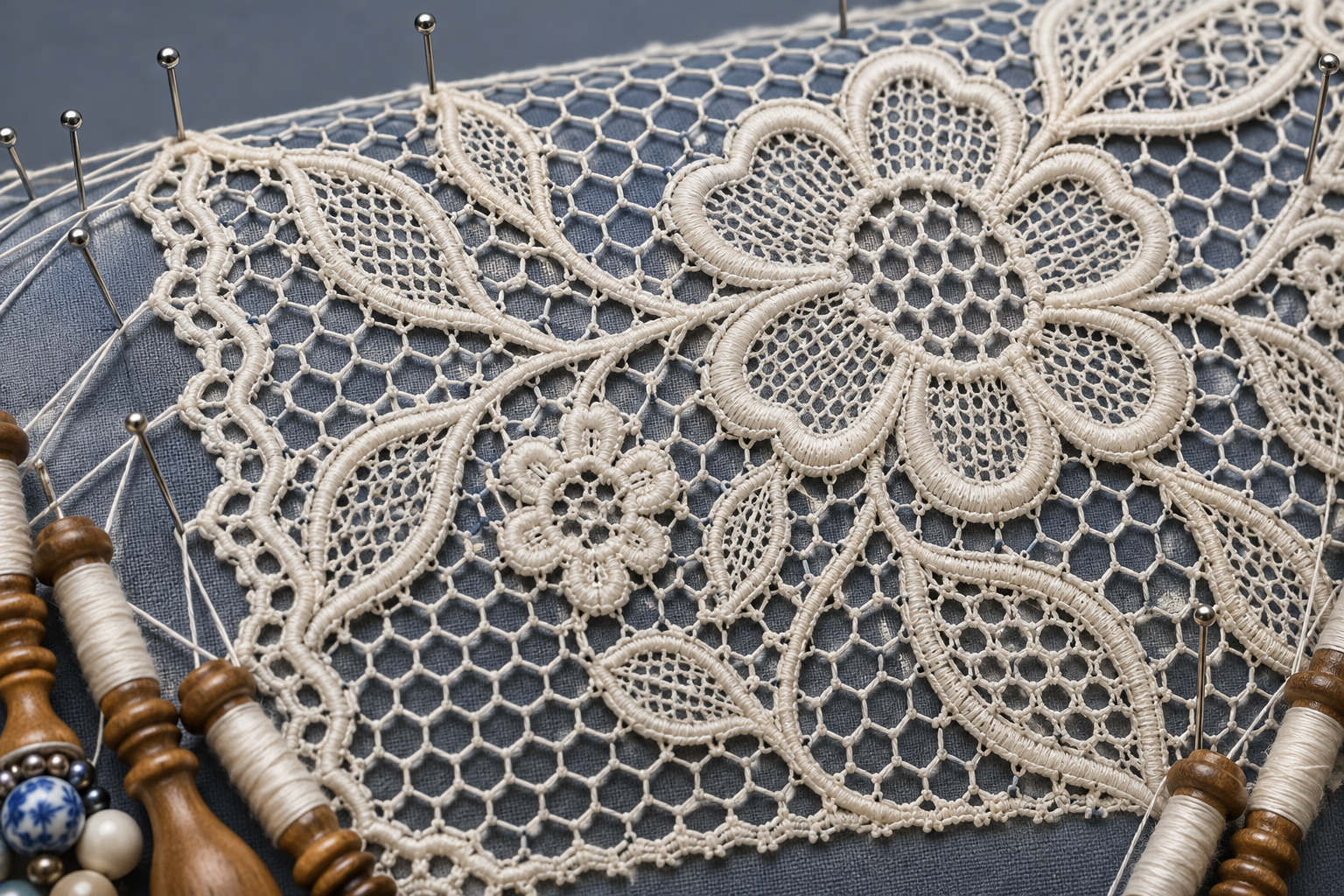
Some laces seem to hold their flowers suspended in mid-air. Bucks Point, which originated in the lace-making region of the English Midlands, achieves this effect with a tiny, even background, delicate motifs, and a thicker thread that outlines the details. Its name is an abbreviation of Buckinghamshire, one of its main production centers, but the technique was also practiced in the neighboring counties of Bedfordshire and Northamptonshire.
Buckinghamshire had a significant lacemaking tradition long before the style we now call Bucks Point appeared. Buckingham Town Hall Its development dates back to the late 18th century, and its relationship to laces like those of Lille and Mechelen is explained. In England, it also became known as "English Lille," a comparison that helps to imagine its fine, light, and delicate appearance.
The word point It alludes to its characteristic background. On this diaphanous mesh appear flowers, leaves, garlands, and small geometric designs. The lace is made in one go on the bobbin lace: background and motifs advance together across the entire width, instead of being worked as separate pieces that must later be joined.
The first is the knitted background, formed by a very fine network of small hexagonal holes. It requires thin thread, constant tension, and precise pin placement. Some areas can be changed to a honeycomb filling, which is more visible and decorative, creating contrast without making the overall piece heavy.
The second feature is the contour thread, or gimpSlightly thicker than the working threads, it outlines petals, stems, and figures. It doesn't create a rigid line: it follows the curves and helps to separate the drawing from the background. The catalog of Norris Museum Describe examples with Bucks Point backgrounds, honeycomb fillings, small decorative stitches, woven leaves, and motifs outlined with this cord.
The third is her small and elegant repertoire. The floral compositions are usually simple and rhythmic, designed for borders, inserts, veils, collars, or clothing embellishments. One piece preserved by the Amersham Museum It measures two meters long and just 6,3 centimeters wide: a proportion that shows how much work could be concentrated in a narrow strip.
Bobbin lace was a rural industry in Buckinghamshire. Women and girls worked at home to supplement meager family incomes. The history compiled by Buckinghamshire Culture Remember that in Marlow girls were already being taught to make bone lace in a school founded in 1624. Merchants would collect the finished strips and sell them in London, while the lacemakers received a modest share of their value.
Light dictated the workday. People worked near doors and windows, and on dark days they might use glass globes filled with water to concentrate a candle flame. Local bobbins were made of wood or bone and often had beads at the end. Besides adding weight, these decorations allowed people to recognize their own tools at a gathering.
The mechanization of lacemaking during the 19th century reduced the profitability of handwork. Many lacemakers sought jobs with more stable wages, although the craft survived for decades in remote villages. A fragment of early 19th-century Buckinghamshire, now in the Metropolitan Museum of ArtIt retains the delicacy of those pieces intended for clothing.
Today, Bucks Point is learned both as a cultural heritage and as a technical challenge. The Lace Guild includes it in its training programs and preserves everything from 19th-century floral borders to contemporary works. New lacemakers reproduce antique patterns, design their own motifs, and experiment with colored threads, but they still face the same question: how to maintain an almost invisible mesh while keeping the design crisp.
Perhaps therein lies its charm. At first glance, Bucks Point appears fragile; upon closer inspection, it reveals a rigorous architecture. Each flower depends on dozens of crosses, each contour guides the eye, and each small hexagon supports the space. It is a lacework that doesn't need to impose itself: it lets the light through and transforms that transparency into its most elegant way of telling a story.
© El Mundillo de Eva 2026