Cable ties: the small bridges that hold the fitting together
Cable ties: the small bridges that hold the fitting together
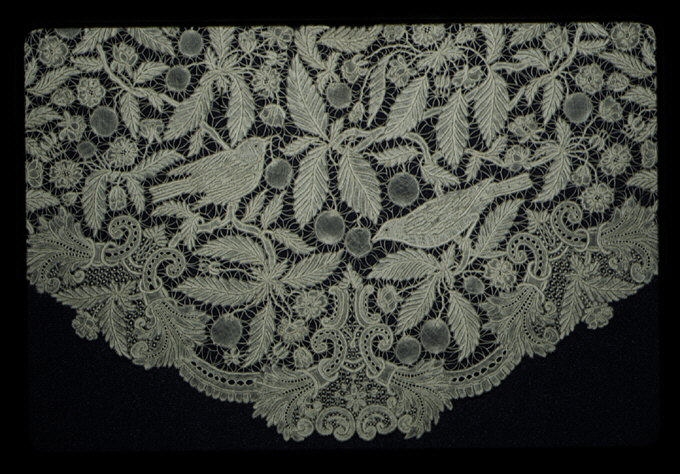
When looking at a lace pattern with large flowers, we sometimes discover that there isn't a continuous mesh behind the design. The petals, leaves, and ribbons seem to float, held together only by small bridges of thread. These links are called ties or bars. They are discreet, but they perform a crucial function: they support the composition and maintain the precise distance between the motifs without filling the entire space with netting.
A bridle is a close connection between two parts of lace. In bobbin lace, it is usually constructed as a braid of two pairs, either single or double, and may include small picots. In needle lace, it is made differently, covering the threads between the motifs with a buttonhole stitch. The final appearance may be similar, although the technique is different.
Their presence changes how we perceive the piece. A net distributes support across the entire surface, creating a uniform background. The cable ties, on the other hand, leave wide, visible gaps. Each one connects two specific points, like a bridge spanning a void. This allows a flower or a ribbon to maintain a strong silhouette and for the air to become part of the design.
It's not enough to simply join any edge to the nearest one. The joins must prevent the motifs from shifting, bending, or losing their shape when the work is removed from the bobbin lace. A bar that's too long can become loose; too many connections make the design rigid and confusing. The stitching distributes these supports to balance strength and lightness.
Tension also matters. The pairs of stitches that form the braid must advance steadily and reach the opposite motif without pulling on it. In some projects, a picot is added halfway through. Besides being decorative, this small loop breaks the straight line and adds rhythm to the open space. Seen up close, the cable ties reveal how much calculation is hidden behind an area that appears empty.
Bridles are especially associated with guipure, a name applied to lace whose motifs are joined by bars or braids instead of resting on a net. Within this large family, we find very different traditions: Genoese and Milanese lace, Cluny, Malta, Bedfordshire, and certain pieces from Honiton. Not all are made in the same way, but they share a preference for a bold design and open spaces.
In ribbon lace, the ribbon itself follows curves and forms leaves or scrolls. When two sections approach each other, a small join maintains the intended separation. In lace with individual motifs, bars help to join separately made pieces. Thus, a tiny element can have a structural function in handkerchiefs, collars, or large ruffles made up of many strands.
The Powerhouse Museum holds an English Honiton border, dating from between 1840 and 1860, featuring flowers, leaves, and butterflies linked by bars. Its description explains that the background of Honiton guipure is formed with cable ties, while in older, more expensive pieces, a needle-stitched net could be added. In the mid-19th century, this system allowed for the assembly of the familiar little bouquets or sprigs without hiding them behind a uniform mesh.
Honiton's production was highly fragmented. Different women crafted small motifs in their homes, and a specialist assembled them to create collars, shawls, scarves, or ruffles. The connections had to be adapted to the final piece. In this way, the rod was not an improvised filler, but the piece that transformed many separate units into a single, stable fabric.
The word applies to both major paths of handcrafted lace. Bobbin lace is characterized by braids of crossed and twisted pairs. Needle lace, as seen in Venetian lace, involves stretching threads and covering them with stitches; some bars are picotted, while others appear grouped together. Recognizing the difference requires close examination and following the direction of the threads.
This comparison also helps to understand why two pieces with large openings can have different textures. A bobbin lace retains the character of the interlaced pairs. A needlepoint bar reveals the succession of stitches that envelops its core. Both solve the same visual and mechanical problem: piercing the air without turning it into a net.
To locate the ties, look for short lines that originate from a flower, leaf, or ribbon and terminate in another motif. If they form a repeating grid, it's probably a background; if each tie corresponds to the available space and leaves irregular gaps, it's more likely bars.
Their beauty lies in that blend of humility and precision. They are almost never the first thing that catches the eye, but without them the design would fall apart. The ties remind us that lace is also built with pauses: small bridges that hold the flowers together and transform emptiness into an active part of the work.
© El Mundillo de Eva 2026