The little treasure that hangs from the bobbin lace: beads, shine and memory in the lace
The little treasure that hangs from the bobbin lace: beads, shine and memory in the lace
A bobbin lace may seem like a humble tool: a bit of wood, a tightly wound thread, and many hours of patience. However, some historical pieces hold an unexpected detail that transforms the craft into a colorful little story. This is the case with a bobbin lace preserved by the London Museum, finished with several beads that still attract attention almost two centuries later.
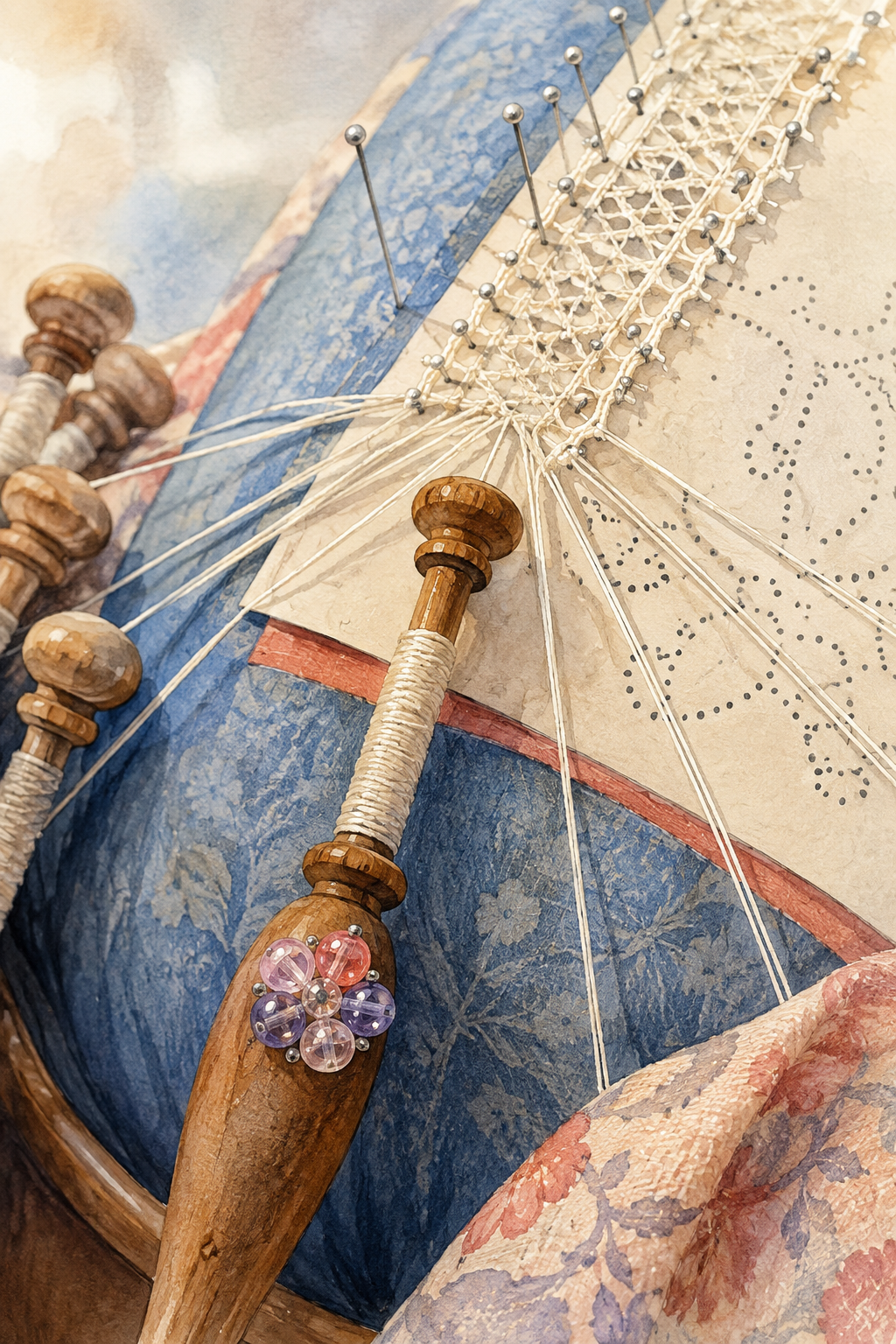
The museum's catalog identifies the object with the number A9923 and dates it between 1776 and 1800. It is described as a bobbin made of turned wood, with a thick body and designed for torchon lace. It has eight pewter bands and, at one end, a small ornament made of five beads: two transparent, two pale pink, and one lilac, with traces of pink and blue. It measures approximately 95 millimeters in length and reaches about 9 millimeters at its widest point.
In English, this finishing move is known as spangleA lightweight piece that hangs from the bobbin lace and can be made with beads, thread, and small metal elements. There isn't a single, universally accepted technical translation in Spanish, so we'll refer to it as a "beaded ornament." The beauty of this London-style piece lies in the fact that, besides complementing the work, it reveals the taste of the person who used it.
The London Museum's record lists the materials, measurements, and decoration, but it doesn't explain who the lacemaker was or attribute any specific meaning to the beads. It's wise to maintain this caution. It's often said that bobbin lace decorations served as amulets, keepsakes, or personal markers; these may be suggestive interpretations, but we shouldn't take them as facts when they aren't documented. What we can say for sure is that an everyday tool ended up becoming part of a permanent collection, and that its appearance offers a clue about the relationship between craftsmanship and personality.
The decoration also suggests the variety of bobbins. Some are simple, made of light wood, while others feature rings, designs, initials, or special finials. They vary depending on the region, family tradition, and the type of lace. For those who collect or inherit bobbins, examining the decorated end can be almost as interesting as observing the shape of the bobbin itself: it reveals colors, materials, and subtle details that are never exactly the same.
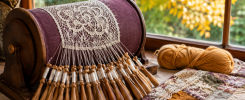
Decoration doesn't replace technique. The Powerhouse Museum explains bobbin lace as a form of weaving in which the threads are constantly changing position. Its two basic movements are crossing and twisting, performed with two pairs of threads. The work progresses on a cardboard pattern attached to a firm pillow and is held in place with pins.
A piece of torchon lace held by the Cleveland Museum of Art helps us imagine the scene from another angle. Its cylindrical pillow, of Spanish origin, brings together pattern, pins, linen threads, and handmade boxwood bobbins. The museum notes that the threads are crossed and twisted to form each connection, while the pin secures the correct spacing. When the lace is finished, the pins are removed, and the work is separated from the pillow. It's a simple explanation, but it makes clear why each bobbin must respond precisely to the movement of the hand.
If you'd like to try beadwork on your own bobbins, approach it as an exercise in observation, not as a historical replica. Choose a comfortable, lightweight bobbin, prepare a combination of beads that won't rub against the threads, and check that the embellishment doesn't hit the pillow when you move it. Work a few simple rows first and see if the weight changes the tension. If you notice the bobbin spinning too much or catching, reduce the number of beads. The idea is for the color to complement the work and not become an obstacle.
It can also be a lovely family project: gathering beads of the same color, noting who chose each color, and keeping a photograph of the beginning of the project. In this way, the bobbin lace ceases to be just a tool and becomes part of the lacemaking diary. The result doesn't have to look antique or perfect; it simply needs to be comfortable, recognizable, and your own.
The guide to the Museu Marès de la Punta places the development of bobbin lace in Flanders at the end of the 16th century and reminds us that, over time, different styles and techniques emerged in many European cities. Torchon, guipure, Valenciennes, and Honiton are not simply pretty names: they speak of traditions, materials, and ways of organizing the design. In this vast landscape, a bobbin with five beads seems like a tiny detail, but it helps us remember that history is also preserved in the objects that are passed down from hand to hand.
The next time you see a pillow covered in bobbins, look at the ends. You might find a discreet finishing touch, a colored bead, or a small identifying mark. And if there's none, that too tells a story: that each lacemaker decides what her tool needs to work comfortably. Between crosses, twists, and pins, these details ensure that a traditional craft retains its personal voice.
Sources: London Museum, object A9923; Powerhouse Collection, torchon piece A1486-9; Cleveland Museum of Art, Lace Pillow; Museu Marès de la Punta, guide to the collection.
© El Mundillo de Eva 2026