Blonde de Caen: the silk lace that shone like honey
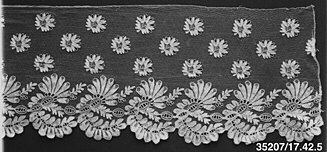
Blonde de Caen: the silk lace that shone like honey
Not all laces called "white" were made from pure white thread. Blonde de Caen became famous for the warm sheen of its natural silk, a shade between ivory and honey that seemed to gather the light. Its large flowers, suspended on an almost transparent net, adorned veils, stoles, ruffles, and even entire dresses. For several decades in the 19th century, this specialty made Normandy one of the great European centers of luxury lace.
The word blonde It referred to the color of unbleached silk. The thread retained a golden hue and a lustrous surface, quite unlike the matte appearance of linen. Over time, white and black lace were also made, but the name remained associated with a whole family of bobbin laces made with silk.
The technique sought contrast. The main motifs were woven with wider, shinier threads, while a fine thread created the light background. In this way, the flowers appeared to float and changed in intensity as the garment moved. The silk allowed for the creation of broad petals, leaves, and curves with an almost satiny quality, without losing the delicacy of the mesh that surrounded them.
The Musée de Normandie explains that this type of lace appeared in the Paris region during the 17th century and began to be manufactured in Normandy, especially in Caen and its surroundings, from the 18th century onwards. Between 1820 and 1840, it reached its technical and commercial peak. The reputation of the lacemakers was so great that producers from Switzerland, Germany, and Spain tried to attract Norman workers.
Bayeux also became an essential part of this story. The city's museum notes that around 1830 there were nearly twenty lace-making companies and almost fifteen thousand workers in the area. Maison Lefébure, founded from a workshop acquired in 1829 by Auguste-René Lefébure, directed much of its production toward the luxury market and found clients in Paris, Spain, and South America.
Fashion favored increasingly spectacular pieces. Blonde lace was used in ruffles, shawls, mantillas, veils, fans, and complete dresses. The Musée de Normandie preserves a wedding dress from around 1822It is one of the first white bridal gowns in her collection. It is entirely covered in Blonde silk lace and retains the high Empire waistline, along with a skirt that begins to flare out and voluminous sleeves.
The piece helps to imagine the original effect. It wasn't just a decoration placed on the edge: the lace could envelop the body and reflect light in every motif. The combination of silk, fullness, and transparency transformed the work of thousands of crosses into an elegant surface that appeared light, even though it required an enormous amount of time.
Blonde silk lace was closely linked to France, but its history also has ties to Spain. The Metropolitan Museum of Art holds a 19th-century fragment classified as either French or Spanish, made of Blonde silk bobbin lace. Measuring 142,2 centimeters long by 29,2 centimeters wide, it demonstrates the generous proportions the pieces could achieve.
The SFO Museum notes that, while European taste began to shift towards black Chantilly lace around 1840, Blonde lace maintained its appeal in Spain for longer. Mantillas and large silk accessories found a particularly favorable environment there. The exchange was also commercial: Bayeux houses shipped their creations to Spanish and South American clients.
The very fashion that propelled Blonde lace could change rapidly. From 1870 onward, Bayeux's hand-made lace production declined sharply in the face of machine-made lace, which could imitate the look of the pieces at a lower cost. The craft lost its industrial scale, although the Maison Lefébure school helped to maintain the technique throughout the 20th century.
Today, the museums of Caen and Bayeux allow us to observe silk beyond its mere fashionable connotations. They reveal the skill of the lacemakers, the work of merchants and workshops, and an international network that linked Normandy with Madrid and South America. Blonde de Caen lace retains something of that journey: it is a lace born from honey-colored thread that learned to shine in salons far and wide.
© El Mundillo de Eva 2026