Bizzilla: the lace of Malta and Gozo that preserves the memory of the islands
Bizzilla: the lace of Malta and Gozo that preserves the memory of the islands
In Malta and Gozo there is a word that sounds small but holds a whole world: bizarreThis is how bobbin lace is known there, a craft that involves fine threads, great patience, and a family tradition passed down from one hand to the next. Among the golden stone, the blue sea, and the houses with colorful shutters, the bobbin lace reminds us that an island can also be told through its lacework.
El National Inventory of the Intangible Cultural Heritage of Malta It links the origins of the tradition to the cotton trade and the maritime routes that connected the islands with Genoa from 1530. The work was promoted in the old convents of Mdina and, later, in the cities built around the Grand Port after the arrival of the Knights of Malta.
The story didn't stay confined to important buildings. Lacemaking entered homes and became a craft that could accompany conversations, commissions, and celebrations. The same source notes that the practice has been passed down through generations and that many lacemakers, especially women, have worked in their own homes or private spaces.
Although bizzilla lace is present in Malta and Gozo, the sister island holds a special place in their collective imagination. There, lace is associated with rural paths, small workshops, and pieces prepared for a specific occasion. Textile Research Center Leiden She explains that Maltese lace is usually made with raw silk thread, although there are also black pieces and some examples in linen.
That ivory tone has a warmth distinct from optic white. On a collar, a stole, or a small decorative piece, the silk allows the pattern to breathe and the motifs to appear light. Bizzilla doesn't need many colors to attract attention: its richness lies in its structure, in the alternation between dense areas and open spaces.
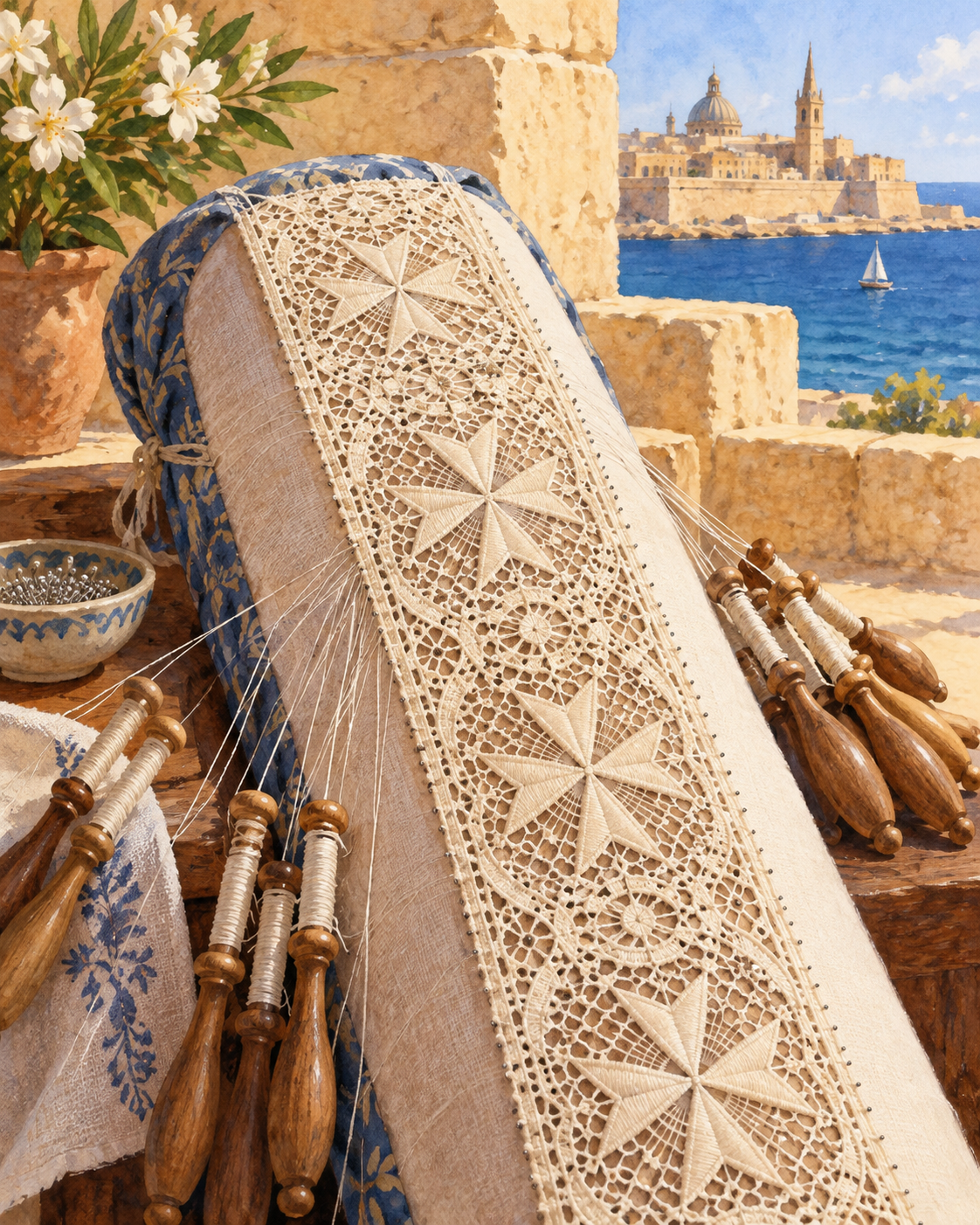
One of the most recognizable motifs is the Maltese cross. It can appear surrounded by flowers, leaves, or small geometric shapes, integrated into a composition that unfolds like a border. The technique belongs to the group of guipure laces, in which the motifs are joined by bridges or bars rather than resting on a continuous network.
Looking at a piece closely reveals that every void has a function. Bridges connect, infills add weight, and edges organize the whole. The design may seem simple from afar, but it becomes intricate when we discern the choices that keep the piece stable and balanced.
The bizzilla is performed on a long, narrow cushion known as trajbuThe Textile Research Centre describes a support about sixty centimeters high, prepared with dried straw wrapped in cloth and placed almost vertically. The design is fixed onto it, the pins are stuck in, and the bobbins that carry the thread are arranged.
The position changes the way of working. The lace is at eye level, and every movement must be precise: crossing, turning, tightening, and securing. The wooden bobbins produce a soft sound when they meet. It's a domestic, almost musical rhythm that accompanies the construction of a form that initially exists only in the drawing.
The Maltese inventory recorded the practice in 2018, a sign that bizzilla is part of the living heritage and needs care. Preserving it doesn't mean silently storing the pieces away. It also involves teaching the techniques, documenting the names of the stitches, and allowing new generations to experiment with different sizes, uses, and combinations of materials.
For anyone visiting Malta or Gozo, exploring the local lacemaking tradition is a delightful way to discover the area. You can begin in a museum, continue in a craft shop, and end by chatting with a lacemaker. It's worth examining the piece from both sides, inquiring about the cushion, and observing how the pattern finds its balance. At that moment, the journey ceases to be merely about scenery; it becomes a story woven with silk, wood, and time.
© El Mundillo de Eva 2026