Maltese lace: the English lace that reinvented Maltese wheat.
Maltese lace: the English lace that reinvented Maltese wheat.
In the mid-19th century, English lacemakers looked to Malta and found an idea capable of revitalizing their craft. They didn't simply copy what came from the Mediterranean. They changed the material, lengthened the shapes, and combined familiar techniques to create Maltese Beds lace, a bobbin lace with its own distinct character that, for a few years, revitalized the lace-making villages of Bedfordshire.
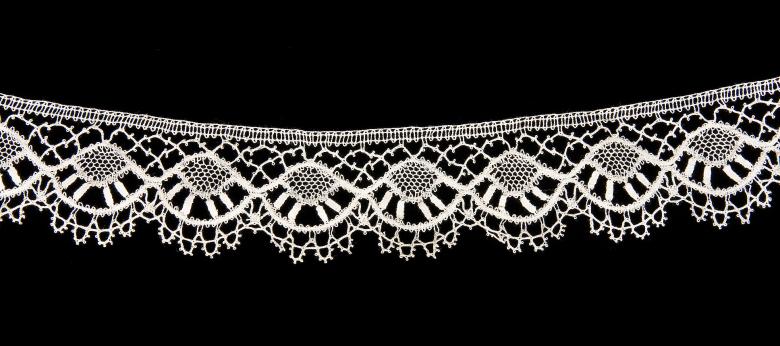
Maltese Beds belongs to the guipure family. Its linen stitch motifs and herringbone patterns are joined by small braids, called flangesInstead of resting on a net spread across the entire piece, this construction leaves ample space and allows each shape to be clearly seen. The spikes, known in English as tallies or “wheat ears”, are woven with a few pairs and require careful tension control to ensure they are firm and regular.
In traditional Maltese lace, those wheat stalks had a fleshy, lustrous appearance. It was usually worked with cream or honey-colored silk, a thread that lent volume and light to the motifs. When the style arrived in England, the artisans adapted it to the linen they knew so well. The stalks became longer, thinner, and with almost square ends. The result retained the Mediterranean feel, but spoke with the accent of the Midlands.
When observing a strip, the eye jumps from one spike to the next and traces the braids that support the whole. There is no background to conceal the path: the architecture of the piece is on full display. This structural frankness is one of the reasons for its decorative power.
La Research from the Pitt Rivers Museum at the University of Oxford It identifies a pivotal moment in the Great Exhibition of London in 1851. There, manufacturers, merchants, and the public could admire Maltese lace, while English women workers demonstrated their own craft. The encounter between objects, techniques, and markets accelerated a transformation that was already seeking answers to a profound crisis.
Mechanization had struck hard. Since John Heathcoat's invention of the net machine in 1809, handmade backgrounds had to compete with much faster imitations. By the 1840s, the old knitted lace industry was in decline. The Maltese pattern offered a way out because it was showy, didn't require a full net, and could be made more quickly than delicate styles like Bucks Point.
Lacemakers did not work within rigid boundaries. A piece attributed to Mrs. Campbell of Bicester combines the structure of Maltese Beds with a small Bucks Point net motif. This detail reveals a practical and creative attitude: if a known solution enriched the design, it could be incorporated. Bicester was one of the lace-making centers of Oxfordshire, connected to the thousands of households where women and girls produced lace in the heart of England.
Bedfordshire embraced the new taste with particular speed. The technique could be learned and executed in less time than other fine laces, allowing for the production of eye-catching embellishments for a middle-class clientele and, for about a decade, providing a reasonable income for many workers. By the 1862 International Exhibition in London, almost all the lace presented by Bedfordshire merchants belonged to this family.
The advantage was short-lived. By 1865, machinery had also been able to reproduce the look of Maltese guipure. Industrial competition once again squeezed the market, and the Maltese Beds lace boom ended almost as quickly as it had begun. This timeline does not diminish the style's importance; on the contrary, it demonstrates the lacemakers' ability to observe international fashion, interpret it with their materials, and respond to a changing economy.
The Mrs. Campbell print in Oxford was purchased in 1900 and arrived at the museum in 1917 thanks to Henry Balfour. Against a dark background, her fans, braids, and pale ears of wheat appear as if they have just emerged from the cushion. Within it, Malta, Bedfordshire, Oxfordshire, and the memory of a particular artisan converge.
Maltese lace reminds us that tradition has never been static. Lace travels with exhibitions, dealers, and people; then it changes with each cushion. Wherever someone lengthens a spike, substitutes linen for silk, or combines two backgrounds, a new way of telling the world with thread is born.
© El Mundillo de Eva 2026